<?xml version="1.0" encoding="UTF-8"?>
<rss version="2.0"
	xmlns:content="http://purl.org/rss/1.0/modules/content/"
	xmlns:wfw="http://wellformedweb.org/CommentAPI/"
	xmlns:dc="http://purl.org/dc/elements/1.1/"
	xmlns:atom="http://www.w3.org/2005/Atom"
	xmlns:sy="http://purl.org/rss/1.0/modules/syndication/"
	xmlns:slash="http://purl.org/rss/1.0/modules/slash/"
	>

<channel>
	<title>Resume Writing, Jobs and Careers Blog</title>
	<atom:link href="http://www.resume-resource.com/resumeblog/feed/" rel="self" type="application/rss+xml" />
	<link>http://www.resume-resource.com/resumeblog</link>
	<description>Resume Writing, Cover Letter Writing, Job Search and Advice to Advance Your Career</description>
	<lastBuildDate>Fri, 27 Aug 2010 13:39:26 +0000</lastBuildDate>
	<language>en</language>
	<sy:updatePeriod>hourly</sy:updatePeriod>
	<sy:updateFrequency>1</sy:updateFrequency>
	<generator>http://wordpress.org/?v=abc</generator>
		<item>
		<title>To Lie or Not to Lie</title>
		<link>http://www.resume-resource.com/resumeblog/to-lie-or-not-to-lie/1152/</link>
		<comments>http://www.resume-resource.com/resumeblog/to-lie-or-not-to-lie/1152/#comments</comments>
		<pubDate>Fri, 27 Aug 2010 13:36:38 +0000</pubDate>
		<dc:creator>dwheatman</dc:creator>
				<category><![CDATA[Resume Writing]]></category>

		<guid isPermaLink="false">http://www.resume-resource.com/resumeblog/?p=1152</guid>
		<description><![CDATA[I work with clients occasionally that ask me to lie, or at least greatly exaggerate items on their resume.  Sometimes I see through the lens of untruth – sometimes I don’t. When I see it, I call it. Often in these cases the client asks what harm a little lie will do and I tell [...]]]></description>
			<content:encoded><![CDATA[
<!-- Quick Adsense WordPress Plugin: http://techmilieu.com/quick-adsense -->
<div style="float:left;margin:10px 10px 10px 0;">
<script type="text/javascript"><!--
google_ad_client = "pub-8691351273368067";
/* 300x250, created 7/21/08 */
google_ad_slot = "1402546176";
google_ad_width = 300;
google_ad_height = 250;
//-->
</script>
<script type="text/javascript"
src="http://pagead2.googlesyndication.com/pagead/show_ads.js">
</script>
</div>
<p>I work with clients occasionally that ask me to lie, or at least greatly exaggerate items on their resume.  <span id="more-1152"></span>Sometimes I see through the lens of untruth – sometimes I don’t. When I see it, I call it. Often in these cases the client asks what harm a little lie will do and I tell them some stories.</p>
<p>1. A      tech guy, let us call him Hans lied on his resume about his ability to manage a Storage      Area Network (SAN). Well, unfortunately for him and the company that hired      him the SAN crashed 2 hours into his new gig. Hans did his best working      from manuals, but he made a huge mistake and lost 6 days’ worth of client      data – he got fired, he got sued and he got blackballed in the industry.</p>
<p>2. A young woman I worked with      said she graduated from Columbia with an MBA, it turns out she was 6      credits short. She was the most qualified candidate, she would have gotten      the job in spite of not having the degree, but when they found out she      lied she got fired from her dream job.</p>
<p>There have been a few stories that made the press over the last few years – the most notable being &#8211; In April 2007 the dean of admissions at MIT, resigned after the university confirmed that she had claimed academic degrees she never earned – yes the person in charge of assessing whether you could come to MIT lied about her educational background.</p>
<p>The fact is more and more employers are doing more diligent background checks.  So here is my advice – <strong>don’t lie on your resume</strong> – ever. You might get caught, you might not – but think about whether or not you would be proud of your kids of they lied. My guess is not so much.</p>
<div class="sigblock">
<p>You are encouraged to comment on blog posts and/or submit questions to  Debra. You can reach her on <a href="http://www.twitter.com/debrawheatman" target="_blank">Twitter</a>, <a href="http://www.linkedin.com/in/careersdonewrite" target="_blank">LinkedIn</a>,  and <a href="http://www.facebook.com/pages/New-York-NY/Careers-Done-Write/135140683183550?ref=ts&amp;__a=38&amp;" target="_blank">Facebook.</a> </p>

<p>Debra Wheatman, CPRW, CPCC is President of Careers Done Write, a  premier career services provider focused on developing highly  personalized career roadmaps for senior leaders and executives across  all verticals and industries. Visit <a href="http://www.careersdonewrite.com/" target="_blank">careersdonewrite.com</a> to learn more.</p></div>
<div style="font-size:0px;height:0px;line-height:0px;margin:0;padding:0;clear:both"></div>]]></content:encoded>
			<wfw:commentRss>http://www.resume-resource.com/resumeblog/to-lie-or-not-to-lie/1152/feed/</wfw:commentRss>
		<slash:comments>0</slash:comments>
		</item>
		<item>
		<title>Top Five Resume No No’s</title>
		<link>http://www.resume-resource.com/resumeblog/top-five-resume-no-nos/1148/</link>
		<comments>http://www.resume-resource.com/resumeblog/top-five-resume-no-nos/1148/#comments</comments>
		<pubDate>Mon, 23 Aug 2010 12:09:47 +0000</pubDate>
		<dc:creator>dwheatman</dc:creator>
				<category><![CDATA[Resume Writing]]></category>

		<guid isPermaLink="false">http://www.resume-resource.com/resumeblog/?p=1148</guid>
		<description><![CDATA[Certainly, there is no such thing as the &#8220;perfect&#8221; resume. Every person is different with different backgrounds, skills; and knowledge; in other words &#8211; what works for me might not work for you or anyone else either.  There is no &#8220;right&#8221; resume, but there are definitely wrong ones.  Here are five things that should never [...]]]></description>
			<content:encoded><![CDATA[<p>Certainly, there is no such thing as the &#8220;perfect&#8221; resume. Every person is different with different backgrounds, skills; and knowledge; in other words &#8211; what works for me might not work for you or anyone else either.  There is no &#8220;right&#8221; resume, but there are definitely wrong ones.  Here are five things that should never be on your resume, at least if you want to get an interview.<span id="more-1148"></span><strong></strong></p>
<p><strong>1. </strong><strong>Objective statements</strong></p>
<p>These are out – <strong>O U T</strong> – out.  Objective statements are great at telling the reader what you want, but I have news for you bucko, they don’t care what you want.  They need to understand what you offer, not what you want.  Can you do the job? Can you deliver value for the compensation they are giving you?  In short, why should they hire you? And it isn’t because you want to be a team player and contributor.<strong></strong></p>
<p><strong>2. </strong><strong>“Responsible for”</strong></p>
<p>Every job has responsibilities and obviously you must have been able to deliver on them, or you wouldn’t have held your last job for four years.  These days to get hired, you need to accomplish something, not be responsible for it. You were responsible for a budget of $5MM. So what? Did you come in under budget and save money? Did you bring more to the table for that amount of money? Did you create, deploy, sell, buy &lt;INSERT SOMETHING HERE&gt; that made the company better?<strong></strong></p>
<p><strong>3. </strong><strong>Mistakes</strong></p>
<p>Spelling, grammar, formatting, etcetera, etcetera, etcetera.  It has always been the case that mistakes on a resume dramatically cut down the likelihood that you will be called.  Nowadays, when there are dozens, if not hundreds of applicants for the same position errors are a quick and easy way for the hiring manager or HR to parse the stack and lessen the number of resumes they need to read.  Have an independent third party proof your resume for you, submit it to a proofreading service, read it backwards (this really works) to make sure there are zero mistakes. If English isn’t your native language, this is doubly important.</p>
<p><strong>4. </strong><strong>More than two pages</strong></p>
<p>This one isn’t a never.  But, I have written more than 10,000 resumes; and my team has written thousands more, and I would say that a very small percentage of the clients we have collectively worked with could justify more than two pages.  While I am sure everything you have ever done in your career is very, very, very important you must think about it from the other side of the desk.  Do you really think they want to read page three, four, five or seven hundred?  I will give you a hint – they don’t.<strong></strong></p>
<p><strong>5. </strong><strong>Personal information</strong></p>
<p>I could easily fill an entire blog with lists of personal things that I have seen on resumes, that just don’t belong there – but a short list will suffice to get the point across – date of birth, height, weight, 27 hobbies, political affiliation, religion, family pictures, names of kids, names of pets, names of kids’ pets – don’t think for a minute I am making this up &#8211; any of it.  The bottom line is you are applying for a job, not a lifelong friendship. There are many reasons why these things don’t belong on a resume, but the number one reason is you won’t get called. Hiring managers find this irksome, among many other things.</p>
<p>So, some homework – pull your resume out and see if you have any of the above five faux pas on your documents.  Well…?</p>
<div class="sigblock">
<p>You are encouraged to comment on blog posts and/or submit questions to  Debra. You can reach her on <a href="http://www.twitter.com/debrawheatman" target="_blank">Twitter</a>, <a href="http://www.linkedin.com/in/careersdonewrite" target="_blank">LinkedIn</a>,  and <a href="http://www.facebook.com/pages/New-York-NY/Careers-Done-Write/135140683183550?ref=ts&amp;__a=38&amp;" target="_blank">Facebook.</a> </p>

<p>Debra Wheatman, CPRW, CPCC is President of Careers Done Write, a  premier career services provider focused on developing highly  personalized career roadmaps for senior leaders and executives across  all verticals and industries. Visit <a href="http://www.careersdonewrite.com/" target="_blank">careersdonewrite.com</a> to learn more.</p></div>]]></content:encoded>
			<wfw:commentRss>http://www.resume-resource.com/resumeblog/top-five-resume-no-nos/1148/feed/</wfw:commentRss>
		<slash:comments>0</slash:comments>
		</item>
		<item>
		<title>Getting From Here to Here: Gearing Up for Career Transition</title>
		<link>http://www.resume-resource.com/resumeblog/getting-from-here-to-here-gearing-up-for-career-transition/1141/</link>
		<comments>http://www.resume-resource.com/resumeblog/getting-from-here-to-here-gearing-up-for-career-transition/1141/#comments</comments>
		<pubDate>Wed, 18 Aug 2010 13:03:25 +0000</pubDate>
		<dc:creator>dwheatman</dc:creator>
				<category><![CDATA[Career Planning]]></category>

		<guid isPermaLink="false">http://www.resume-resource.com/resumeblog/?p=1141</guid>
		<description><![CDATA[I won&#8217;t lie; making a career transition is a very difficult thing. In a lot of cases, many professionals have been working for a number of years in one area and then decide they want to pursue a different line of work. Some decide that they want to do something they are more passionate about; [...]]]></description>
			<content:encoded><![CDATA[<p>I won&#8217;t lie; making a career transition is a very difficult thing. In a lot of cases, many professionals have been working for a number of years in one area and then decide they want to pursue a different line of work. Some decide that they want to do something they are more passionate about; work in an area that they previously studied; or even, pursue something that was a hobby and turn it into their professional life. No matter what the reason, there are some basic things that you need to explore and understand to ensure that you are not wasting your time.<span id="more-1141"></span><strong></strong></p>
<p><strong>Industry Understanding: </strong>Once you have decided to make the transition, do you understand enough about the industry that you are now targeting? Oftentimes I hear people talk about making a transition, yet they don&#8217;t fully understand the industry parameters or players. Part of what will make your transition smoother is KNOWLEDGE. You need to do the research about the industry, including trends. This will help you identify positions that might be right for you, and also set you up to prepare yourself for a change.</p>
<p><strong>Viability: </strong>This is a topic that begs serious consideration. Is transitioning a viable option for you? I have found that people decide they are going to make a switch without fully exploring or understanding the potential ramifications, including salary and position. It is likely that you will need to take a step back in your career to make a move. Unless you are totally unencumbered  &#8211; family, car payments, a mortgage or two can put the kebash on a transition where you will definitely feel it in your wallet. This obvious hurdle notwithstanding, what about the (potential) blow to your ego when you are interviewing for junior positions? Is transitioning really a viable option for you?</p>
<p><strong>Education: </strong>One thing that many people fail to consider is that additional education might be necessary to make a successful transition. You will need to factor this expense and time commitment into your overall program. A relevant industry certification can help open doors and give you the credibility to make a transition.</p>
<p><strong>Plan of Attack: </strong>To avoid wasting a tremendous amount of energy and time, you will need to develop an action plan for the transition. There is nothing that is a bigger time waster than a disorganized approach to your search. You will likely feel more than a little lost and harried &#8211; unless you create your &#8216;transition plan&#8217;. This should include the following elements:</p>
<ul>
<li>List of companies that you are interested in targeting;</li>
<li>Information you learned about the company;</li>
<li>Information you learned about open positions;</li>
<li>Connection between your background and a potential      opening;</li>
<li>Name and contact details of a source.</li>
</ul>
<p><strong>Closing the Loop: </strong>Once you have done all of the above you will be in a good position to start your search. Establish milestones along the way to keep you focused and motivated to pursue your ultimately goal. Your perseverance and diligence throughout the process is an important component to ensuring ultimate success!</p>
<p>A career transition is possible!</p>
<p>Here&#8217;s to your continued success!</p>
<div class="sigblock">
<p>You are encouraged to comment on blog posts and/or submit questions to  Debra. You can reach her on <a href="http://www.twitter.com/debrawheatman" target="_blank">Twitter</a>, <a href="http://www.linkedin.com/in/careersdonewrite" target="_blank">LinkedIn</a>,  and <a href="http://www.facebook.com/pages/New-York-NY/Careers-Done-Write/135140683183550?ref=ts&amp;__a=38&amp;" target="_blank">Facebook.</a> </p>

<p>Debra Wheatman, CPRW, CPCC is President of Careers Done Write, a  premier career services provider focused on developing highly  personalized career roadmaps for senior leaders and executives across  all verticals and industries. Visit <a href="http://www.careersdonewrite.com/" target="_blank">careersdonewrite.com</a> to learn more.</p></div>]]></content:encoded>
			<wfw:commentRss>http://www.resume-resource.com/resumeblog/getting-from-here-to-here-gearing-up-for-career-transition/1141/feed/</wfw:commentRss>
		<slash:comments>0</slash:comments>
		</item>
		<item>
		<title>Out with the Objective</title>
		<link>http://www.resume-resource.com/resumeblog/out-with-the-objective/1138/</link>
		<comments>http://www.resume-resource.com/resumeblog/out-with-the-objective/1138/#comments</comments>
		<pubDate>Fri, 13 Aug 2010 14:51:19 +0000</pubDate>
		<dc:creator>dwheatman</dc:creator>
				<category><![CDATA[Resume Writing]]></category>

		<guid isPermaLink="false">http://www.resume-resource.com/resumeblog/?p=1138</guid>
		<description><![CDATA[There seems to be some confusion as to whether or not you should put an objective statement on your resume. Here’s the short answer: NO. Objective statements are outdated; but more than that, they only serve to tell the reader (aka hiring manager) what you want – not what you can contribute. Of course I [...]]]></description>
			<content:encoded><![CDATA[<p>There seems to be some confusion as to whether or not you should put an objective statement on your resume. Here’s the short answer: NO.<span id="more-1138"></span></p>
<p>Objective statements are outdated; but more than that, they only serve to tell the reader (aka hiring manager) what you want – not what you can contribute. Of course I realize that you are desirous of a job you want – who wouldn’t be? BUT on the other end of the spectrum you have the company; since you are the one applying to them for the opportunity, you must consider that what they are looking for is going to supersede what you want.</p>
<p><strong>ENTER: The headline and professional summary.</strong></p>
<p>The headline and professional summary has replaced our erstwhile friend, ‘The Objective’. So, by way of example I will share with you the aforementioned headline and summary below.</p>
<p><em>Let’s say you are applying for a role in operations with a manufacturing company. Your headline might be the following:</em></p>
<p><strong>Operations Management – Six Sigma &amp; Lean Principles</strong></p>
<p>Right there the reader knows what you are. Without blatantly stating that you are looking for an operations role, you are sharing that information by way of a headline or opening. This is less intrusive; a nicer way of providing the reader with what you are looking for without saying “Hey, look, this is what I want.”</p>
<p><em>Now you are going to back up the headline with a short paragraph regarding your operations management experience. Since the top 1/3 of the resume is prime real estate, you want to employ a balanced complement of information about your abilities from both an operations standpoint and also a communication / interpersonal interaction perspective. I like to say: long enough to cover the topic, but short enough to keep it interesting:</em></p>
<p>Direct and supervise all aspects of the purchasing, refurbishing, manufacturing, service, warehousing and quality systems for XYZ Corporation. Oversee new plant processes, including the installation of a new risk and safety system. Conceptualize and implement best practices around Lean Six Sigma methodologies. Establish and ensure the adoption of processes and procedures to facilitate attainment of short- and long-term corporate goals. Regarded for strong leadership skills, motivating, supporting and driving team success. Embrace change and work well in dynamic environments.</p>
<p>After you create this summary paragraph, you should include a core competency section that will facilitate key word search and then begin with your professional experiences.</p>
<p>So, in the ‘new’ world, I say ‘Down with the objective’! In with the professional headline and summary!  Keep your resume interesting – chock full of examples and results of your efforts. You will likely find yourself at the head of the interview pile.</p>
<p>Happy Searching!<em> </em></p>
<div class="sigblock">
<p>You are encouraged to comment on blog posts and/or submit questions to  Debra. You can reach her on <a href="http://www.twitter.com/debrawheatman" target="_blank">Twitter</a>, <a href="http://www.linkedin.com/in/careersdonewrite" target="_blank">LinkedIn</a>,  and <a href="http://www.facebook.com/pages/New-York-NY/Careers-Done-Write/135140683183550?ref=ts&amp;__a=38&amp;" target="_blank">Facebook.</a> </p>

<p>Debra Wheatman, CPRW, CPCC is President of Careers Done Write, a  premier career services provider focused on developing highly  personalized career roadmaps for senior leaders and executives across  all verticals and industries. Visit <a href="http://www.careersdonewrite.com/" target="_blank">careersdonewrite.com</a> to learn more.</p></div>]]></content:encoded>
			<wfw:commentRss>http://www.resume-resource.com/resumeblog/out-with-the-objective/1138/feed/</wfw:commentRss>
		<slash:comments>0</slash:comments>
		</item>
		<item>
		<title>Questions to Ask During The Interview</title>
		<link>http://www.resume-resource.com/resumeblog/questions-to-ask-during-the-interview/1134/</link>
		<comments>http://www.resume-resource.com/resumeblog/questions-to-ask-during-the-interview/1134/#comments</comments>
		<pubDate>Mon, 09 Aug 2010 10:51:14 +0000</pubDate>
		<dc:creator>dwheatman</dc:creator>
				<category><![CDATA[Job Interviews]]></category>

		<guid isPermaLink="false">http://www.resume-resource.com/resumeblog/?p=1134</guid>
		<description><![CDATA[It comes up all the time, people are at the interview and things are going along smoothly. You think you have done a good job of expressing yourself, your achievements, and how you can add value; and then – the question from the interviewer: “So, do you have any questions for me?” Silence. You didn’t [...]]]></description>
			<content:encoded><![CDATA[<p>It comes up all the time, people are at the interview and things are going along smoothly. You think you have done a good job of expressing yourself, your achievements, and how you can add value; and then – the question from the interviewer: “So, do you have any questions for me?” Silence. You didn’t think about this; you don’t really know what to ask.<span id="more-1134"></span>First let me start by saying that the interview is a two way street. The interviewer just sat there for roughly 40 minutes (maybe) asking you all sorts of questions about your background and professional history. Now it’s your turn – you have nothing? How is that even possible?</p>
<p>It is important to ask questions. This is your chance to learn something that you don’t know about the company. The questions you ask can play a big part in helping you determine if the company is right for you. You need to interview the interviewer.</p>
<p>Here are some recommended questions to get you back on your feet.</p>
<ul>
<li>How      long have you worked at the company?</li>
<li>What      are some of the things you enjoy about your role?</li>
<li>What      are some things that you find frustrating about the working environment?</li>
<li>Do      you have any information regarding the company’s social responsibility?</li>
<li>What      kinds of issues do you deal with on a daily basis?</li>
<li>What      are the traits that you are looking for in a new employee?</li>
<li>Is      there anything about my background that you feel is missing to obtain      employment here?</li>
<li>What      is the company’s position on internal movement?</li>
<li>What      is the work culture like? Do people come early and leave on time, or do      they generally arrive a bit later and stay later?</li>
<li>What      are some of the challenges the organization is facing today?</li>
<li>Do you      recommend any professional organizations that I should consider joining as      I explore opportunities within the field?</li>
<li>What do you      see as some of the immediate deliverables for the person entering this      role?</li>
<li>How large is      the department? (If you are a senior level employee: Is there support      staff for this role?)</li>
<li>Does the      company offer any formal training programs?</li>
<li>Is there      anyone else to whom I should speak to learn more about the organization?</li>
</ul>
<p>Of course you are not going to ask all of these questions; this is a good starting point though. You might even have come up with a few questions of your own specific to the company / role. You can fill in your own list with a few of these.</p>
<p>I recommend asking a few solid questions. You don’t want to keep the interview going for an extra 30 minutes with question after question. Ask the most relevant questions that will help facilitate your decision. You will likely have time throughout the remainder of the interview process to speak with others and address any other issues you have.</p>
<p>Find this helpful? Have a question for me? Send it to me: <a href="mailto:debra@careersdonewrite.com">debra@careersdonewrite.com</a></p>
<p>Happy searching!</p>
<div class="sigblock">
<p>You are encouraged to comment on blog posts and/or submit questions to  Debra. You can reach her on <a href="http://www.twitter.com/debrawheatman" target="_blank">Twitter</a>, <a href="http://www.linkedin.com/in/careersdonewrite" target="_blank">LinkedIn</a>,  and <a href="http://www.facebook.com/pages/New-York-NY/Careers-Done-Write/135140683183550?ref=ts&amp;__a=38&amp;" target="_blank">Facebook.</a> </p>

<p>Debra Wheatman, CPRW, CPCC is President of Careers Done Write, a  premier career services provider focused on developing highly  personalized career roadmaps for senior leaders and executives across  all verticals and industries. Visit <a href="http://www.careersdonewrite.com/" target="_blank">careersdonewrite.com</a> to learn more.</p></div>]]></content:encoded>
			<wfw:commentRss>http://www.resume-resource.com/resumeblog/questions-to-ask-during-the-interview/1134/feed/</wfw:commentRss>
		<slash:comments>0</slash:comments>
		</item>
		<item>
		<title>3 Easy Ways to Improve Resume Wording</title>
		<link>http://www.resume-resource.com/resumeblog/3-easy-ways-to-improve-resume-wording/1131/</link>
		<comments>http://www.resume-resource.com/resumeblog/3-easy-ways-to-improve-resume-wording/1131/#comments</comments>
		<pubDate>Mon, 02 Aug 2010 14:34:14 +0000</pubDate>
		<dc:creator>admin</dc:creator>
				<category><![CDATA[Resume Writing]]></category>

		<guid isPermaLink="false">http://www.resume-resource.com/resumeblog/?p=1131</guid>
		<description><![CDATA[An effectively worded resume, one that clearly communicates key skills and accomplishments without coming across as unprofessional or rambling, can often mean the difference between an interview and a rejection. Here are 3 tips that can improve both the quality and content of your resume:1)    UTILIZE THE THIRD-PERSON POINT OF VIEW Maintaining a professional tone [...]]]></description>
			<content:encoded><![CDATA[<p>An effectively worded resume, one that clearly communicates key skills and accomplishments without coming across as unprofessional or rambling, can often mean the difference between an interview and a rejection. Here are 3 tips that can improve both the quality and content of your resume:<span id="more-1131"></span>1)    UTILIZE THE THIRD-PERSON POINT OF VIEW</p>
<p>Maintaining a professional tone is essential in a resume. For example, take the following sentence:</p>
<p>“I worked with 6 outside sales reps in landing new accounts and answering customer questions.”</p>
<p>The use of the first-person POV (“I”) devalues the content of the sentence. Now take a look at a revised version utilizing the third-person POV:</p>
<p>“Guided 6-person sales team in garnering new accounts and offering dedicated customer service and support.”</p>
<p>See the difference? Maintaining the third-person point of view throughout your resume will significantly increase its impact.</p>
<p>2)    SELECT THE RIGHT VERBS WHEN BEGINNING SENTENCES</p>
<p>Resumes utilize a particular language all their own, composed of brief sentences beginning with verbs. However, choosing the RIGHT verbs is key. Here is an example taken from an actual candidate’s resume:</p>
<p>“Rocketed sales through seizing channel partnership opportunities and boosting staff capabilities through training sessions.”</p>
<p>Selecting exaggerated verbs such as “rocketed” and “seizing” draws attention away from the crux of the sentence, namely the candidate’s ability to create channel partnerships and effectively train staff. As a general rule of thumb, stick to conventional verbs such as “managed”, “led”, and “resolved”.  Here is a revised version of the above sentence:</p>
<p>“Exceeded profitability targets through developing channel partnerships and providing 1-on-1 staff training.”</p>
<p>3)    KEEP SENTENCES FOCUSED</p>
<p>Don’t make the mistake of trying to summarize a position within a sentence or two. Taking the space necessary to CLEARLY communicate skills and accomplishments is critical. Take the following line:</p>
<p>“Led projects increasing yearly sales and eliminating debt, created market segmentation strategy compensating for changing economies, and devised programs for competitive edge.”</p>
<p>There’s so much information contained in this sentence that all impact is lost simply trying to make sense of it all. Here’s a revised version:</p>
<p>“Led strategic initiatives increasing YOY sales while eliminating debt. Devised market segmentation strategy compensating for changing economies and market fluctuations. Developed programs achieving sustainable competitive edge.”</p>
<p>Applying these 3 strategies will result in a resume that makes an impression within the average 20-30 seconds a recruiter/hiring manager will spend on a first pass.</p>
<p><strong>Guest Post Contributor:</strong></p>
<p><em>Anish Majumdar is a Certified Professional Resume Writer (CPRW) and Owner at ResumeOrbit.com. 95% of clients report an increase in interviews within 30 days, and all work comes backed by a 100% Satisfaction or Money Back Guarantee (in writing).</em></p>
<p><em> </em></p>
<p><em>Submit your existing resume for a FREE CRITIQUE at <a href="http://www.resumeorbit.com/">www.resumeorbit.com</a></em></p>
]]></content:encoded>
			<wfw:commentRss>http://www.resume-resource.com/resumeblog/3-easy-ways-to-improve-resume-wording/1131/feed/</wfw:commentRss>
		<slash:comments>0</slash:comments>
		</item>
		<item>
		<title>Leveraging LinkedIN Groups For Your Job Search</title>
		<link>http://www.resume-resource.com/resumeblog/leveraging-linkedin-groups-for-your-job-search/1128/</link>
		<comments>http://www.resume-resource.com/resumeblog/leveraging-linkedin-groups-for-your-job-search/1128/#comments</comments>
		<pubDate>Fri, 30 Jul 2010 11:14:22 +0000</pubDate>
		<dc:creator>dwheatman</dc:creator>
				<category><![CDATA[Job Search]]></category>

		<guid isPermaLink="false">http://www.resume-resource.com/resumeblog/?p=1128</guid>
		<description><![CDATA[I have found that many people still do not see the obvious power that LinkedIN has as a networking tool, and I regularly spend countless coaching hours helping people establish a presence on LinkedIN, including how to find and connect to people that might be able to further their careers – which is very easy, [...]]]></description>
			<content:encoded><![CDATA[<p>I have found that many people still do not see the obvious power that LinkedIN has as a networking tool, and I regularly spend countless coaching hours helping people establish a presence on LinkedIN, including how to find and connect to people that might be able to further their careers – which is very easy, by the way. To give you an idea of how powerful it can be, I have two personal examples of how LinkedIN groups were instrumental to job seekers:<span id="more-1128"></span></p>
<p>First: My husband’s cousin used it to identify and ultimately secure a new position by joining a group focused on the industry in which he wanted to work.</p>
<p>Second: My friend used LinkedIN to help her land her current job; there was someone she found on LinkedIN that she thought could help her; the problem was this person wasn’t in her network – so she found a group the person was in, joined the group and <em>voila</em> … that person was now in her LinkedIN sphere.</p>

<p>I am not sure if you have noticed, but there are new groups popping up on LinkedIN all the time, not to mention the existing groups, some of which have hundreds of thousands of members. This is an awesome way to connect (albeit virtually) with people. Share ideas; encourage collaboration; establish interactions. You can use the groups to let people know that you are looking, generate interest in your background, while also helping other people. We are always on a journey of some sort or another. You never know the kind of interactions one of your ideas will spark. Joining a group will provide a forum for discussion and sometimes debate. It’s all good though! You never know when a connection can turn into something like a partnership or result in a beneficial introduction.</p>
<p>Also, a secret way to connect to someone out of your network is to do what my friend did and join a group that they belong to and connect to him or her that way.  After all, LinkedIN is a networking tool and what better way to connect than finding groups with similar interests or goals that match your own, in your industry or the industry you want to be in, or just social-type networks.</p>
<p>So, here is your <em>Action Plan</em> – join five groups this week and see how much you can get out of it.</p>
<div class="sigblock">
<p>You are encouraged to comment on blog posts and/or submit questions to  Debra. You can reach her on <a href="http://www.twitter.com/debrawheatman" target="_blank">Twitter</a>, <a href="http://www.linkedin.com/in/careersdonewrite" target="_blank">LinkedIn</a>,  and <a href="http://www.facebook.com/pages/New-York-NY/Careers-Done-Write/135140683183550?ref=ts&amp;__a=38&amp;" target="_blank">Facebook.</a> </p>

<p>Debra Wheatman, CPRW, CPCC is President of Careers Done Write, a  premier career services provider focused on developing highly  personalized career roadmaps for senior leaders and executives across  all verticals and industries. Visit <a href="http://www.careersdonewrite.com/" target="_blank">careersdonewrite.com</a> to learn more.</p></div>]]></content:encoded>
			<wfw:commentRss>http://www.resume-resource.com/resumeblog/leveraging-linkedin-groups-for-your-job-search/1128/feed/</wfw:commentRss>
		<slash:comments>1</slash:comments>
		</item>
		<item>
		<title>Down But Not Out – Dealing with Job Loss</title>
		<link>http://www.resume-resource.com/resumeblog/down-but-not-out-%e2%80%93-dealing-with-job-loss/1124/</link>
		<comments>http://www.resume-resource.com/resumeblog/down-but-not-out-%e2%80%93-dealing-with-job-loss/1124/#comments</comments>
		<pubDate>Mon, 26 Jul 2010 12:33:41 +0000</pubDate>
		<dc:creator>dwheatman</dc:creator>
				<category><![CDATA[Career Planning]]></category>

		<guid isPermaLink="false">http://www.resume-resource.com/resumeblog/?p=1124</guid>
		<description><![CDATA[Involuntary job loss due to a reorganization or downsizing happens. Oftentimes, people don’t even see it coming. One day you are employed; the next you aren’t. Of course you will feel that initial jolt of shock; it is important that you take stock of the situation as you prepare to recharge and take the necessary [...]]]></description>
			<content:encoded><![CDATA[<p>Involuntary job loss due to a reorganization or downsizing happens. Oftentimes, people don’t even see it coming. One day you are employed; the next you aren’t. Of course you will feel that initial jolt of shock; it is important that you take stock of the situation as you prepare to recharge and take the necessary steps to fuel your motivation and begin anew. Here are some tips and recommendations to get you going: <span id="more-1124"></span></p>
<p><strong>Take some time to regroup: </strong>I recommend taking some time to collect your thoughts before rushing around to seek new employment. Losing a job is a traumatic experience – and certainly not one to be taken lightly, especially if you have been with your company for a long time. It is important that you use this as an opportunity to review your personal and professional needs; approach an upcoming search in a manner that meets your needs. Perhaps your family life has some boundaries that need consideration, or maybe you have developed skills that you can use in a new arena. No matter what the situation, rushing into something without a plan can be a big waste of time and a source of aggravation.</p>
<p><strong>Create your plan of action: </strong>Once you have done a little soul searching begin to prepare yourself for your search. Hopefully you have a strong network that you have cultivated and maintained over the course of your career. This should be your first order of business – reach out to your network to help generate activity for you. Consider joining a related industry group to further expand your contacts.</p>
<p><strong>Use this time to figure out what you really want to be when you grow up: </strong>I recall a time when I was working in corporate and my position was eliminated. Being the uber Type A personality, I immediately began my search. I did not even consider taking a moment’s breath, much less a rest. My main focus was to get another position – immediately! I did this; of course, after I got my new shiny job I wished I had taken some time to relax. It would have been the perfect opportunity – not only to regroup, but also to figure out if I still wanted to remain in the same line of work. While I would not suggest taking some sort of extended vacation, a la ‘<em>Eat, Pray, Love’ </em>unless you have the good fortune and real fortune for such a thing, you can assess your position and passion, and possibly change course.</p>
<p><strong>Leverage your support system: </strong>During times of change, especially where your livelihood is concerned, you might be feeling a bit down or frantic. Don’t keep this to yourself. I have found that in times like this, you really learn who your true friends are. Many clients have told me that strangers have been more helpful and supportive than people they have known their entire lives! True friends, family, a coach or counselor can serve as a sounding board and provide you with the right amount of encouragement and empathy you need to keep you positive and on track.</p>
<p><strong>Resume and Cover Letter! </strong>Of course you knew I would come to this. As I continually beat the drum that there is no resume without the cover, make sure your documents complement each other. They should be consistent in presentation, results focused, without any errors (grammatical or spelling). Working with a professional can greatly improve your presentation, content, and drive interest in your background. Remember, your cover letter should not regurgitate what is on your resume. Make sure you use it to provide a flavor of who you are as a person – not just what you can do professionally.</p>
<p><strong>Chin Up: </strong>Believe me – I know it is not easy to maintain motivated or keep a completely positive attitude. The better able you are to do this, the more productive you will be. Negative thoughts will not help you move ahead; in fact, moping around will prevent you from pursuing opportunities and being pursued as a potential employee. Engage with others, network, and research other avenues that may be of interest to you.</p>
<p>Job loss is not the end of the world! You may be down (for a bit); but, you are certainly not out. Get your plan in place and pursue your next opportunity. Success is imminent – you need to believe it, too.</p>
<p>Here’s to your continued success!</p>
<div class="sigblock">
<p>You are encouraged to comment on blog posts and/or submit questions to  Debra. You can reach her on <a href="http://www.twitter.com/debrawheatman" target="_blank">Twitter</a>, <a href="http://www.linkedin.com/in/careersdonewrite" target="_blank">LinkedIn</a>,  and <a href="http://www.facebook.com/pages/New-York-NY/Careers-Done-Write/135140683183550?ref=ts&amp;__a=38&amp;" target="_blank">Facebook.</a> </p>

<p>Debra Wheatman, CPRW, CPCC is President of Careers Done Write, a  premier career services provider focused on developing highly  personalized career roadmaps for senior leaders and executives across  all verticals and industries. Visit <a href="http://www.careersdonewrite.com/" target="_blank">careersdonewrite.com</a> to learn more.</p></div>]]></content:encoded>
			<wfw:commentRss>http://www.resume-resource.com/resumeblog/down-but-not-out-%e2%80%93-dealing-with-job-loss/1124/feed/</wfw:commentRss>
		<slash:comments>0</slash:comments>
		</item>
		<item>
		<title>Preparing for a Successful Job Interview</title>
		<link>http://www.resume-resource.com/resumeblog/preparing-for-a-successful-job-interview/1120/</link>
		<comments>http://www.resume-resource.com/resumeblog/preparing-for-a-successful-job-interview/1120/#comments</comments>
		<pubDate>Tue, 20 Jul 2010 10:29:45 +0000</pubDate>
		<dc:creator>dwheatman</dc:creator>
				<category><![CDATA[Job Interviews]]></category>

		<guid isPermaLink="false">http://www.resume-resource.com/resumeblog/?p=1120</guid>
		<description><![CDATA[Preparing for a job interview is something akin to auditioning. Of course you want to put your best foot forward and ensure you are knowledgeable about the company and your own background to make a strong impression. The interview is an opportunity for you to ‘market yourself’ to a potential hiring manager and demonstrate the [...]]]></description>
			<content:encoded><![CDATA[<p>Preparing for a job interview is <a href="http://resumesdonewrite.blogspot.com/2009/10/interviewing-tips-you-have-interview.html" target="_blank">something akin to auditioning</a>. Of course you want to put your best foot forward and ensure you are knowledgeable about the company and your own background to make a strong impression. The interview is an opportunity for you to ‘market yourself’ to a potential hiring manager and demonstrate the skills and competencies you possess that make you a unique and compelling candidate for the role. Below are some recommendations to help you get your ‘game face on’.</p>
<p><span id="more-1120"></span><strong>Preparation</strong> – Before the interview you should make sure that you do the proper due diligence to learn about the company. This includes any recent changes or ‘current events’ that have made a substantial impact. A quick search online will likely give you relevant newsworthy information. You should also review the company’s website to learn about their mission and corporate values. If you have any contacts internally, make sure you reach out early so you can get the ‘inside track’. The more you know the better prepared you will be to respond accordingly. Here are some things to do in preparation for the day of the interview:</p>
<ul>
<li> <strong>Select your clothing the night before so you don’t scramble for what to wear;</strong></li>
<li><strong>Have the address readily available so you know where you are going;</strong></li>
<li> <strong>Make sure you leave early so you arrive with some time to spare;</strong></li>
<li> <strong>Prepare some questions in advance so you have something to ask the interviewer.</strong></li>
</ul>
<p><strong> </strong></p>
<p><strong>Interviewer Interaction – </strong>Your first impression should be positive and proactive. No ‘limp’ handshake. Shake hands like you mean it – but don’t give the death grip. Make strong eye contact and make sure your body language says that you are engaged and ready to go. Stand up tall with your shoulders back and be sure to give a genuine smile. When you begin speaking with the interviewer, make sure you answer the questions without delivering a sermon. Balance your responses so that the interviewer has time to speak. Most importantly, don’t interrupt; let the interviewer finish his thought or question before you speak. Here are a few important bits of information:</p>
<ul>
<li><strong>It is ok to pause before you answer a question to collect your thoughts;</strong></li>
<li><strong>If you are unsure of what you are being asked, ask for clarification;</strong></li>
<li><strong>Make sure you answer honestly.</strong></li>
<li><strong>Be prepared for <a href="http://resumesdonewrite.blogspot.com/2009/11/worst-interview-question-ever-and-how.html" target="_blank">“unusual” questions</a> </strong></li>
</ul>
<p><strong> </strong></p>
<p><strong>Due Diligence – </strong>Remember the interview is not all about them – it’s about you, too. This is your opportunity to learn more about the company. You will get a sense about the company and role – TO SEE IF IT IS RIGHT FOR YOU. This is critical to ensure that you make a good decision for yourself. Ask questions and take some notes so you don’t forget key elements to help with a potential decision making process. If you are interested, find out how far along they are in the process. If you are interested in the job TELL THE INTERVIEWER.</p>
<p><strong>Post Interview Follow-Up – </strong>Make sure that you <a href="http://resumesdonewrite.blogspot.com/2010/06/career-query-2-hiring-manager-hasnt.html" target="_blank">send a follow-up thank you note to each person you see</a>. Get business cards so you can quickly send out a note. A handwritten note is ideal as it demonstrates that you are willing to go the extra mile.</p>
<p>These simple yet effective guidelines will help you prepare for the interview, and will certainly contribute to your success. In a follow-up post, I will publish a list of commonly asked interview questions and how to answer them.</p>
<p>Here’s to your career success!</p>
<div class="sigblock">
<p>You are encouraged to comment on blog posts and/or submit questions to  Debra. You can reach her on <a href="http://www.twitter.com/debrawheatman" target="_blank">Twitter</a>, <a href="http://www.linkedin.com/in/careersdonewrite" target="_blank">LinkedIn</a>,  and <a href="http://www.facebook.com/pages/New-York-NY/Careers-Done-Write/135140683183550?ref=ts&amp;__a=38&amp;" target="_blank">Facebook.</a> </p>

<p>Debra Wheatman, CPRW, CPCC is President of Careers Done Write, a  premier career services provider focused on developing highly  personalized career roadmaps for senior leaders and executives across  all verticals and industries. Visit <a href="http://www.careersdonewrite.com/" target="_blank">careersdonewrite.com</a> to learn more.</p></div>]]></content:encoded>
			<wfw:commentRss>http://www.resume-resource.com/resumeblog/preparing-for-a-successful-job-interview/1120/feed/</wfw:commentRss>
		<slash:comments>0</slash:comments>
		</item>
		<item>
		<title>Create a Resume Opening that Wows</title>
		<link>http://www.resume-resource.com/resumeblog/create-a-resume-opening-that-wows/1117/</link>
		<comments>http://www.resume-resource.com/resumeblog/create-a-resume-opening-that-wows/1117/#comments</comments>
		<pubDate>Fri, 16 Jul 2010 14:25:53 +0000</pubDate>
		<dc:creator>admin</dc:creator>
				<category><![CDATA[Resume Writing]]></category>

		<guid isPermaLink="false">http://www.resume-resource.com/resumeblog/?p=1117</guid>
		<description><![CDATA[Nothing piques reader interest quite like a succinct and powerful resume opening. Correctly executed, it can effectively target the document, ensure relevant keywords are integrated, and encourage close analysis of your work history. Here’s how: 1) CREATE AN OPENING PARAGRAPH SUMMARIZING KEY SKILLS What types of positions are you interested in? Go through your work [...]]]></description>
			<content:encoded><![CDATA[<p>Nothing piques reader interest quite like a succinct and powerful resume opening. Correctly executed, it can effectively target the document, ensure relevant keywords are integrated, and encourage close analysis of your work history. Here’s how:</p>
<p><span id="more-1117"></span>1) CREATE AN OPENING PARAGRAPH SUMMARIZING KEY SKILLS</p>
<p>What types of positions are you interested in? Go through your work history and identify key skills you can bring to the table. For example, if you’re seeking an Executive Assistant position you might focus on your ability to manage multiple projects simultaneously, provide 1-on-1 customer support, and develop high-impact proposals and presentations.</p>
<p>Once you have a list of skills, create a brief paragraph highlighting them. Keep the language active, sentences short, and avoid the temptation to list specific metrics: the place for the latter is within your actual work history.</p>
<p>Here’s an example of an effective resume opening:</p>
<p>Seasoned professional adept at managing multiple projects, providing dedicated customer support, and streamlining office operations for marked productivity gains. Skilled in optimizing billing activities and crafting high-impact proposals and presentations. Able to apply technical proficiencies spanning InDesign, Outlook, and PowerPoint.</p>
<p>2) CREATE A CORE COMPETENCIES SECTION LISTING IN-DEMAND KEYWORDS</p>
<p>A Core Competencies section provides a great snapshot of your abilities, as well as ensuring your resume passes evaluation by Applicant Tracking Systems such as Taleo and Kenexa. Creating a strong Core Competencies section requires the following:</p>
<p>-Analyzing pertinent job postings to identify in-demand keywords. For example, an Executive Assistant candidate might have some or all of the following keywords:</p>
<p>Administrative Support</p>
<p>Financial Management, Reporting</p>
<p>Standards Development</p>
<p>Database Management</p>
<p>Operational Streamlining</p>
<p>Verbal/Written Communications</p>
<p>-Listing keywords in a separate section immediately following the opening paragraph. A good rule of thumb (and space-saver) is to list them in horizontal bullets, along the lines of:</p>
<p>Administrative Support · Financial Management, Reporting · Standards Development</p>
<p>Database Management · Operational Streamlining · Verbal/Written Communications</p>
<p>By taking the time to create a powerful opening paragraph and Core Competencies section you increase the likelihood of your resume garnering recruiter/hiring manager attention, resulting in more interviews.</p>
<p><strong> Guest Post Contributor:</strong></p>
<p><em>Anish Majumdar is a Certified Professional Resume Writer (CPRW) and Owner at ResumeOrbit.com. 95% of clients report an increase in interviews within 30 days, and all work comes backed by a 100% Satisfaction or Money Back Guarantee (in writing).</em></p>
<p><em> </em></p>
<p><em>Submit your existing resume for a FREE CRITIQUE at <a href="http://www.resumeorbit.com/">www.resumeorbit.com</a></em></p>
]]></content:encoded>
			<wfw:commentRss>http://www.resume-resource.com/resumeblog/create-a-resume-opening-that-wows/1117/feed/</wfw:commentRss>
		<slash:comments>0</slash:comments>
		</item>
		<item>
		<title>Creating a Resume for Mothers Returning to the Workforce</title>
		<link>http://www.resume-resource.com/resumeblog/creating-a-resume-for-mothers-returning-to-the-workforce/1115/</link>
		<comments>http://www.resume-resource.com/resumeblog/creating-a-resume-for-mothers-returning-to-the-workforce/1115/#comments</comments>
		<pubDate>Tue, 13 Jul 2010 14:21:48 +0000</pubDate>
		<dc:creator>dwheatman</dc:creator>
				<category><![CDATA[Resume Writing]]></category>

		<guid isPermaLink="false">http://www.resume-resource.com/resumeblog/?p=1115</guid>
		<description><![CDATA[I am often contacted by people (oftentimes mothers) who took an extended absence from the workforce to raise children. Those children get older and more self-sufficient; the stay at home moms decide they would like to return to the workplace. Oftentimes these women had good careers, working as attorneys, project managers, analysts, and technology professionals, [...]]]></description>
			<content:encoded><![CDATA[<p>I am often contacted by people (oftentimes mothers) who took an extended absence from the workforce to raise children. Those children get older and more self-sufficient; the stay at home moms decide they would like to return to the workplace. Oftentimes these women had good careers, working as attorneys, project managers, analysts, and technology professionals, among many other professions.<span id="more-1115"></span>They are confounded about how to showcase their skills on their resumes. I cannot tell you how many people have said to me: “Well, I stayed home to raise my family.” As if this is any small feat. Raising a family is hard work. You’ve heard the quote, “It takes a village to raise a child.” Right, because if raising them was so easy, we would all have a really cool formula for doing so. To my knowledge, no such formula exists. My three are all completely different.</p>
<p>So, this brings me to the things that can be captured on a resume for a person returning to work after a long hiatus:</p>
<ul>
<li>Use the hybrid style resume format to allow you to highlight relevant skills from your past working experiences. This resume type will allow you to bring relevant achievements to the top of the page. (<a href="http://resumesdonewrite.blogspot.com/2009/04/what-kind-of-resume-do-you-need-to.html">http://resumesdonewrite.blogspot.com/2009/04/what-kind-of-resume-do-you-need-to.html</a>) Don’t be afraid to reference things that you did during your work “at home.” Consider the organization, planning, and attention to detail required to keep family matters in order, including finances, children’s activities, and the other million things that need to happen to run a household. No doubt, without you, the entire roof would cave in.</li>
<li>Do not apologize for staying home to do what is absolutely the hardest job in the world – hands down. Highlight the skills that demonstrate your competency, including previous experiences that make you unique.</li>
<li>Did you volunteer for any organizations? Volunteer efforts though unpaid, is still work! In many ways volunteering is harder than traditional business. Why? Many volunteer efforts require you to lead and motivate others who are also unpaid. It can be harder to generate results and make things happen, especially when those people are not accountable in the same way they would be in a paid position. Volunteer work is most definitely business-oriented and the work completed should be appropriately represented on the resume.</li>
</ul>
<p>Here are some recommendations:</p>
<ul>
<li>Make a list of the things you do in your current role; think about your background from a different perspective;</li>
<li>Use the SAR method Situation, Action, Result to ensure that you accurately and effectively capture the most salient elements of your background;</li>
<li>Educate yourself on the market place; the more informed you are the better you will be able to evaluate opportunities and make an appropriate decision.</li>
</ul>
<p>It might require some creative thinking and a different approach, but you can position yourself for re-entry and success!</p>
<div class="sigblock">
<p>You are encouraged to comment on blog posts and/or submit questions to  Debra. You can reach her on <a href="http://www.twitter.com/debrawheatman" target="_blank">Twitter</a>, <a href="http://www.linkedin.com/in/careersdonewrite" target="_blank">LinkedIn</a>,  and <a href="http://www.facebook.com/pages/New-York-NY/Careers-Done-Write/135140683183550?ref=ts&amp;__a=38&amp;" target="_blank">Facebook.</a> </p>

<p>Debra Wheatman, CPRW, CPCC is President of Careers Done Write, a  premier career services provider focused on developing highly  personalized career roadmaps for senior leaders and executives across  all verticals and industries. Visit <a href="http://www.careersdonewrite.com/" target="_blank">careersdonewrite.com</a> to learn more.</p></div>]]></content:encoded>
			<wfw:commentRss>http://www.resume-resource.com/resumeblog/creating-a-resume-for-mothers-returning-to-the-workforce/1115/feed/</wfw:commentRss>
		<slash:comments>0</slash:comments>
		</item>
		<item>
		<title>Keeping Up With the Joneses and Your Social Networking Strategy</title>
		<link>http://www.resume-resource.com/resumeblog/keeping-up-with-the-jones-and-your-social-networking-strategy/1112/</link>
		<comments>http://www.resume-resource.com/resumeblog/keeping-up-with-the-jones-and-your-social-networking-strategy/1112/#comments</comments>
		<pubDate>Thu, 08 Jul 2010 15:37:53 +0000</pubDate>
		<dc:creator>dwheatman</dc:creator>
				<category><![CDATA[Career Advice]]></category>

		<guid isPermaLink="false">http://www.resume-resource.com/resumeblog/?p=1112</guid>
		<description><![CDATA[It is so funny to me when I think about the phrase: Keeping up with the Joneses. To give you the dictionary version of the phrase I did a quick search online and here it is: &#8220;Keeping up with the Joneses&#8221; (http://en.wikipedia.org/wiki/Keeping_up_with_the_Joneses) is a catchphrase in many parts of the English-speaking world referring to the [...]]]></description>
			<content:encoded><![CDATA[<p>It is so funny to me when I think about the phrase: <em>Keeping up with the Joneses</em>. To give you the dictionary version of the phrase I did a quick search online and here it is:</p>
<p>&#8220;<strong>Keeping up with the Joneses</strong>&#8221; (<a href="http://en.wikipedia.org/wiki/Keeping_up_with_the_Joneses">http://en.wikipedia.org/wiki/Keeping_up_with_the_Joneses</a>) is a catchphrase in many parts of the English-speaking world referring to the comparison to one&#8217;s neighbor as a benchmark for social caste or the accumulation of material goods. To fail to &#8220;keep up with the Joneses&#8221; is perceived as demonstrating socio-economic or cultural inferiority.</p>
<p>In the world of career planning and networking, I think there is also an element of ‘<em>Keeping up with the Joneses</em>’ &#8211; you want to ensure that you have the ‘right’ contacts and cultivate those relationships so that you can benefit from the assistance / advice of others. Similarly, they can benefit from your network; after all, <em>what goes around comes around (</em><a href="http://en.wiktionary.org/wiki/what_goes_around,_comes_around">http://en.wiktionary.org/wiki/what_goes_around,_comes_around</a>). This brings me to the point (finally). What are some of the critical elements that should comprise your networking strategy so that you develop, maintain, and nurture the ‘right’ connections to generate results?</p>
<p><strong>Social Sites: </strong>There are numerous social sites to keep you busier than you ever expected to be, or confounded, as the case may be. Facebook, LinkedIN, Plaxo, YouTube, and MySpace are just a sampling; there are hundreds of these sites with more cropping up everyday. Naturally you will not be able to join all of them; even if you could, why would you want to? Pick two or three sites that you feel comfortable with; your choice will be wholly depended on what your primary goals are with regard to enhancing your search and business strategy. Your message, objective, and time spent on these efforts should embody a professional presence where you can engage in open and productive discourse with others, share ideas, seek opinions, and form relationships.</p>
<p><strong>Establishing your Objective: </strong>Depending upon your objective will certainly govern which sites you join and frequent most often. From my own research, and discussions with clients and peers I have found that sites like Facebook and MySpace are much more geared toward personal interactions – purely for chatting and sharing things about family, friends, kids, etc., whereas LinkedIN, Plaxo, and other sites operate more in the professional arena. Identifying your objective will enable you to choose the sites that are most appropriate for you.</p>
<p><strong>Your Message: </strong>This is perhaps the most important part of your social strategy. Your message should be clear, concise, and to the point. If you are using social sites to facilitate your job search, it will be imperative that you are prepared to share related ideas and information regarding your background and competencies to potential hiring managers. Your online profile, résumé, and cover letter should be complete and ready for viewing / submission should the opportunity arise. If you have a blog or method of sharing your ideas with people; be sure that it is established and that you are ready to share. More importantly, be prepared to help others. Networking is a two-way street. Just as you are concerned with your search, other people are trying to achieve the same thing for their own job hunt. Communicating with others should include your willingness to help the other party, too.</p>
<p>Here are some items for your to do list:</p>
<p>1. Research which social networking sites you want to join.</p>
<p>2. Establish your online profile with an appropriate picture.</p>
<p>3. Start making connections with friends or people you know.</p>
<p>4.Cultivate your extended network by engaging with people that are 2<sup>nd</sup> or 3<sup>rd</sup> removed from you.</p>
<p>5.Contribute to online postings by either answering questions or posting information that might be interesting or useful for others.</p>
<p>6.Continue to expand your network by engaging people online while being receptive to new connections.</p>
<p>As you refine your strategy, you will learn new ways of connecting to people and establishing value in your social networks.</p>
<p>How’s that for ‘Keeping up with the Joneses’?</p>
<div class="sigblock">
<p>You are encouraged to comment on blog posts and/or submit questions to  Debra. You can reach her on <a href="http://www.twitter.com/debrawheatman" target="_blank">Twitter</a>, <a href="http://www.linkedin.com/in/careersdonewrite" target="_blank">LinkedIn</a>,  and <a href="http://www.facebook.com/pages/New-York-NY/Careers-Done-Write/135140683183550?ref=ts&amp;__a=38&amp;" target="_blank">Facebook.</a> </p>

<p>Debra Wheatman, CPRW, CPCC is President of Careers Done Write, a  premier career services provider focused on developing highly  personalized career roadmaps for senior leaders and executives across  all verticals and industries. Visit <a href="http://www.careersdonewrite.com/" target="_blank">careersdonewrite.com</a> to learn more.</p></div>]]></content:encoded>
			<wfw:commentRss>http://www.resume-resource.com/resumeblog/keeping-up-with-the-jones-and-your-social-networking-strategy/1112/feed/</wfw:commentRss>
		<slash:comments>1</slash:comments>
		</item>
		<item>
		<title>The Differences: Junior vs. Senior Level Resumes</title>
		<link>http://www.resume-resource.com/resumeblog/the-differences-junior-vs-senior-level-resumes/1097/</link>
		<comments>http://www.resume-resource.com/resumeblog/the-differences-junior-vs-senior-level-resumes/1097/#comments</comments>
		<pubDate>Tue, 06 Jul 2010 12:33:29 +0000</pubDate>
		<dc:creator>dwheatman</dc:creator>
				<category><![CDATA[Resume Writing]]></category>

		<guid isPermaLink="false">http://www.resume-resource.com/resumeblog/?p=1097</guid>
		<description><![CDATA[Of course there are (and should be) differences between a senior level resume and someone who is just entering the job market or early in their career. Certainly it would look a bit strange for a senior leader or executive to reference education at the top of their resume. It would also look odd for [...]]]></description>
			<content:encoded><![CDATA[<p>Of course there are (and should be) differences between a senior level resume and someone who is just entering the job market or early in their career. Certainly it would look a bit strange for a senior leader or executive to reference education at the top of their resume. It would also look odd for someone with a limited amount of experience to present him or herself in a manner, which might imply that the candidate was experienced in a particular area of business (e.g. finance or accounting).</p>
<p>Of course everyone wants to present qualifications and credentials that will pass muster with the hiring manager. Just like there are different levels of positions, so too are there different levels of resumes. If you are just entering the workforce or have a limited amount of experience, consider the following to bolster your resume and make yourself more attractive for an entry- or junior-level position:</p>
<table border="1" cellspacing="0" cellpadding="0" width="100%">
<tbody>
<tr>
<td width="11%" valign="top"><strong> </strong></td>
<td class="tbl" width="44%" valign="top"><strong>Junior</strong></td>
<td class="tbl" width="44%" valign="top"><strong>Senior</strong></td>
</tr>
<tr>
<td class="tbl" width="11%" valign="top"><strong>Summary</strong></td>
<td class="tbl" width="44%" valign="top">Your summary should reference any related experience that you have to contribute to the position for which you are    applying. Additionally, you might include related academic training that complements the position. This will serve to demonstrate to the reader that you understand the underlying concepts of the focus of the role.</td>
<td class="tbl" width="44%" valign="top">Your summary should provide a strong sampling of    what you have contributed in your roles in a leadership capacity. Present an    example of something specific with the corresponding result to make an    immediate impact. You want to provide a clear understanding that past performance    is an indicator of future success.</td>
</tr>
<tr>
<td class="tbl" width="11%" valign="top"><strong>Education</strong></td>
<td class="tbl" width="44%" valign="top">If you recently graduated, reference your    education at the top of the resume with some related coursework that you    completed. Again, this shows your understanding of a particular topic. GPA    3.5 or greater? Your strong academic performance will allow you to stand out    from the crowd. If you achieved academic honors or contributed to activities    reference them. Your involvement in extracurricular or other programs    demonstrates your willingness and ability to engage outside your daily    educational training.</td>
<td class="tbl" width="44%" valign="top">They say that experience is the best teacher. That    being the case, a senior level resume should highlight education at the    bottom of the document.  Included    within the education section should be advanced degrees or any additional    training that indicates your commitment to ongoing learning. If you possess    professional designations (e.g. CPA, PMP, SPHR, etc.) you can include the    designation under a sub heading entitled Certifications.</td>
</tr>
<tr>
<td class="tbl" width="11%" valign="top"><strong>Professional Experience</strong></td>
<td class="tbl" width="44%" valign="top">The professional experience portion of the resume    of someone who is just entering the workforce might consist of summer    employment (e.g. camp counselor, waitress, part-time retail sales associate).    There are still many things that can be captured from these experiences!    Consider the leadership skills and patience needed to manage a group of young    children for the summer; or think about the organizational and planning    competencies needed to wait tables; further, how about the customer service    and sales ability to work in retail? You see right there, that there are very    definitely transferable skills that should be referenced to allow the reader    to gain perspective regarding your potential performance.<strong></strong></td>
<td class="tbl" width="44%" valign="top">For a senior professional, this section of the resume    should give the reader a clear and compelling understanding of what you did    in each of your roles with the compelling results. If you are remaining in    the same type of work / industry, a reverse chronological resume will    probably work best. If you are considering a transition to something new, you    will need to provide the reader with an understanding of your transferable    skills. Consider a hybrid format to showcase your talents appropriately to    make the most impact. It is likely that you will have a lot of information;    you don’t need to tell the reader everything. Just ‘show a little shoulder’    to get the reader interested. You will have the interview to go into more    detail.</td>
</tr>
<tr>
<td class="tbl" width="11%" valign="top"><strong>Affiliations &amp; Volunteer Activities</strong></td>
<td class="tbl" width="44%" valign="top">This is a topic that is somewhat universal.    Consider including some information on the resume about your involvement with    a professional or volunteer organization. This type of information sheds    light on leadership capabilities and provides further evidence of your    ability to work with others in what can be dynamic and sometimes challenging    environments.<strong></strong></td>
<td class="tbl" width="44%" valign="top">Reference any volunteer positions or professional    affiliations with which you are aligned. If you serve in a leadership    position on a Board of Directors, reference that information in this section.</td>
</tr>
</tbody>
</table>
<p>No matter what level you are in your career, it is critical to highlight examples of your work and how you added value. When your resume is being reviewed in the short amount of time that hiring professionals spend with your resume, yours will remain at the top of the pile. Continue to use the SAR S: Situation, A: Action, and R: Result method when presenting your qualifications to keep the reader’s interest!</p>
<p>Here’s to your career success!</p>
<div class="sigblock">
<p>You are encouraged to comment on blog posts and/or submit questions to  Debra. You can reach her on <a href="http://www.twitter.com/debrawheatman" target="_blank">Twitter</a>, <a href="http://www.linkedin.com/in/careersdonewrite" target="_blank">LinkedIn</a>,  and <a href="http://www.facebook.com/pages/New-York-NY/Careers-Done-Write/135140683183550?ref=ts&amp;__a=38&amp;" target="_blank">Facebook.</a> </p>

<p>Debra Wheatman, CPRW, CPCC is President of Careers Done Write, a  premier career services provider focused on developing highly  personalized career roadmaps for senior leaders and executives across  all verticals and industries. Visit <a href="http://www.careersdonewrite.com/" target="_blank">careersdonewrite.com</a> to learn more.</p></div>]]></content:encoded>
			<wfw:commentRss>http://www.resume-resource.com/resumeblog/the-differences-junior-vs-senior-level-resumes/1097/feed/</wfw:commentRss>
		<slash:comments>0</slash:comments>
		</item>
		<item>
		<title>What Do You know about Rugby and Lessons Learned About Assuming What People Know</title>
		<link>http://www.resume-resource.com/resumeblog/what-do-you-know-about-rugby-and-lessons-learned-about-assuming-what-people-know/1093/</link>
		<comments>http://www.resume-resource.com/resumeblog/what-do-you-know-about-rugby-and-lessons-learned-about-assuming-what-people-know/1093/#comments</comments>
		<pubDate>Tue, 29 Jun 2010 15:50:11 +0000</pubDate>
		<dc:creator>dwheatman</dc:creator>
				<category><![CDATA[Career Advice]]></category>

		<guid isPermaLink="false">http://www.resume-resource.com/resumeblog/?p=1093</guid>
		<description><![CDATA[This morning, as I was daydreaming between cups of coffee, I stumbled across a wikipedia entry on rugby (http://en.wikipedia.org/wiki/Rugby_football).  Wow!  Did you know that there are two different kinds of rugby – with different numbers of players and different rules – who knew?  As I have a wont to do, I started reading and it [...]]]></description>
			<content:encoded><![CDATA[<p>This morning, as I was daydreaming between cups of coffee, I stumbled across a wikipedia entry on rugby (<span style="text-decoration: underline;"><a href="http://en.wikipedia.org/wiki/Rugby_football">http://en.wikipedia.org/wiki/Rugby_football</a></span>).  Wow!  Did you know that there are two different kinds of rugby – with different numbers of players and different rules – who knew?  As I have a wont to do, I started reading and it turns out that rugby is as confusing to understand as cricket (<span style="text-decoration: underline;"><a href="http://en.wikipedia.org/wiki/Cricket">http://en.wikipedia.org/wiki/Cricket</a></span>).<span id="more-1093"></span><br />
It was right about coffee number 3, or was it 4, that I had an epiphany – I do that quite frequently.  Things with which we are unfamiliar are confusing.  I realize that to some of you this may seem like common sense, but I began to think about that fact that while I am considered by some to be an expert in my field I often make assumptions that others should find the things I tell them to do to be obvious, but maybe they are only obvious to me because of my background – but may not be so obvious to my clients.  So I have compiled a short list of some common areas of misunderstanding within the job search industry.</p>
<ul>
<li>A plain text resume – is a resume with the formatting stripped out so when it is loaded into a resume tracking system such as those run by job boards it doesn’t get all jumbled and garbled.</li>
<li>Taleo is a human capital management system that is used by larger companies to manage their open positions and applicants.</li>
<li>Personality profiling is used to help match candidate “archetypes” to common characteristics perceived to be necessary for certain job types, in other words – sales people tend to have certain traits and engineers tend to have other traits and never the twain shall meet.</li>
<li>360-degree feedback is a type of review where individuals are rated by their peers and subordinates in addition to their management in an effort to help balance performance measurement.</li>
<li>The difference between a resume and CV – CV or curriculum vitae, tends to be more common in the EU – they tend to be longer and contain more personal details which would be out of the norm in the US. They also tend to be more common within roles such as medicine, law or academia.</li>
</ul>
<p>These are just some common things I know about just as part of doing my day-to-day job that may not be quite as well known to those of you in other fields.  Any others? Feel free to ping me and I will explain them in a future entry.</p>
<div class="sigblock">
<p>You are encouraged to comment on blog posts and/or submit questions to  Debra. You can reach her on <a href="http://www.twitter.com/debrawheatman" target="_blank">Twitter</a>, <a href="http://www.linkedin.com/in/careersdonewrite" target="_blank">LinkedIn</a>,  and <a href="http://www.facebook.com/pages/New-York-NY/Careers-Done-Write/135140683183550?ref=ts&amp;__a=38&amp;" target="_blank">Facebook.</a> </p>

<p>Debra Wheatman, CPRW, CPCC is President of Careers Done Write, a  premier career services provider focused on developing highly  personalized career roadmaps for senior leaders and executives across  all verticals and industries. Visit <a href="http://www.careersdonewrite.com/" target="_blank">careersdonewrite.com</a> to learn more.</p></div>]]></content:encoded>
			<wfw:commentRss>http://www.resume-resource.com/resumeblog/what-do-you-know-about-rugby-and-lessons-learned-about-assuming-what-people-know/1093/feed/</wfw:commentRss>
		<slash:comments>0</slash:comments>
		</item>
		<item>
		<title>4 Tips To Make Your Resume Scream, &#8220;Talk To Me!&#8221;</title>
		<link>http://www.resume-resource.com/resumeblog/4-tips-to-make-your-resume-scream/1091/</link>
		<comments>http://www.resume-resource.com/resumeblog/4-tips-to-make-your-resume-scream/1091/#comments</comments>
		<pubDate>Fri, 25 Jun 2010 13:21:56 +0000</pubDate>
		<dc:creator>heagar</dc:creator>
				<category><![CDATA[Resume Writing]]></category>

		<guid isPermaLink="false">http://www.resume-resource.com/resumeblog/?p=1091</guid>
		<description><![CDATA[It has been said many times and in many ways, your resume is not to be designed to land you any job. It is not a biography. It is not a sales letter. Consider it more of your personal billboard. It will need to be seen, and a specific message received, probably more than once. [...]]]></description>
			<content:encoded><![CDATA[<p>It has been said many times and in many ways, your resume is not to be designed to land you any job. It is not a biography. It is not a sales letter. Consider it more of your personal billboard. It will need to be seen, and a specific message received, probably more than once. The sales process of you convincing a prospective employer they were right in calling you in for more information, and then selling them on all the benefits to be gained by hiring you, will take place in the interview.<span id="more-1091"></span>Here are 4 tips to see your resume survive the elimination process and put the odds in your favor of getting a chance to sit down face-to-face and land that life-changing interview you so richly deserve:<strong></strong></p>
<p><strong>1. </strong><strong>Be Specific and Concise</strong></p>
<p>One of the easiest ways to put this is to keep it short, sweet and to the point. When a Human Resources Department is scanning possibly a couple of hundred resumes, you can bet they are not much interested in reading long-winded, detailed, &#8216;my job required . . . blah, blah, blah.&#8217; Keep it to what you were able to accomplish and how you were an asset in your past positions.<strong></strong></p>
<p><strong>2. </strong><strong>List Your Strongest Assets First</strong></p>
<p>This may go against the chronological details of your training, strengths, skills and specific experiences. If you are motivated enough, you should tailor a resume for each employer. (If not, at least make the effort to write a specific cover letter for each position you are interested in.) That is why it is important to decide what resume format will best suit your needs.</p>
<p><strong>3. </strong><strong>Find and Make Liberal Use of Effective Keywords</strong></p>
<p>Know that many companies are now using technology to scan resumes. Simply put, resumes will be scanned and then a program may be run searching for certain keywords that apply to a specific position. If none, or few, are found, you may find your precious resume sitting in the &#8216;No&#8217; box with no further fanfare. You can get an idea of what is being sought by carefully reading the job descriptions. Also include words that imply action.</p>
<p><strong>4. </strong><strong>Seriously Consider Investing In Having Your Resume Done Right</strong></p>
<p>When you prepare your resume, always try to keep the perspective of a harried hiring manager in mind. Better yet, why not just invest in a professional resume service?</p>
<p>You have invested thousands of dollars and hours in honing your skills. There is absolutely no reason to leave such an important document in the hands of one that is not attuned to the best methods to make sure you are putting your best &#8216;first-foot&#8217; forward. (That would be you, or your friend, that puts one together.)</p>
<p>A professional resume will be prepared by those that know from direct experience the most effective format and information to provide. Maybe just as important, they will know what to keep out. It will be well laid out, optimized, and ensure more positive results.</p>
<p>Is your future worth anything less?</p>
<div class="sigblock">
<p>Heather Eagar is a former professional resume writer and is passionate about providing working professionals with current, reliable and effective job search tools and information. Compare the top resume writers in the industry at <a href="http://www.resumelines.com">http://www.resumelines.com</a>.</p></div>]]></content:encoded>
			<wfw:commentRss>http://www.resume-resource.com/resumeblog/4-tips-to-make-your-resume-scream/1091/feed/</wfw:commentRss>
		<slash:comments>0</slash:comments>
		</item>
		<item>
		<title>Motivation for Success</title>
		<link>http://www.resume-resource.com/resumeblog/motivation-for-success/971/</link>
		<comments>http://www.resume-resource.com/resumeblog/motivation-for-success/971/#comments</comments>
		<pubDate>Mon, 21 Jun 2010 12:03:45 +0000</pubDate>
		<dc:creator>dwheatman</dc:creator>
				<category><![CDATA[Career Advice]]></category>

		<guid isPermaLink="false">http://www.resume-resource.com/resumeblog/?p=971</guid>
		<description><![CDATA[When you start to feel unmotivated because of a demanding job search that is moving along at a snail’s pace, it’s hard to get going again! It happens to all of us. You don’t even want to think about it sometimes. You need to jumpstart your engine, reengage, and get pumped to keep going. Here [...]]]></description>
			<content:encoded><![CDATA[<p>When you start to feel unmotivated  because of a demanding job search that is moving along at a snail’s  pace, <strong>it’s hard to get going again!</strong> It  happens to all of us. You don’t even want to think about it sometimes.  You need to jumpstart your engine, reengage, and get pumped to keep  going. Here are some things to help you go the distance:<strong></strong></p>
<p style="padding-left: 30px;"><strong>Focus  on the</strong><strong> Goal</strong>. Whenever I’ve been down, I  find that it is because I have too many things going on; it is  stressful to look at a laundry list of ‘to-dos’ and  feel energized by that. The overwhelming sensation that there are simply  not enough hours in the day grips me like I am paralyzed. I think about  all of the things. How will I get them all done? It consumes all of my  energy. One of the most common mistakes people make is trying to do too  much. Choose one goal at a time. Focus on that goal; make a plan to  achieve it before you try to move on to the next thing. The simplicity  of putting all your ‘eggs in one basket’ as it were will be just the  thing you need to forge ahead. Divide and conquer I say!</p>
<p style="padding-left: 30px;"><strong>Look  for the Inspiration: </strong>We are all inspired by different  things – some read books, articles, journals, blogs, or other materials  regarding someone else who has overcome adversity or some other  challenge. Some speak to people and learn of their efforts  to promote change in their own lives. Whatever your method for becoming  inspired, embrace it! You will feel empowered and inspired to keep  going.</p>
<p style="padding-left: 30px;"><strong>Psych yourself up: </strong>Seems  totally obvious, right? Well, not so much. It is hard to be excited by  something that represents a lot of work and requires, as I always say ‘a  significant amount of skin in the game’. Talk to your friends,  relatives, and people within your sphere of influence. You might even  consider joining a networking group. There are some that really provide a  lot of inspiration and support from the other group members. Visualize  your success in your head. (I do this at the gym). I know it sounds  hokey, but I get my best ideas while I am running. Embrace  that renewed sense of power and carry it forward.</p>
<p style="padding-left: 30px;"><strong>Set  Milestones: </strong>Setting milestones to achieve the  overarching goal will allow to formalize your approach and celebrate the  little achievements. It is the crawl, walk, run theory. Keep notes; write  down the milestones on a calendar. When you achieve them, give yourself a  ‘present’. This could be something as simple as an afternoon in the  park. The point is that you should reward yourself for achieving your  milestones. This will help you achieve the points referenced above.</p>
<p style="padding-left: 30px;"><strong>Publicize  it: </strong>Tell other people – friends, family about what  you are doing. People will ask you how things are coming along. You will  want to have something to share with them. Sharing  what you are doing with other people – similar to writing it down makes  it seem more ‘real’. Find a person, or people with whom you can share  your updates on a regular basis. You will find that your progress  reports will allow others to help you help yourself.</p>
<p style="padding-left: 30px;"><strong>Embrace  the Level Set: </strong>There will be high’s and low’s to  your search. Things fluctuate; life fluctuates. If you need a good swift  kick in the bootie, call someone who inspires you for a reality check.  It will happen for you.</p>
<p style="padding-left: 30px;"><strong>Don’t  Despair and Don’t Give Up: </strong>Consider your search a  journey with stops along the way. You might hit bumps in  the road; at some point the bumps will turn to clear highway. You might  even be forced to have to choose between making a left or a right!  (Think two options.) Stick it out; you will be glad you did.</p>
<p style="padding-left: 30px;"><strong>Power  of Positive Thinking: </strong>How you feel about yourself is  what you project to others. This is especially true of job search! You  must remain positive during your search. Other people will sense your  proactive and ‘happy’ mentality. This will contribute to your success! Value  yourself – others will value you too. You can do this!</p>
<p>“I&#8217;ve missed more than 9000 shots in my <strong>career</strong>. I&#8217;ve lost  almost 300 games. 26 times, I&#8217;ve been trusted to take the game winning  shot and missed. I&#8217;ve failed over and over and over again in my life.  And that is why I succeed.”  &#8212; Michael Jordan</p>
<div class="sigblock">
<p>You are encouraged to comment on blog posts and/or submit questions to  Debra. You can reach her on <a href="http://www.twitter.com/debrawheatman" target="_blank">Twitter</a>, <a href="http://www.linkedin.com/in/careersdonewrite" target="_blank">LinkedIn</a>,  and <a href="http://www.facebook.com/pages/New-York-NY/Careers-Done-Write/135140683183550?ref=ts&amp;__a=38&amp;" target="_blank">Facebook.</a> </p>

<p>Debra Wheatman, CPRW, CPCC is President of Careers Done Write, a  premier career services provider focused on developing highly  personalized career roadmaps for senior leaders and executives across  all verticals and industries. Visit <a href="http://www.careersdonewrite.com/" target="_blank">careersdonewrite.com</a> to learn more.</p></div>]]></content:encoded>
			<wfw:commentRss>http://www.resume-resource.com/resumeblog/motivation-for-success/971/feed/</wfw:commentRss>
		<slash:comments>0</slash:comments>
		</item>
		<item>
		<title>Getting Your Game Face On</title>
		<link>http://www.resume-resource.com/resumeblog/getting-your-game-face-on/969/</link>
		<comments>http://www.resume-resource.com/resumeblog/getting-your-game-face-on/969/#comments</comments>
		<pubDate>Wed, 16 Jun 2010 17:28:25 +0000</pubDate>
		<dc:creator>dwheatman</dc:creator>
				<category><![CDATA[Job Interviews]]></category>

		<guid isPermaLink="false">http://www.resume-resource.com/resumeblog/?p=969</guid>
		<description><![CDATA[We all know how draining the interview process can be. If you really want to kick butt and take names you better get your game face on. What does this mean? It doesn’t mean you should be a “face painter.” Preparation: A successful interview can only be achieved with preparation; knowing your background and ability [...]]]></description>
			<content:encoded><![CDATA[<p>We all know how draining the interview process  can be. If you really want to kick butt and take names you better get  your game face on. What does this mean? It doesn’t mean you should be a  “face painter.”<span id="more-969"></span></p>
<p><strong>Preparation: </strong>A successful interview can  only be achieved with preparation; knowing your background and ability  to articulate your achievements, goals and interests is critical to a  positive interview experience. Your resume can get you the interview –  what you say, how you behave, and the impression you leave is what will  get you the offer.</p>
<p><strong>Experience makes the  best Teacher: </strong>Of course you are not a serial interviewer. You don’t run  around interviewing just for the heck of it. It is a targeted effort;  you interview for a short period of time to secure a position – it could  then be years before you do it again. It is not possible to remain  schooled in all of the ‘interview ins and outs’. My recommendation is to  plan for the ‘real deal’ by interviewing for things you are not  interested in. This will give you the practice you need for the  opportunities that really matter.</p>
<p><strong>Q&amp;A: </strong>You  will no doubt run into what I commonly refer to as ‘the stupid  questions’. You know – the “<a href="http://resumesdonewrite.blogspot.com/2009/11/worst-interview-question-ever-and-how.html" target="_blank">Where do you see yourself in ten years?</a>”   or “<a href="http://resumesdonewrite.blogspot.com/2009/12/bad-interview-questions-and-how-to.html" target="_blank">What  is your greatest weakness</a>?”  or “What  do you do if you are being chased by a pack of hungry wolves?” Ok. Maybe  that last one is a stretch – or not (<a href="http://escapethewolf.com/"><span style="text-decoration: underline;">http://escapethewolf.com/</span></a>) But, you know what I  mean. You need to be prepared with an answer; and I don’t mean a trite,  thoughtless, or clichéd answer. The power is hanging in the balance! You  need to prepare to answer these and other similar questions. Your  responses matter – no matter how useless you think the question is.</p>
<p><strong>Know Thyself:</strong> Know your background like the back of your  hand; practice your interview skills with friends; respond questions in  front of a mirror to examine your body language and facial expression.  Get comfortable with the answers and your delivery.</p>
<p><strong>Enthusiasm: </strong>Your positive approach during the process will  go a long way in setting the appropriate tone. People want to work with  people that give off ‘positive vibes’. And the flipside is true as well –  nobody will hire you if you can’t find your tail. (<a href="http://en.wikipedia.org/wiki/Eeyore"><span style="text-decoration: underline;">http://en.wikipedia.org/wiki/Eeyore</span></a>) Your presentation and  natural passion should shine through.</p>
<p>I am  not saying anything revolutionary here. Companies and hiring managers  want well rounded candidates – people that can communicate effectively,  work well with others, and can demonstrate throughout the process that  they have the ability (through past performance) to drive results in a  new position.</p>
<div class="sigblock">
<p>You are encouraged to comment on blog posts and/or submit questions to  Debra. You can reach her on <a href="http://www.twitter.com/debrawheatman" target="_blank">Twitter</a>, <a href="http://www.linkedin.com/in/careersdonewrite" target="_blank">LinkedIn</a>,  and <a href="http://www.facebook.com/pages/New-York-NY/Careers-Done-Write/135140683183550?ref=ts&amp;__a=38&amp;" target="_blank">Facebook.</a> </p>

<p>Debra Wheatman, CPRW, CPCC is President of Careers Done Write, a  premier career services provider focused on developing highly  personalized career roadmaps for senior leaders and executives across  all verticals and industries. Visit <a href="http://www.careersdonewrite.com/" target="_blank">careersdonewrite.com</a> to learn more.</p></div>]]></content:encoded>
			<wfw:commentRss>http://www.resume-resource.com/resumeblog/getting-your-game-face-on/969/feed/</wfw:commentRss>
		<slash:comments>1</slash:comments>
		</item>
		<item>
		<title>How to Make Your Resume Rock, Not Flop</title>
		<link>http://www.resume-resource.com/resumeblog/how-to-make-your-resume-rock-not-flop/911/</link>
		<comments>http://www.resume-resource.com/resumeblog/how-to-make-your-resume-rock-not-flop/911/#comments</comments>
		<pubDate>Fri, 11 Jun 2010 12:38:26 +0000</pubDate>
		<dc:creator>dwheatman</dc:creator>
				<category><![CDATA[Resume Writing]]></category>

		<guid isPermaLink="false">http://www.resume-resource.com/resumeblog/?p=911</guid>
		<description><![CDATA[Strong content with an aesthetically pleasing format is by far the best way to generate interest and get the interview. Having written and reviewed thousands of resumes (over 10,000 at this point!) I am still amazed by how many common errors are made on resumes and cover letters – the kinds of errors that will [...]]]></description>
			<content:encoded><![CDATA[<p>Strong content with an aesthetically pleasing format is by far the best way to generate interest and get the interview. Having written and reviewed thousands of resumes (over 10,000 at this point!) I am still amazed by how many common errors are made on resumes and cover letters – the kinds of errors that will immediately send your resume to the trashcan. Making your resume ‘reader-friendly’ complemented by a strong proofreading (resulting in zero errors) will solidify your first place position in the interview line.</p>
<p><strong>Opening Paragraph: </strong>A good way to help the reader understand the difference between responsibilities and achievements is to separate the information into a bullet point and paragraph style. The paragraph part should come directly under the titles of your positions. The paragraph should consist of 5-6 lines of information that provide a brief understanding of what you do; and for smaller companies, I recommend adding something about the business so the reader gains information about the nature of the company and industry.</p>
<p><strong>Bullet Points: </strong>After you draft your paragraph you should have key achievements – these are the bullets. The reader will be drawn to this information where you will provide examples of the work completed and the outcome. Where possible, make sure that there are metrics to support your work. I don’t advise a bullet that is longer than three lines. If it is getting that long, consider a sub bullet to talk about the project in further detail. For each main bullet, I recommend two sub bullets so the information looks complete.</p>
<p><strong>Size Matters: </strong>Do not try to cram all of your information onto one page. If you have enough content for a 1.5- or 2-page document, go for it. There is nothing worse than trying to read a resume as if you are reading the fine print on a sweepstakes. You want to engage the reader, not send them to a Duane Reade for reading glasses. If the font is too small, your resume will quickly make its way to the ‘No’ pile.</p>
<p><strong>Formatting Fiasco: </strong>The overabundant use of formatting will not score you any points. You want the résumé to be aesthetically pleasing and easy to read. I understand you want to make sure you stand out; but, preparing your résumé with a lot of glitz (aka underline, bold, italics) is distracting. The résumé should be professional and not overly busy.</p>
<p><strong>Inconsistent Use of Punctuation: </strong>To have a serial comma or not, that is the question. If you use it, make sure you use it everywhere. Consistency is king (or queen as the case may be) on your resume. Using periods at the ends of your bullets? Fine. But they need to be everywhere. Same rules apply for numbers. Make sure that you present them in a consistent manner. My general rule of thumb is to write out numbers under ten; for numbers over 10 I use the numeric equivalent.</p>
<p><strong>Capitalizing on Capitalization: </strong>Proper nouns should be capitalized. Period.</p>
<p><strong>Widows and orphans: </strong>If you have one word on a line by itself rewrite it so that it is on one line only or add additional words so that it extends onto the second line. It looks strange to have only one word on a line.</p>
<p><strong>I repeat myself under stress; I repeat myself under stress: </strong>Repetitive word use in your resume is BORING. Get a thesaurus or go online and choose different words that mean the same thing. Select verbs that are exciting and allow your audience to learn how interesting and compelling you are as a candidate.</p>
<p><strong>Speilling (sp) Errors: </strong>Nothing screams careless like spelling errors. Spell check is not enough. Check your work and double check it. Read it backwards to catch those spelling errors that are trying to slip past you!! Get another set of eyes. Get it right.</p>
<p>Until they meet you and find out how wonderful and engaging you are – your resume is your representative and the definitive gateway to the interview.</p>
<div class="sigblock">
<p>You are encouraged to comment on blog posts and/or submit questions to  Debra. You can reach her on <a href="http://www.twitter.com/debrawheatman" target="_blank">Twitter</a>, <a href="http://www.linkedin.com/in/careersdonewrite" target="_blank">LinkedIn</a>,  and <a href="http://www.facebook.com/pages/New-York-NY/Careers-Done-Write/135140683183550?ref=ts&amp;__a=38&amp;" target="_blank">Facebook.</a> </p>

<p>Debra Wheatman, CPRW, CPCC is President of Careers Done Write, a  premier career services provider focused on developing highly  personalized career roadmaps for senior leaders and executives across  all verticals and industries. Visit <a href="http://www.careersdonewrite.com/" target="_blank">careersdonewrite.com</a> to learn more.</p></div>]]></content:encoded>
			<wfw:commentRss>http://www.resume-resource.com/resumeblog/how-to-make-your-resume-rock-not-flop/911/feed/</wfw:commentRss>
		<slash:comments>0</slash:comments>
		</item>
		<item>
		<title>3 Important Aspects of Your Resume Cover Letter</title>
		<link>http://www.resume-resource.com/resumeblog/3-important-aspects-of-your-resume-cover-letter/907/</link>
		<comments>http://www.resume-resource.com/resumeblog/3-important-aspects-of-your-resume-cover-letter/907/#comments</comments>
		<pubDate>Fri, 11 Jun 2010 12:30:47 +0000</pubDate>
		<dc:creator>heagar</dc:creator>
				<category><![CDATA[Cover Letter Writing]]></category>

		<guid isPermaLink="false">http://www.resume-resource.com/resumeblog/?p=907</guid>
		<description><![CDATA[Before going ahead with the importance of a cover letter, I would like to elaborate on the meaning of a cover letter. In general, a cover letter is a writing that you send along with your resume when applying for a job. The cover letter gives a brief overview of your professional achievement and your [...]]]></description>
			<content:encoded><![CDATA[<p>Before going ahead with the importance of a cover letter, I would like to elaborate on the meaning of a cover letter. In general, a cover letter is a writing that you send along with your resume when applying for a job. The cover letter gives a brief overview of your professional achievement and your message for the HR personnel. Most of the companies expect a cover letter along with the application.<strong> </strong></p>
<p><strong>1. </strong><strong>One Of The Protocols For Business Writing</strong></p>
<p>Cover letters are an important part of business writings. Most of the companies think that it is already understood by the applicants that they need to include a cover letter with their resumes.</p>
<p>The cover letter includes your message to the employer that why they should hire you and why are you the right person for the job. It also gives your formal introduction to the employer.<strong> </strong></p>
<p><strong>2. </strong><strong>An Important Overview Of Your Personality To The HR Personnel</strong></p>
<p>Most of the HR personnel expect a cover letter from the applicants. If your cover letter impresses the personnel then maybe you have a chance to qualify for the job. This point also has a solid reason behind it. They receive a lot of applications and an impressive cover letter could win over the HR personnel.<strong> </strong></p>
<p><strong>3. </strong><strong>Overview Of Your Skill Sets</strong></p>
<p>Every organization wants its employees to be well versed in communication and presentation skills. A cover letter gives them a snapshot of those skills. In your cover letter you try to convey your message in a very precise manner in order to impress the employers and if you are successful in doing so the employers would create a positive image of you even before having a look at your resume. You will benefit, even if you have some negatives in your resume the employer already has a positive vibe about your skill sets, so there are chances that he can overlook the drawbacks and only look for the positives.</p>
<p>All the above stated points elaborate the importance of a cover letter. So in order to impress the HR personnel and grab a job opportunity, every applicant must include a cover letter and should also follow the important points quoted above.</p>
<p><strong>6 Things That You Should Keep In Mind before Writing a Cover Letter</strong></p>
<ol>
<li>Keep in mind the job profile you are applying for. You should fit into the criteria provided by the employer.</li>
<li>Include the reference source &amp; why are <strong>YOU </strong>the right candidate for them.</li>
<li>You should sound confident about your abilities.</li>
<li>Try to sound humble not boastful, it creates a negative impression on the employer.</li>
<li>Never use the traditional copy-paste formats, keep it as simple as possible because the employers are not concerned about the design of your letter whereas they are concerned about your skills.</li>
<li>Proofread the cover letter before posting it. Using the spell check is also a good idea to make your cover letter error free.</li>
</ol>
<div id="_mcePaste" style="position: absolute; left: -10000px; top: 0px; width: 1px; height: 1px; overflow: hidden;"><!--[if gte mso 9]><xml> <w:WordDocument> <w:View>Normal</w:View> <w:Zoom>0</w:Zoom> <w:TrackMoves /> <w:TrackFormatting /> <w:PunctuationKerning /> <w:ValidateAgainstSchemas /> <w:SaveIfXMLInvalid>false</w:SaveIfXMLInvalid> <w:IgnoreMixedContent>false</w:IgnoreMixedContent> <w:AlwaysShowPlaceholderText>false</w:AlwaysShowPlaceholderText> <w:DoNotPromoteQF /> <w:LidThemeOther>EN-US</w:LidThemeOther> <w:LidThemeAsian>X-NONE</w:LidThemeAsian> <w:LidThemeComplexScript>X-NONE</w:LidThemeComplexScript> <w:Compatibility> <w:BreakWrappedTables /> <w:SnapToGridInCell /> <w:WrapTextWithPunct /> <w:UseAsianBreakRules /> <w:DontGrowAutofit /> <w:SplitPgBreakAndParaMark /> <w:DontVertAlignCellWithSp /> <w:DontBreakConstrainedForcedTables /> <w:DontVertAlignInTxbx /> <w:Word11KerningPairs /> <w:CachedColBalance /> </w:Compatibility> <m:mathPr> <m:mathFont m:val="Cambria Math" /> <m:brkBin m:val="before" /> <m:brkBinSub m:val="&#45;-" /> <m:smallFrac m:val="off" /> <m:dispDef /> <m:lMargin m:val="0" /> <m:rMargin m:val="0" /> <m:defJc m:val="centerGroup" /> <m:wrapIndent m:val="1440" /> <m:intLim m:val="subSup" /> <m:naryLim m:val="undOvr" /> </m:mathPr></w:WordDocument> </xml><![endif]--><!--[if gte mso 9]><xml> <w:LatentStyles DefLockedState="false" DefUnhideWhenUsed="true"   DefSemiHidden="true" DefQFormat="false" DefPriority="99"   LatentStyleCount="267"> <w:LsdException Locked="false" Priority="0" SemiHidden="false"    UnhideWhenUsed="false" QFormat="true" Name="Normal" /> <w:LsdException Locked="false" Priority="9" SemiHidden="false"    UnhideWhenUsed="false" QFormat="true" Name="heading 1" /> <w:LsdException Locked="false" Priority="9" QFormat="true" Name="heading 2" /> <w:LsdException Locked="false" Priority="9" QFormat="true" Name="heading 3" /> <w:LsdException Locked="false" Priority="9" QFormat="true" Name="heading 4" /> <w:LsdException Locked="false" Priority="9" QFormat="true" Name="heading 5" /> <w:LsdException Locked="false" Priority="9" QFormat="true" Name="heading 6" /> <w:LsdException Locked="false" Priority="9" QFormat="true" Name="heading 7" /> <w:LsdException Locked="false" Priority="9" QFormat="true" Name="heading 8" /> <w:LsdException Locked="false" Priority="9" QFormat="true" Name="heading 9" /> <w:LsdException Locked="false" Priority="39" Name="toc 1" /> <w:LsdException Locked="false" Priority="39" Name="toc 2" /> <w:LsdException Locked="false" Priority="39" Name="toc 3" /> <w:LsdException Locked="false" Priority="39" Name="toc 4" /> <w:LsdException Locked="false" Priority="39" Name="toc 5" /> <w:LsdException Locked="false" Priority="39" Name="toc 6" /> <w:LsdException Locked="false" Priority="39" Name="toc 7" /> <w:LsdException Locked="false" Priority="39" Name="toc 8" /> <w:LsdException Locked="false" Priority="39" Name="toc 9" /> <w:LsdException Locked="false" Priority="35" QFormat="true" Name="caption" /> <w:LsdException Locked="false" Priority="10" SemiHidden="false"    UnhideWhenUsed="false" QFormat="true" Name="Title" /> <w:LsdException Locked="false" Priority="1" Name="Default Paragraph Font" /> <w:LsdException Locked="false" Priority="11" SemiHidden="false"    UnhideWhenUsed="false" QFormat="true" Name="Subtitle" /> <w:LsdException Locked="false" Priority="22" SemiHidden="false"    UnhideWhenUsed="false" QFormat="true" Name="Strong" /> <w:LsdException Locked="false" Priority="20" SemiHidden="false"    UnhideWhenUsed="false" QFormat="true" Name="Emphasis" /> <w:LsdException Locked="false" Priority="59" SemiHidden="false"    UnhideWhenUsed="false" Name="Table Grid" /> <w:LsdException Locked="false" UnhideWhenUsed="false" Name="Placeholder Text" /> <w:LsdException Locked="false" Priority="1" SemiHidden="false"    UnhideWhenUsed="false" QFormat="true" Name="No Spacing" /> <w:LsdException Locked="false" Priority="60" SemiHidden="false"    UnhideWhenUsed="false" Name="Light Shading" /> <w:LsdException Locked="false" Priority="61" SemiHidden="false"    UnhideWhenUsed="false" Name="Light List" /> <w:LsdException Locked="false" Priority="62" SemiHidden="false"    UnhideWhenUsed="false" Name="Light Grid" /> <w:LsdException Locked="false" Priority="63" SemiHidden="false"    UnhideWhenUsed="false" Name="Medium Shading 1" /> <w:LsdException Locked="false" Priority="64" SemiHidden="false"    UnhideWhenUsed="false" Name="Medium Shading 2" /> <w:LsdException Locked="false" Priority="65" SemiHidden="false"    UnhideWhenUsed="false" Name="Medium List 1" /> <w:LsdException Locked="false" Priority="66" SemiHidden="false"    UnhideWhenUsed="false" Name="Medium List 2" /> <w:LsdException Locked="false" Priority="67" SemiHidden="false"    UnhideWhenUsed="false" Name="Medium Grid 1" /> <w:LsdException Locked="false" Priority="68" SemiHidden="false"    UnhideWhenUsed="false" Name="Medium Grid 2" /> <w:LsdException Locked="false" Priority="69" SemiHidden="false"    UnhideWhenUsed="false" Name="Medium Grid 3" /> <w:LsdException Locked="false" Priority="70" SemiHidden="false"    UnhideWhenUsed="false" Name="Dark List" /> <w:LsdException Locked="false" Priority="71" SemiHidden="false"    UnhideWhenUsed="false" Name="Colorful Shading" /> <w:LsdException Locked="false" Priority="72" SemiHidden="false"    UnhideWhenUsed="false" Name="Colorful List" /> <w:LsdException Locked="false" Priority="73" SemiHidden="false"    UnhideWhenUsed="false" Name="Colorful Grid" /> <w:LsdException Locked="false" Priority="60" SemiHidden="false"    UnhideWhenUsed="false" Name="Light Shading Accent 1" /> <w:LsdException Locked="false" Priority="61" SemiHidden="false"    UnhideWhenUsed="false" Name="Light List Accent 1" /> <w:LsdException Locked="false" Priority="62" SemiHidden="false"    UnhideWhenUsed="false" Name="Light Grid Accent 1" /> <w:LsdException Locked="false" Priority="63" SemiHidden="false"    UnhideWhenUsed="false" Name="Medium Shading 1 Accent 1" /> <w:LsdException Locked="false" Priority="64" SemiHidden="false"    UnhideWhenUsed="false" Name="Medium Shading 2 Accent 1" /> <w:LsdException Locked="false" Priority="65" SemiHidden="false"    UnhideWhenUsed="false" Name="Medium List 1 Accent 1" /> <w:LsdException Locked="false" UnhideWhenUsed="false" Name="Revision" /> <w:LsdException Locked="false" Priority="34" SemiHidden="false"    UnhideWhenUsed="false" QFormat="true" Name="List Paragraph" /> <w:LsdException Locked="false" Priority="29" SemiHidden="false"    UnhideWhenUsed="false" QFormat="true" Name="Quote" /> <w:LsdException Locked="false" Priority="30" SemiHidden="false"    UnhideWhenUsed="false" QFormat="true" Name="Intense Quote" /> <w:LsdException Locked="false" Priority="66" SemiHidden="false"    UnhideWhenUsed="false" Name="Medium List 2 Accent 1" /> <w:LsdException Locked="false" Priority="67" SemiHidden="false"    UnhideWhenUsed="false" Name="Medium Grid 1 Accent 1" /> <w:LsdException Locked="false" Priority="68" SemiHidden="false"    UnhideWhenUsed="false" Name="Medium Grid 2 Accent 1" /> <w:LsdException Locked="false" Priority="69" SemiHidden="false"    UnhideWhenUsed="false" Name="Medium Grid 3 Accent 1" /> <w:LsdException Locked="false" Priority="70" SemiHidden="false"    UnhideWhenUsed="false" Name="Dark List Accent 1" /> <w:LsdException Locked="false" Priority="71" SemiHidden="false"    UnhideWhenUsed="false" Name="Colorful Shading Accent 1" /> <w:LsdException Locked="false" Priority="72" SemiHidden="false"    UnhideWhenUsed="false" Name="Colorful List Accent 1" /> <w:LsdException Locked="false" Priority="73" SemiHidden="false"    UnhideWhenUsed="false" Name="Colorful Grid Accent 1" /> <w:LsdException Locked="false" Priority="60" SemiHidden="false"    UnhideWhenUsed="false" Name="Light Shading Accent 2" /> <w:LsdException Locked="false" Priority="61" SemiHidden="false"    UnhideWhenUsed="false" Name="Light List Accent 2" /> <w:LsdException Locked="false" Priority="62" SemiHidden="false"    UnhideWhenUsed="false" Name="Light Grid Accent 2" /> <w:LsdException Locked="false" Priority="63" SemiHidden="false"    UnhideWhenUsed="false" Name="Medium Shading 1 Accent 2" /> <w:LsdException Locked="false" Priority="64" SemiHidden="false"    UnhideWhenUsed="false" Name="Medium Shading 2 Accent 2" /> <w:LsdException Locked="false" Priority="65" SemiHidden="false"    UnhideWhenUsed="false" Name="Medium List 1 Accent 2" /> <w:LsdException Locked="false" Priority="66" SemiHidden="false"    UnhideWhenUsed="false" Name="Medium List 2 Accent 2" /> <w:LsdException Locked="false" Priority="67" SemiHidden="false"    UnhideWhenUsed="false" Name="Medium Grid 1 Accent 2" /> <w:LsdException Locked="false" Priority="68" SemiHidden="false"    UnhideWhenUsed="false" Name="Medium Grid 2 Accent 2" /> <w:LsdException Locked="false" Priority="69" SemiHidden="false"    UnhideWhenUsed="false" Name="Medium Grid 3 Accent 2" /> <w:LsdException Locked="false" Priority="70" SemiHidden="false"    UnhideWhenUsed="false" Name="Dark List Accent 2" /> <w:LsdException Locked="false" Priority="71" SemiHidden="false"    UnhideWhenUsed="false" Name="Colorful Shading Accent 2" /> <w:LsdException Locked="false" Priority="72" SemiHidden="false"    UnhideWhenUsed="false" Name="Colorful List Accent 2" /> <w:LsdException Locked="false" Priority="73" SemiHidden="false"    UnhideWhenUsed="false" Name="Colorful Grid Accent 2" /> <w:LsdException Locked="false" Priority="60" SemiHidden="false"    UnhideWhenUsed="false" Name="Light Shading Accent 3" /> <w:LsdException Locked="false" Priority="61" SemiHidden="false"    UnhideWhenUsed="false" Name="Light List Accent 3" /> <w:LsdException Locked="false" Priority="62" SemiHidden="false"    UnhideWhenUsed="false" Name="Light Grid Accent 3" /> <w:LsdException Locked="false" Priority="63" SemiHidden="false"    UnhideWhenUsed="false" Name="Medium Shading 1 Accent 3" /> <w:LsdException Locked="false" Priority="64" SemiHidden="false"    UnhideWhenUsed="false" Name="Medium Shading 2 Accent 3" /> <w:LsdException Locked="false" Priority="65" SemiHidden="false"    UnhideWhenUsed="false" Name="Medium List 1 Accent 3" /> <w:LsdException Locked="false" Priority="66" SemiHidden="false"    UnhideWhenUsed="false" Name="Medium List 2 Accent 3" /> <w:LsdException Locked="false" Priority="67" SemiHidden="false"    UnhideWhenUsed="false" Name="Medium Grid 1 Accent 3" /> <w:LsdException Locked="false" Priority="68" SemiHidden="false"    UnhideWhenUsed="false" Name="Medium Grid 2 Accent 3" /> <w:LsdException Locked="false" Priority="69" SemiHidden="false"    UnhideWhenUsed="false" Name="Medium Grid 3 Accent 3" /> <w:LsdException Locked="false" Priority="70" SemiHidden="false"    UnhideWhenUsed="false" Name="Dark List Accent 3" /> <w:LsdException Locked="false" Priority="71" SemiHidden="false"    UnhideWhenUsed="false" Name="Colorful Shading Accent 3" /> <w:LsdException Locked="false" Priority="72" SemiHidden="false"    UnhideWhenUsed="false" Name="Colorful List Accent 3" /> <w:LsdException Locked="false" Priority="73" SemiHidden="false"    UnhideWhenUsed="false" Name="Colorful Grid Accent 3" /> <w:LsdException Locked="false" Priority="60" SemiHidden="false"    UnhideWhenUsed="false" Name="Light Shading Accent 4" /> <w:LsdException Locked="false" Priority="61" SemiHidden="false"    UnhideWhenUsed="false" Name="Light List Accent 4" /> <w:LsdException Locked="false" Priority="62" SemiHidden="false"    UnhideWhenUsed="false" Name="Light Grid Accent 4" /> <w:LsdException Locked="false" Priority="63" SemiHidden="false"    UnhideWhenUsed="false" Name="Medium Shading 1 Accent 4" /> <w:LsdException Locked="false" Priority="64" SemiHidden="false"    UnhideWhenUsed="false" Name="Medium Shading 2 Accent 4" /> <w:LsdException Locked="false" Priority="65" SemiHidden="false"    UnhideWhenUsed="false" Name="Medium List 1 Accent 4" /> <w:LsdException Locked="false" Priority="66" SemiHidden="false"    UnhideWhenUsed="false" Name="Medium List 2 Accent 4" /> <w:LsdException Locked="false" Priority="67" SemiHidden="false"    UnhideWhenUsed="false" Name="Medium Grid 1 Accent 4" /> <w:LsdException Locked="false" Priority="68" SemiHidden="false"    UnhideWhenUsed="false" Name="Medium Grid 2 Accent 4" /> <w:LsdException Locked="false" Priority="69" SemiHidden="false"    UnhideWhenUsed="false" Name="Medium Grid 3 Accent 4" /> <w:LsdException Locked="false" Priority="70" SemiHidden="false"    UnhideWhenUsed="false" Name="Dark List Accent 4" /> <w:LsdException Locked="false" Priority="71" SemiHidden="false"    UnhideWhenUsed="false" Name="Colorful Shading Accent 4" /> <w:LsdException Locked="false" Priority="72" SemiHidden="false"    UnhideWhenUsed="false" Name="Colorful List Accent 4" /> <w:LsdException Locked="false" Priority="73" SemiHidden="false"    UnhideWhenUsed="false" Name="Colorful Grid Accent 4" /> <w:LsdException Locked="false" Priority="60" SemiHidden="false"    UnhideWhenUsed="false" Name="Light Shading Accent 5" /> <w:LsdException Locked="false" Priority="61" SemiHidden="false"    UnhideWhenUsed="false" Name="Light List Accent 5" /> <w:LsdException Locked="false" Priority="62" SemiHidden="false"    UnhideWhenUsed="false" Name="Light Grid Accent 5" /> <w:LsdException Locked="false" Priority="63" SemiHidden="false"    UnhideWhenUsed="false" Name="Medium Shading 1 Accent 5" /> <w:LsdException Locked="false" Priority="64" SemiHidden="false"    UnhideWhenUsed="false" Name="Medium Shading 2 Accent 5" /> <w:LsdException Locked="false" Priority="65" SemiHidden="false"    UnhideWhenUsed="false" Name="Medium List 1 Accent 5" /> <w:LsdException Locked="false" Priority="66" SemiHidden="false"    UnhideWhenUsed="false" Name="Medium List 2 Accent 5" /> <w:LsdException Locked="false" Priority="67" SemiHidden="false"    UnhideWhenUsed="false" Name="Medium Grid 1 Accent 5" /> <w:LsdException Locked="false" Priority="68" SemiHidden="false"    UnhideWhenUsed="false" Name="Medium Grid 2 Accent 5" /> <w:LsdException Locked="false" Priority="69" SemiHidden="false"    UnhideWhenUsed="false" Name="Medium Grid 3 Accent 5" /> <w:LsdException Locked="false" Priority="70" SemiHidden="false"    UnhideWhenUsed="false" Name="Dark List Accent 5" /> <w:LsdException Locked="false" Priority="71" SemiHidden="false"    UnhideWhenUsed="false" Name="Colorful Shading Accent 5" /> <w:LsdException Locked="false" Priority="72" SemiHidden="false"    UnhideWhenUsed="false" Name="Colorful List Accent 5" /> <w:LsdException Locked="false" Priority="73" SemiHidden="false"    UnhideWhenUsed="false" Name="Colorful Grid Accent 5" /> <w:LsdException Locked="false" Priority="60" SemiHidden="false"    UnhideWhenUsed="false" Name="Light Shading Accent 6" /> <w:LsdException Locked="false" Priority="61" SemiHidden="false"    UnhideWhenUsed="false" Name="Light List Accent 6" /> <w:LsdException Locked="false" Priority="62" SemiHidden="false"    UnhideWhenUsed="false" Name="Light Grid Accent 6" /> <w:LsdException Locked="false" Priority="63" SemiHidden="false"    UnhideWhenUsed="false" Name="Medium Shading 1 Accent 6" /> <w:LsdException Locked="false" Priority="64" SemiHidden="false"    UnhideWhenUsed="false" Name="Medium Shading 2 Accent 6" /> <w:LsdException Locked="false" Priority="65" SemiHidden="false"    UnhideWhenUsed="false" Name="Medium List 1 Accent 6" /> <w:LsdException Locked="false" Priority="66" SemiHidden="false"    UnhideWhenUsed="false" Name="Medium List 2 Accent 6" /> <w:LsdException Locked="false" Priority="67" SemiHidden="false"    UnhideWhenUsed="false" Name="Medium Grid 1 Accent 6" /> <w:LsdException Locked="false" Priority="68" SemiHidden="false"    UnhideWhenUsed="false" Name="Medium Grid 2 Accent 6" /> <w:LsdException Locked="false" Priority="69" SemiHidden="false"    UnhideWhenUsed="false" Name="Medium Grid 3 Accent 6" /> <w:LsdException Locked="false" Priority="70" SemiHidden="false"    UnhideWhenUsed="false" Name="Dark List Accent 6" /> <w:LsdException Locked="false" Priority="71" SemiHidden="false"    UnhideWhenUsed="false" Name="Colorful Shading Accent 6" /> <w:LsdException Locked="false" Priority="72" SemiHidden="false"    UnhideWhenUsed="false" Name="Colorful List Accent 6" /> <w:LsdException Locked="false" Priority="73" SemiHidden="false"    UnhideWhenUsed="false" Name="Colorful Grid Accent 6" /> <w:LsdException Locked="false" Priority="19" SemiHidden="false"    UnhideWhenUsed="false" QFormat="true" Name="Subtle Emphasis" /> <w:LsdException Locked="false" Priority="21" SemiHidden="false"    UnhideWhenUsed="false" QFormat="true" Name="Intense Emphasis" /> <w:LsdException Locked="false" Priority="31" SemiHidden="false"    UnhideWhenUsed="false" QFormat="true" Name="Subtle Reference" /> <w:LsdException Locked="false" Priority="32" SemiHidden="false"    UnhideWhenUsed="false" QFormat="true" Name="Intense Reference" /> <w:LsdException Locked="false" Priority="33" SemiHidden="false"    UnhideWhenUsed="false" QFormat="true" Name="Book Title" /> <w:LsdException Locked="false" Priority="37" Name="Bibliography" /> <w:LsdException Locked="false" Priority="39" QFormat="true" Name="TOC Heading" /> </w:LatentStyles> </xml><![endif]--><!--  /* Font Definitions */  @font-face 	{font-family:"Cambria Math"; 	panose-1:2 4 5 3 5 4 6 3 2 4; 	mso-font-charset:1; 	mso-generic-font-family:roman; 	mso-font-format:other; 	mso-font-pitch:variable; 	mso-font-signature:0 0 0 0 0 0;} @font-face 	{font-family:Calibri; 	panose-1:2 15 5 2 2 2 4 3 2 4; 	mso-font-charset:0; 	mso-generic-font-family:swiss; 	mso-font-pitch:variable; 	mso-font-signature:-520092929 1073786111 9 0 415 0;}  /* Style Definitions */  p.MsoNormal, li.MsoNormal, div.MsoNormal 	{mso-style-unhide:no; 	mso-style-qformat:yes; 	mso-style-parent:""; 	margin-top:0in; 	margin-right:0in; 	margin-bottom:10.0pt; 	margin-left:0in; 	line-height:115%; 	mso-pagination:widow-orphan; 	font-size:11.0pt; 	font-family:"Calibri","sans-serif"; 	mso-ascii-font-family:Calibri; 	mso-ascii-theme-font:minor-latin; 	mso-fareast-font-family:Calibri; 	mso-fareast-theme-font:minor-latin; 	mso-hansi-font-family:Calibri; 	mso-hansi-theme-font:minor-latin; 	mso-bidi-font-family:"Times New Roman"; 	mso-bidi-theme-font:minor-bidi;} p.MsoListParagraph, li.MsoListParagraph, div.MsoListParagraph 	{mso-style-priority:34; 	mso-style-unhide:no; 	mso-style-qformat:yes; 	margin-top:0in; 	margin-right:0in; 	margin-bottom:10.0pt; 	margin-left:.5in; 	mso-add-space:auto; 	line-height:115%; 	mso-pagination:widow-orphan; 	font-size:11.0pt; 	font-family:"Calibri","sans-serif"; 	mso-ascii-font-family:Calibri; 	mso-ascii-theme-font:minor-latin; 	mso-fareast-font-family:Calibri; 	mso-fareast-theme-font:minor-latin; 	mso-hansi-font-family:Calibri; 	mso-hansi-theme-font:minor-latin; 	mso-bidi-font-family:"Times New Roman"; 	mso-bidi-theme-font:minor-bidi;} p.MsoListParagraphCxSpFirst, li.MsoListParagraphCxSpFirst, div.MsoListParagraphCxSpFirst 	{mso-style-priority:34; 	mso-style-unhide:no; 	mso-style-qformat:yes; 	mso-style-type:export-only; 	margin-top:0in; 	margin-right:0in; 	margin-bottom:0in; 	margin-left:.5in; 	margin-bottom:.0001pt; 	mso-add-space:auto; 	line-height:115%; 	mso-pagination:widow-orphan; 	font-size:11.0pt; 	font-family:"Calibri","sans-serif"; 	mso-ascii-font-family:Calibri; 	mso-ascii-theme-font:minor-latin; 	mso-fareast-font-family:Calibri; 	mso-fareast-theme-font:minor-latin; 	mso-hansi-font-family:Calibri; 	mso-hansi-theme-font:minor-latin; 	mso-bidi-font-family:"Times New Roman"; 	mso-bidi-theme-font:minor-bidi;} p.MsoListParagraphCxSpMiddle, li.MsoListParagraphCxSpMiddle, div.MsoListParagraphCxSpMiddle 	{mso-style-priority:34; 	mso-style-unhide:no; 	mso-style-qformat:yes; 	mso-style-type:export-only; 	margin-top:0in; 	margin-right:0in; 	margin-bottom:0in; 	margin-left:.5in; 	margin-bottom:.0001pt; 	mso-add-space:auto; 	line-height:115%; 	mso-pagination:widow-orphan; 	font-size:11.0pt; 	font-family:"Calibri","sans-serif"; 	mso-ascii-font-family:Calibri; 	mso-ascii-theme-font:minor-latin; 	mso-fareast-font-family:Calibri; 	mso-fareast-theme-font:minor-latin; 	mso-hansi-font-family:Calibri; 	mso-hansi-theme-font:minor-latin; 	mso-bidi-font-family:"Times New Roman"; 	mso-bidi-theme-font:minor-bidi;} p.MsoListParagraphCxSpLast, li.MsoListParagraphCxSpLast, div.MsoListParagraphCxSpLast 	{mso-style-priority:34; 	mso-style-unhide:no; 	mso-style-qformat:yes; 	mso-style-type:export-only; 	margin-top:0in; 	margin-right:0in; 	margin-bottom:10.0pt; 	margin-left:.5in; 	mso-add-space:auto; 	line-height:115%; 	mso-pagination:widow-orphan; 	font-size:11.0pt; 	font-family:"Calibri","sans-serif"; 	mso-ascii-font-family:Calibri; 	mso-ascii-theme-font:minor-latin; 	mso-fareast-font-family:Calibri; 	mso-fareast-theme-font:minor-latin; 	mso-hansi-font-family:Calibri; 	mso-hansi-theme-font:minor-latin; 	mso-bidi-font-family:"Times New Roman"; 	mso-bidi-theme-font:minor-bidi;} .MsoChpDefault 	{mso-style-type:export-only; 	mso-default-props:yes; 	mso-ascii-font-family:Calibri; 	mso-ascii-theme-font:minor-latin; 	mso-fareast-font-family:Calibri; 	mso-fareast-theme-font:minor-latin; 	mso-hansi-font-family:Calibri; 	mso-hansi-theme-font:minor-latin; 	mso-bidi-font-family:"Times New Roman"; 	mso-bidi-theme-font:minor-bidi;} .MsoPapDefault 	{mso-style-type:export-only; 	margin-bottom:10.0pt; 	line-height:115%;} @page WordSection1 	{size:8.5in 11.0in; 	margin:1.0in 1.0in 1.0in 1.0in; 	mso-header-margin:.5in; 	mso-footer-margin:.5in; 	mso-paper-source:0;} div.WordSection1 	{page:WordSection1;}  /* List Definitions */  @list l0 	{mso-list-id:1442803009; 	mso-list-type:hybrid; 	mso-list-template-ids:-1329193654 67698703 67698713 67698715 67698703 67698713 67698715 67698703 67698713 67698715;} @list l0:level1 	{mso-level-tab-stop:none; 	mso-level-number-position:left; 	text-indent:-.25in;} @list l1 	{mso-list-id:2077891941; 	mso-list-type:hybrid; 	mso-list-template-ids:-67183388 67698703 67698713 67698715 67698703 67698713 67698715 67698703 67698713 67698715;} @list l1:level1 	{mso-level-tab-stop:none; 	mso-level-number-position:left; 	margin-left:.25in; 	text-indent:-.25in;} ol 	{margin-bottom:0in;} ul 	{margin-bottom:0in;} --><!--[if gte mso 10]> <mce:style><!   /* Style Definitions */  table.MsoNormalTable 	{mso-style-name:"Table Normal"; 	mso-tstyle-rowband-size:0; 	mso-tstyle-colband-size:0; 	mso-style-noshow:yes; 	mso-style-priority:99; 	mso-style-qformat:yes; 	mso-style-parent:""; 	mso-padding-alt:0in 5.4pt 0in 5.4pt; 	mso-para-margin-top:0in; 	mso-para-margin-right:0in; 	mso-para-margin-bottom:10.0pt; 	mso-para-margin-left:0in; 	line-height:115%; 	mso-pagination:widow-orphan; 	font-size:11.0pt; 	font-family:"Calibri","sans-serif"; 	mso-ascii-font-family:Calibri; 	mso-ascii-theme-font:minor-latin; 	mso-hansi-font-family:Calibri; 	mso-hansi-theme-font:minor-latin; 	mso-bidi-font-family:"Times New Roman"; 	mso-bidi-theme-font:minor-bidi;} --> <!--[endif]--></p>
<p class="MsoNormal" style="text-align: justify;"><span style="font-size: 12pt; line-height: 115%; font-family: &amp;amp;amp;">Before going ahead with the importance of a cover letter, I would like to elaborate on the meaning of a cover letter. In general, a cover letter is a writing that you send along with your resume when applying for a job. The cover letter gives a brief overview of your professional achievement and your message for the HR personnel. Most of the companies expect a cover letter along with the application. </span></p>
<p class="MsoListParagraph" style="margin-left: 0.25in; text-align: justify; text-indent: -0.25in;"><!--[if !supportLists]--><strong><span style="font-size: 12pt; line-height: 115%; font-family: &amp;amp;amp;"><span>1.<span style="font: 7pt &amp;amp;amp;"> </span></span></span></strong><!--[endif]--><strong><span style="font-size: 12pt; line-height: 115%; font-family: &amp;amp;amp;">One Of The Protocols For Business Writing</span></strong></p>
<p class="MsoNormal" style="text-align: justify;"><span style="font-size: 12pt; line-height: 115%; font-family: &amp;amp;amp;">Cover letters are an important part of business writings. Most of the companies think that it is already understood by the applicants that they need to include a cover letter with their resumes.<span> </span></span></p>
<p class="MsoNormal" style="text-align: justify;"><span style="font-size: 12pt; line-height: 115%; font-family: &amp;amp;amp;">The cover letter includes your message to the employer that why they should hire you and why are you the right person for the job. It also gives your formal introduction to the employer.</span></p>
<p class="MsoListParagraph" style="margin-left: 0.25in; text-align: justify; text-indent: -0.25in;"><!--[if !supportLists]--><strong><span style="font-size: 12pt; line-height: 115%; font-family: &amp;amp;amp;"><span>2.<span style="font: 7pt &amp;amp;amp;"> </span></span></span></strong><!--[endif]--><strong><span style="font-size: 12pt; line-height: 115%; font-family: &amp;amp;amp;">An Important Overview Of Your Personality To The HR Personnel</span></strong></p>
<p class="MsoNormal" style="text-align: justify;"><span style="font-size: 12pt; line-height: 115%; font-family: &amp;amp;amp;">Most of the HR personnel expect a cover letter from the applicants. If your cover letter impresses the personnel then maybe you have a chance to qualify for the job. This point also has a solid reason behind it. They receive a lot of applications and an impressive cover letter could win over the HR personnel.</span></p>
<p class="MsoListParagraph" style="margin-left: 0.25in; text-align: justify; text-indent: -0.25in;"><!--[if !supportLists]--><strong><span style="font-size: 12pt; line-height: 115%; font-family: &amp;amp;amp;"><span>3.<span style="font: 7pt &amp;amp;amp;"> </span></span></span></strong><!--[endif]--><strong><span style="font-size: 12pt; line-height: 115%; font-family: &amp;amp;amp;">Overview Of Your Skill Sets</span></strong></p>
<p class="MsoNormal" style="text-align: justify;"><span style="font-size: 12pt; line-height: 115%; font-family: &amp;amp;amp;">Every organization wants its employees to be well versed in communication and presentation skills. A cover letter gives them a snapshot of those skills. In your cover letter you try to convey your message in a very precise manner in order to impress the employers and if you are successful in doing so the employers would create a positive image of you even before having a look at your resume. You will benefit, even if you have some negatives in your resume the employer already has a positive vibe about your skill sets, so there are chances that he can overlook the drawbacks and only look for the positives.</span></p>
<p class="MsoNormal" style="text-align: justify;"><span style="font-size: 12pt; line-height: 115%; font-family: &amp;amp;amp;">All the above stated points elaborate the importance of a cover letter. So in order to impress the HR personnel and grab a job opportunity, every applicant must include a cover letter and should also follow the important points quoted above. </span></p>
<p class="MsoNormal" style="text-align: justify;"><strong><span style="font-size: 12pt; line-height: 115%; font-family: &amp;amp;amp;">6 Things That You Should Keep In Mind before Writing a Cover Letter</span></strong><span style="font-size: 12pt; line-height: 115%; font-family: &amp;amp;amp;"> </span></p>
<p class="MsoListParagraphCxSpFirst" style="text-align: justify; text-indent: -0.25in;"><!--[if !supportLists]--><span style="font-size: 12pt; line-height: 115%; font-family: &amp;amp;amp;"><span>1.<span style="font: 7pt &amp;amp;amp;"> </span></span></span><!--[endif]--><span style="font-size: 12pt; line-height: 115%; font-family: &amp;amp;amp;">Keep in mind the job profile you are applying for. You should fit into the criteria provided by the employer.</span></p>
<p class="MsoListParagraphCxSpMiddle" style="text-align: justify; text-indent: -0.25in;"><!--[if !supportLists]--><span style="font-size: 12pt; line-height: 115%; font-family: &amp;amp;amp;"><span>2.<span style="font: 7pt &amp;amp;amp;"> </span></span></span><!--[endif]--><span style="font-size: 12pt; line-height: 115%; font-family: &amp;amp;amp;">Include the reference source &amp; why are <strong>YOU </strong>the right candidate for them.</span></p>
<p class="MsoListParagraphCxSpMiddle" style="text-align: justify; text-indent: -0.25in;"><!--[if !supportLists]--><span style="font-size: 12pt; line-height: 115%; font-family: &amp;amp;amp;"><span>3.<span style="font: 7pt &amp;amp;amp;"> </span></span></span><!--[endif]--><span style="font-size: 12pt; line-height: 115%; font-family: &amp;amp;amp;">You should sound confident about your abilities.</span></p>
<p class="MsoListParagraphCxSpMiddle" style="text-align: justify; text-indent: -0.25in;"><!--[if !supportLists]--><span style="font-size: 12pt; line-height: 115%; font-family: &amp;amp;amp;"><span>4.<span style="font: 7pt &amp;amp;amp;"> </span></span></span><!--[endif]--><span style="font-size: 12pt; line-height: 115%; font-family: &amp;amp;amp;">Try to sound humble not boastful, it creates a negative impression on the employer.</span></p>
<p class="MsoListParagraphCxSpMiddle" style="text-align: justify; text-indent: -0.25in;"><!--[if !supportLists]--><span style="font-size: 12pt; line-height: 115%; font-family: &amp;amp;amp;"><span>5.<span style="font: 7pt &amp;amp;amp;"> </span></span></span><!--[endif]--><span style="font-size: 12pt; line-height: 115%; font-family: &amp;amp;amp;">Never use the traditional copy-paste formats, keep it as simple as possible because the employers are not concerned about the design of your letter whereas they are concerned about your skills.</span></p>
<p class="MsoListParagraphCxSpLast" style="text-align: justify; text-indent: -0.25in;"><!--[if !supportLists]--><span style="font-size: 12pt; line-height: 115%; font-family: &amp;amp;amp;"><span>6.<span style="font: 7pt &amp;amp;amp;"> </span></span></span><!--[endif]--><span style="font-size: 12pt; line-height: 115%; font-family: &amp;amp;amp;">Proofread the cover letter before posting it. Using the spell check is also a good idea to make your cover letter error free.</span></p>
<p class="MsoNormal" style="text-align: justify;"><span style="font-size: 12pt; line-height: 115%; font-family: &amp;amp;amp;"> </span></p>
</div>
<div class="sigblock">
<p>Heather Eagar is a former professional resume writer and is passionate about providing working professionals with current, reliable and effective job search tools and information. Compare the top resume writers in the industry at <a href="http://www.resumelines.com">http://www.resumelines.com</a>.</p></div>]]></content:encoded>
			<wfw:commentRss>http://www.resume-resource.com/resumeblog/3-important-aspects-of-your-resume-cover-letter/907/feed/</wfw:commentRss>
		<slash:comments>0</slash:comments>
		</item>
		<item>
		<title>What to Consider When Writing Your Resume</title>
		<link>http://www.resume-resource.com/resumeblog/what-to-consider-when-writing-your-resume/850/</link>
		<comments>http://www.resume-resource.com/resumeblog/what-to-consider-when-writing-your-resume/850/#comments</comments>
		<pubDate>Mon, 07 Jun 2010 12:57:27 +0000</pubDate>
		<dc:creator>dwheatman</dc:creator>
				<category><![CDATA[Resume Writing]]></category>

		<guid isPermaLink="false">http://www.resume-resource.com/resumeblog/?p=850</guid>
		<description><![CDATA[What should you consider when writing your resume? Some people just don’t know where to get started. Of course it is difficult to write about yourself in a way the glorifies what you do. You don’t want to come across as arrogant. Have no fear; your resume is the one place where this is acceptable! [...]]]></description>
			<content:encoded><![CDATA[<p>What should you consider when  writing your resume? Some people just don’t know where to get started.  Of course it is difficult to write about yourself in a way the glorifies  what you do. You don’t want to come across as arrogant. Have  no fear; your resume is the one place where this  is acceptable! The reader should have a clear picture of what you  achieved in your professional roles to demonstrate just how wonderful  you are!</p>
<p>Here  are  some <em>instructions </em>to  help you:<br />
<span id="more-850"></span></p>
<p>1.    <strong>Consider your present  employment situation</strong>. Write down what you were responsible for in  one area. Follow-up in a separate section with what your achievements  are. Consider the SAR method: <strong>S: Situation</strong> – what did you do; <strong>A: Action</strong> – what action did you  take on a particular project or specific engagement; <strong>R: Result</strong> – what did you achieve?  Cost Savings? Revenue Generation? Put the metrics in there if you can.  Repeat this exercise for each of your roles keeping the responsibilities  and achievements separated so you can make sure that when you write the  first draft of your resume that you have a clear delineation between  the two.</p>
<p>2.     <strong>Define your  accomplishments. </strong>Are you having some trouble coming up with accomplishments?  Think about the things you have done that had a significant impact for  the organization. You might review old job descriptions or your  performance appraisals to help you find positive things you have done.  Employers want to know that you are capable of problem solving – they  want to know that you are able to deliver change. How you have done  things in the past is a predictor of future performance.</p>
<p>3.    <strong>Let your creativity  show. </strong>Think about your achievements. What have you done to make or  save money? Improve sales? Gain market share? Increase efficiency? Drive  the company’s brand position? These types of things on your resume will  send a strong message to a hiring manager that you have ‘the stuff’ to  make a positive impact.</p>
<p>4.    <strong>The numbers tell the story. </strong>Make sure you include  metrics on your resume. Numbers demonstrate immediate value. The reader  is drawn to that information. Include budget and revenue numbers, how  many people you oversaw both directly and indirectly. If you improved  operating performance, profitability, efficiency make sure to include  the metrics. You will need to substantiate your claims so make sure you  review your background and are prepared to review the numbers during an  interview.</p>
<p>5.     <strong>Awards and  Honors: </strong>Have you been selected for any achievements? Include that  information on the resume to make you stand out. Promotions due to  performance are important to note as well; that information tells the  reader that you exceeded expectations, resulting in a position with  increased responsibility.</p>
<p><strong> </strong></p>
<p>You  will need to modify your document as you apply to make sure the  presentation and content is relevant to the opening. The resume is not a  one size fits all garment; make sure that you tailor it for your  opportunities and highlight compelling information towards the top. Your  prime real estate is in the top third of the page. Strike while the  iron is hot to get the interviews.</p>
<div class="sigblock">
<p>You are encouraged to comment on blog posts and/or submit questions to  Debra. You can reach her on <a href="http://www.twitter.com/debrawheatman" target="_blank">Twitter</a>, <a href="http://www.linkedin.com/in/careersdonewrite" target="_blank">LinkedIn</a>,  and <a href="http://www.facebook.com/pages/New-York-NY/Careers-Done-Write/135140683183550?ref=ts&amp;__a=38&amp;" target="_blank">Facebook.</a> </p>

<p>Debra Wheatman, CPRW, CPCC is President of Careers Done Write, a  premier career services provider focused on developing highly  personalized career roadmaps for senior leaders and executives across  all verticals and industries. Visit <a href="http://www.careersdonewrite.com/" target="_blank">careersdonewrite.com</a> to learn more.</p></div>]]></content:encoded>
			<wfw:commentRss>http://www.resume-resource.com/resumeblog/what-to-consider-when-writing-your-resume/850/feed/</wfw:commentRss>
		<slash:comments>0</slash:comments>
		</item>
		<item>
		<title>Resume Tips for Recent College Grads</title>
		<link>http://www.resume-resource.com/resumeblog/resume-tips-for-recent-college-grads/834/</link>
		<comments>http://www.resume-resource.com/resumeblog/resume-tips-for-recent-college-grads/834/#comments</comments>
		<pubDate>Tue, 01 Jun 2010 11:24:36 +0000</pubDate>
		<dc:creator>dwheatman</dc:creator>
				<category><![CDATA[Resume Writing]]></category>

		<guid isPermaLink="false">http://www.resume-resource.com/resumeblog/?p=834</guid>
		<description><![CDATA[Graduating from college is an exciting, but also scary time. For as many people that have a clear picture of what they want to do, there are infinitely more people who are unsure as to the career path they want to take. College is a wonderful experience; and certainly you gain a lot of experience, [...]]]></description>
			<content:encoded><![CDATA[<p>Graduating from college is  an exciting, but also scary time. For as many people that have a clear  picture of what they want to do, there are infinitely more people who  are unsure as to the career path they want to take. College is a  wonderful experience; and certainly you gain a lot of experience, meet  people, learn to study (and hopefully not have to pull too many  ‘all-nighter’s), and perhaps even get some part-time working experience so you have  some extra cash. Even with all of the classes and a chosen major,  sometimes the path is not so clear. One thing is very clear though –  whether you have known from a young age exactly what you will be ‘when  you grow up’ or if you are still exploring you interests – you will need  a resume as you start your quest for entry-level employment.</p>
<p><span id="more-834"></span>When writing a resume for  an entry level graduate consider the following to help you:</p>
<p><strong>Education: </strong>In many instances recent  graduates do not have a plethora of experiences to draw from for the  resume. If you graduated within the year, it is fine to put your  education at the top of the page. Consider adding some relevant  coursework that is related to the position you are targeting. This will  help the reader make a connection that you understand the theory behind  the business. Have a high GPA? If it’s 3.5 or better list it. A strong  GPA can set you apart from the pack.</p>
<p><strong>Professional Experience: </strong> Your professional  experience section might consist of part-time opportunities and seasonal  employment. This is ok! Think about the things that you learned during  those roles, the interactions you had with co-workers and clients (if  applicable). Reference the positions and information that is relevant to  the role, including things you learned that you could apply in a  full-time position. For example, if you waited tables at a restaurant  you might discuss your experience providing strong customer service,  ability to manage multiple tasks simultaneously, manage demanding  clients, and ensure timely delivery.</p>
<p><strong>Leadership: </strong>One of the things that hiring managers look for  in young employees is their leadership capabilities. Were you part of  any on-campus organizations? Did you hold any leadership positions or  coordinate programs? You can reference information of this nature under a  heading called Leadership and Extracurricular Activities. Volunteer  efforts would also be included in this category with a short synopsis of  your title and what you did, including any results (e.g. helped to  build five houses for Habitat for Humanity; coordinated food deliveries  for 50 underserved families; tutored children in mathematics and English  to improve academic performance).</p>
<p><strong>Skills and Additional Information: </strong>Are you a whiz at certain  computer programs? This is the place to reference those things. Do not  include email and Internet search. Of course if you know Microsoft  Suite, reference that and any other programs that you can use easily.  Speak one or more foreign languages? Put them in this section. If you  are pursuing opportunities at a global organization your language  ability can give you a leading edge.</p>
<p>Focus your effort, do your research, keep notes, and maintain  an organized approach. Your perseverance will pay off! Don’t forget –  you will need a cover letter, too. All of your document should match in  font size and style. Approach your search in a positive and proactive  manner. With a little bit of time and energy you will land a job that’s  good for you.</p>
<div class="sigblock">
<p>You are encouraged to comment on blog posts and/or submit questions to  Debra. You can reach her on <a href="http://www.twitter.com/debrawheatman" target="_blank">Twitter</a>, <a href="http://www.linkedin.com/in/careersdonewrite" target="_blank">LinkedIn</a>,  and <a href="http://www.facebook.com/pages/New-York-NY/Careers-Done-Write/135140683183550?ref=ts&amp;__a=38&amp;" target="_blank">Facebook.</a> </p>

<p>Debra Wheatman, CPRW, CPCC is President of Careers Done Write, a  premier career services provider focused on developing highly  personalized career roadmaps for senior leaders and executives across  all verticals and industries. Visit <a href="http://www.careersdonewrite.com/" target="_blank">careersdonewrite.com</a> to learn more.</p></div>]]></content:encoded>
			<wfw:commentRss>http://www.resume-resource.com/resumeblog/resume-tips-for-recent-college-grads/834/feed/</wfw:commentRss>
		<slash:comments>0</slash:comments>
		</item>
		<item>
		<title>The Art of Creating a Great Resume</title>
		<link>http://www.resume-resource.com/resumeblog/the-art-of-creating-a-great-resume/819/</link>
		<comments>http://www.resume-resource.com/resumeblog/the-art-of-creating-a-great-resume/819/#comments</comments>
		<pubDate>Wed, 26 May 2010 14:36:50 +0000</pubDate>
		<dc:creator>dwheatman</dc:creator>
				<category><![CDATA[Resume Writing]]></category>

		<guid isPermaLink="false">http://www.resume-resource.com/resumeblog/?p=819</guid>
		<description><![CDATA[What makes for a great resume? There are so many opinions on this topic, it makes your head spin. How can you build a resume that makes you stand out in the crowd? What are the most common resume mistakes and how can you avoid them? How do you use the resume as a starting [...]]]></description>
			<content:encoded><![CDATA[<p>What makes for a great resume? There are so many opinions on this topic, it makes your head spin. How can you build a resume that makes you stand out in the crowd? What are the most common resume mistakes and how can you avoid them? How do you use the resume as a starting point for building your personal brand?</p>
<p>The current economic condition has made it very challenging for people pursuing new job opportunities. On average there are more than 50 applicants for every open job requisition – Are you better than the other 49? Standing out from the crowd is critical to facilitating success.</p>
<p><strong>The value of results:</strong></p>
<p>Results focused and data driven information provide a potential hiring manager with a better understanding of what you can do. Quantify your results where possible. At the top of your resume, start with a paragraph to provide the reader with some solid information. Use short phrases to quickly present the reader with your core competencies. This will be especially useful when the reader scans the document – or if a system like Taleo is used for key word search:</p>
<p><img class="alignnone" src="http://www.resume-resource.com/Graphics/img052010.jpg" alt="resume writing " width="600" height="199" /></p>
<p>The summary and core competency section above sets a proper and compelling tone for the resume. It allows the reader to quickly learn something about you, including overarching abilities and sometimes personal attributes. This presentation facilitates easy scanning.</p>
<p>Moving ahead to the body of your resume, numbers make management notice your background and it demonstrates your ability to drive results. <strong>Use real numbers … but make sure you can defend them. </strong></p>
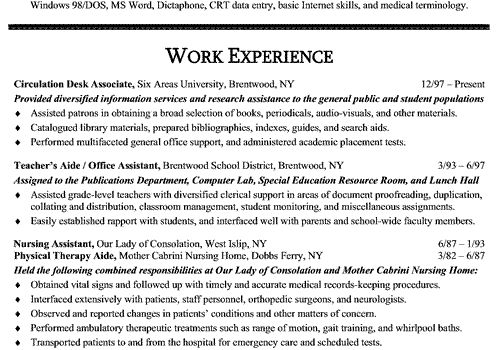
<p><strong> </strong></p>
<p>Start your professional experience by drafting a short paragraph to describe responsibilities.</p>
<p>Use bullets to highlight key achievements. This type of presentation will create a clear and important distinction between what you do on a day-to-day basis vs. what you have delivered for your clients or your company. Remember, the resume is a marketing tool – it should be written to engage the reader and provide information about the things that you are interested in doing again.</p>
<p><strong>Tip: If you are not interested in doing a task again, do not list it on the resume. </strong></p>
<p><strong> </strong></p>
<p><strong>The following is an example of what your professional experience section might look like:</strong></p>
<p style="text-align: left;"><strong>COMPANY NAME, Chicago, IL, 2005-Present</strong></p>
<p>A leading retailer and distributor of natural stone imported from India, Brazil, Italy, Spain, Mexico, and Turkey, among others and specializing in exceptional quality and selection of stone products to meet the needs of builders, contractors, fabricators, retailers, architects, interior designers, and tile distributors. Ranked 19<sup>th</sup> among the fastest 50 growing companies in Chicago by <em>Crain’s</em> in 2007.</p>
<p><strong>Chief Operating Officer</strong></p>
<p><strong> </strong></p>
<p>Spearheaded the company’s expansion from 4 locations doing $16 million in business to 16 locations throughout the Midwest and Southwest doing $50 million in business. Evangelized opportunities to improve profitability through organic growth, and worked with the Board to derive funds from shareholders to support efforts. Provided leadership to 16 vice presidents, general managers, showroom managers, and 6 corporate direct reports.</p>
<ul>
<li><strong>Implemented buying processes</strong>, which included categorizing products to facilitate improved      tracking of purchases and inventory. Reduced unsold inventory and      identified best selling items to improve cash flow, margin, and identify      replenishment points.</li>
<li><strong>Identified new sources and suppliers to optimize the supply chain</strong>. Worked with freight companies and      negotiated competitive pricing to manage import and carrying costs.      Identified ships and vendors that would allow increased tonnage per      container.</li>
</ul>
<p><strong>What else should be on your resume?</strong></p>
<p>You  will want to  include education, advanced degrees, certifications, training, awards, affiliations (professional, community/volunteer) and compelling hobbies/interests. Compelling is the key word here. Generally hobbies and interests can be left off the resume. The caveat is that you should include them if they are really unique. For example, if you have summited Mt. Kilimanjaro or something equally noteworthy. Why something so extreme? Well, just being a voracious reader doesn’t make you all that unique. Not reading, now that would be unique. Seriously though, the general run of the mill hobbies doesn’t provide the reader with anything all that exciting. Competing in a triathlon? Now that’s an icebreaker! Now for the sample of your education and other data for the resume:</p>
<h6 style="text-align: center;"><strong>Education &amp; Academic Achievement</strong></h6>
<p style="text-align: center;">UNIVERSITY OF PENNSYLVANIA, WHARTON BUSINESS SCHOOL, Philadelphia, PA (2001)</p>
<p style="text-align: center;"><strong>Master of Business Administration</strong></p>
<ul style="text-align: center;">
<li><em>Coursework      Emphasis:</em> Quantitative Analytics, Corporate      Finance, Portfolio Theory, and Financial Risk.</li>
</ul>
<p style="text-align: center;">BROWN UNIVERSITY, Providence, RI (1999)</p>
<p style="text-align: center;"><strong>Bachelor of Arts, Mathematics and Economics (Double Degree)</strong></p>
<ul style="text-align: center;">
<li><em>Thesis:</em> “Name of Thesis Here”</li>
<li><em>Leadership:</em> Board of Trustees Investment Committee (Member), Student Investment Fund.</li>
</ul>
<h6 style="text-align: center;"><strong>Professional Certifications</strong></h6>
<p style="text-align: center;">Professional Risk Managers’ International Association (PRMIA) – Professional Risk Manager (PRM) Designation;</p>
<p style="text-align: center;">Chartered Financial Analyst (CFA) Certification (Level I).</p>
<h6 style="text-align: center;">Leadership &amp; Additional Information</h6>
<p style="text-align: center;">Founder and former CEO of the Main Managed Fund.</p>
<p style="text-align: center;"><em>Language Skills:</em> Russian (Fluent). <em>Computer Skills (Expert):</em> Microsoft Excel, @Risk, Crystal Ball, Mathematica, MatLab, and Bloomberg. Knowledge of Visual Basic and C++ programming languages.</p>
<p><strong> </strong></p>
<p><strong>The devil is in the details</strong>. Your presentation counts, including layout, margins, font size, and style. Make sure you’re the resume is balanced with enough white space to facilitate easy reading. If you go to a second page, make sure that at least 50% of that page has content. Going over by one or two lines looks sloppy. Make sure personal details, including name, phone and email address is included at the top of the second page. When the resume is printed, the reader will be able to identify your document if the two pages become separated.</p>
<p>Make sure all of your career documents, including a cover letter, bio, and any other materials match to maintain a positive and pleasing brand.</p>
<div id="_mcePaste" style="overflow: hidden; position: absolute; left: -10000px; top: 159px; width: 1px; height: 1px;"><!--[if gte mso 9]><xml> <o:OfficeDocumentSettings> <o:AllowPNG /> </o:OfficeDocumentSettings> </xml><![endif]--><!--[if gte mso 9]><xml> <w:WordDocument> <w:View>Normal</w:View> <w:Zoom>0</w:Zoom> <w:TrackMoves /> <w:TrackFormatting /> <w:PunctuationKerning /> <w:ValidateAgainstSchemas /> <w:SaveIfXMLInvalid>false</w:SaveIfXMLInvalid> <w:IgnoreMixedContent>false</w:IgnoreMixedContent> <w:AlwaysShowPlaceholderText>false</w:AlwaysShowPlaceholderText> <w:DoNotPromoteQF /> <w:LidThemeOther>EN-US</w:LidThemeOther> <w:LidThemeAsian>X-NONE</w:LidThemeAsian> <w:LidThemeComplexScript>X-NONE</w:LidThemeComplexScript> <w:Compatibility> <w:BreakWrappedTables /> <w:SnapToGridInCell /> <w:WrapTextWithPunct /> <w:UseAsianBreakRules /> <w:DontGrowAutofit /> <w:SplitPgBreakAndParaMark /> <w:DontVertAlignCellWithSp /> <w:DontBreakConstrainedForcedTables /> <w:DontVertAlignInTxbx /> <w:Word11KerningPairs /> <w:CachedColBalance /> </w:Compatibility> <w:DoNotOptimizeForBrowser /> <m:mathPr> <m:mathFont m:val="Cambria Math" /> <m:brkBin m:val="before" /> <m:brkBinSub m:val="&#45;-" /> <m:smallFrac m:val="off" /> <m:dispDef /> <m:lMargin m:val="0" /> <m:rMargin m:val="0" /> <m:defJc m:val="centerGroup" /> <m:wrapIndent m:val="1440" /> <m:intLim m:val="subSup" /> <m:naryLim m:val="undOvr" /> </m:mathPr></w:WordDocument> </xml><![endif]--><!--[if gte mso 9]><xml> <w:LatentStyles DefLockedState="false" DefUnhideWhenUsed="true"   DefSemiHidden="true" DefQFormat="false" DefPriority="99"   LatentStyleCount="267"> <w:LsdException Locked="false" Priority="0" SemiHidden="false"    UnhideWhenUsed="false" QFormat="true" Name="Normal" /> <w:LsdException Locked="false" Priority="0" SemiHidden="false"    UnhideWhenUsed="false" QFormat="true" Name="heading 1" /> <w:LsdException Locked="false" Priority="9" QFormat="true" Name="heading 2" /> <w:LsdException Locked="false" Priority="9" QFormat="true" Name="heading 3" /> <w:LsdException Locked="false" Priority="9" QFormat="true" Name="heading 4" /> <w:LsdException Locked="false" Priority="9" QFormat="true" Name="heading 5" /> <w:LsdException Locked="false" Priority="9" QFormat="true" Name="heading 6" /> <w:LsdException Locked="false" Priority="9" QFormat="true" Name="heading 7" /> <w:LsdException Locked="false" Priority="9" QFormat="true" Name="heading 8" /> <w:LsdException Locked="false" Priority="9" QFormat="true" Name="heading 9" /> <w:LsdException Locked="false" Priority="39" Name="toc 1" /> <w:LsdException Locked="false" Priority="39" Name="toc 2" /> <w:LsdException Locked="false" Priority="39" Name="toc 3" /> <w:LsdException Locked="false" Priority="39" Name="toc 4" /> <w:LsdException Locked="false" Priority="39" Name="toc 5" /> <w:LsdException Locked="false" Priority="39" Name="toc 6" /> <w:LsdException Locked="false" Priority="39" Name="toc 7" /> <w:LsdException Locked="false" Priority="39" Name="toc 8" /> <w:LsdException Locked="false" Priority="39" Name="toc 9" /> <w:LsdException Locked="false" Priority="35" QFormat="true" Name="caption" /> <w:LsdException Locked="false" Priority="10" SemiHidden="false"    UnhideWhenUsed="false" QFormat="true" Name="Title" /> <w:LsdException Locked="false" Priority="1" Name="Default Paragraph Font" /> <w:LsdException Locked="false" Priority="0" Name="Body Text" /> <w:LsdException Locked="false" Priority="11" SemiHidden="false"    UnhideWhenUsed="false" QFormat="true" Name="Subtitle" /> <w:LsdException Locked="false" Priority="22" SemiHidden="false"    UnhideWhenUsed="false" QFormat="true" Name="Strong" /> <w:LsdException Locked="false" Priority="20" SemiHidden="false"    UnhideWhenUsed="false" QFormat="true" Name="Emphasis" /> <w:LsdException Locked="false" Priority="59" SemiHidden="false"    UnhideWhenUsed="false" Name="Table Grid" /> <w:LsdException Locked="false" UnhideWhenUsed="false" Name="Placeholder Text" /> <w:LsdException Locked="false" Priority="1" SemiHidden="false"    UnhideWhenUsed="false" QFormat="true" Name="No Spacing" /> <w:LsdException Locked="false" Priority="60" SemiHidden="false"    UnhideWhenUsed="false" Name="Light Shading" /> <w:LsdException Locked="false" Priority="61" SemiHidden="false"    UnhideWhenUsed="false" Name="Light List" /> <w:LsdException Locked="false" Priority="62" SemiHidden="false"    UnhideWhenUsed="false" Name="Light Grid" /> <w:LsdException Locked="false" Priority="63" SemiHidden="false"    UnhideWhenUsed="false" Name="Medium Shading 1" /> <w:LsdException Locked="false" Priority="64" SemiHidden="false"    UnhideWhenUsed="false" Name="Medium Shading 2" /> <w:LsdException Locked="false" Priority="65" SemiHidden="false"    UnhideWhenUsed="false" Name="Medium List 1" /> <w:LsdException Locked="false" Priority="66" SemiHidden="false"    UnhideWhenUsed="false" Name="Medium List 2" /> <w:LsdException Locked="false" Priority="67" SemiHidden="false"    UnhideWhenUsed="false" Name="Medium Grid 1" /> <w:LsdException Locked="false" Priority="68" SemiHidden="false"    UnhideWhenUsed="false" Name="Medium Grid 2" /> <w:LsdException Locked="false" Priority="69" SemiHidden="false"    UnhideWhenUsed="false" Name="Medium Grid 3" /> <w:LsdException Locked="false" Priority="70" SemiHidden="false"    UnhideWhenUsed="false" Name="Dark List" /> <w:LsdException Locked="false" Priority="71" SemiHidden="false"    UnhideWhenUsed="false" Name="Colorful Shading" /> <w:LsdException Locked="false" Priority="72" SemiHidden="false"    UnhideWhenUsed="false" Name="Colorful List" /> <w:LsdException Locked="false" Priority="73" SemiHidden="false"    UnhideWhenUsed="false" Name="Colorful Grid" /> <w:LsdException Locked="false" Priority="60" SemiHidden="false"    UnhideWhenUsed="false" Name="Light Shading Accent 1" /> <w:LsdException Locked="false" Priority="61" SemiHidden="false"    UnhideWhenUsed="false" Name="Light List Accent 1" /> <w:LsdException Locked="false" Priority="62" SemiHidden="false"    UnhideWhenUsed="false" Name="Light Grid Accent 1" /> <w:LsdException Locked="false" Priority="63" SemiHidden="false"    UnhideWhenUsed="false" Name="Medium Shading 1 Accent 1" /> <w:LsdException Locked="false" Priority="64" SemiHidden="false"    UnhideWhenUsed="false" Name="Medium Shading 2 Accent 1" /> <w:LsdException Locked="false" Priority="65" SemiHidden="false"    UnhideWhenUsed="false" Name="Medium List 1 Accent 1" /> <w:LsdException Locked="false" UnhideWhenUsed="false" Name="Revision" /> <w:LsdException Locked="false" Priority="34" SemiHidden="false"    UnhideWhenUsed="false" QFormat="true" Name="List Paragraph" /> <w:LsdException Locked="false" Priority="29" SemiHidden="false"    UnhideWhenUsed="false" QFormat="true" Name="Quote" /> <w:LsdException Locked="false" Priority="30" SemiHidden="false"    UnhideWhenUsed="false" QFormat="true" Name="Intense Quote" /> <w:LsdException Locked="false" Priority="66" SemiHidden="false"    UnhideWhenUsed="false" Name="Medium List 2 Accent 1" /> <w:LsdException Locked="false" Priority="67" SemiHidden="false"    UnhideWhenUsed="false" Name="Medium Grid 1 Accent 1" /> <w:LsdException Locked="false" Priority="68" SemiHidden="false"    UnhideWhenUsed="false" Name="Medium Grid 2 Accent 1" /> <w:LsdException Locked="false" Priority="69" SemiHidden="false"    UnhideWhenUsed="false" Name="Medium Grid 3 Accent 1" /> <w:LsdException Locked="false" Priority="70" SemiHidden="false"    UnhideWhenUsed="false" Name="Dark List Accent 1" /> <w:LsdException Locked="false" Priority="71" SemiHidden="false"    UnhideWhenUsed="false" Name="Colorful Shading Accent 1" /> <w:LsdException Locked="false" Priority="72" SemiHidden="false"    UnhideWhenUsed="false" Name="Colorful List Accent 1" /> <w:LsdException Locked="false" Priority="73" SemiHidden="false"    UnhideWhenUsed="false" Name="Colorful Grid Accent 1" /> <w:LsdException Locked="false" Priority="60" SemiHidden="false"    UnhideWhenUsed="false" Name="Light Shading Accent 2" /> <w:LsdException Locked="false" Priority="61" SemiHidden="false"    UnhideWhenUsed="false" Name="Light List Accent 2" /> <w:LsdException Locked="false" Priority="62" SemiHidden="false"    UnhideWhenUsed="false" Name="Light Grid Accent 2" /> <w:LsdException Locked="false" Priority="63" SemiHidden="false"    UnhideWhenUsed="false" Name="Medium Shading 1 Accent 2" /> <w:LsdException Locked="false" Priority="64" SemiHidden="false"    UnhideWhenUsed="false" Name="Medium Shading 2 Accent 2" /> <w:LsdException Locked="false" Priority="65" SemiHidden="false"    UnhideWhenUsed="false" Name="Medium List 1 Accent 2" /> <w:LsdException Locked="false" Priority="66" SemiHidden="false"    UnhideWhenUsed="false" Name="Medium List 2 Accent 2" /> <w:LsdException Locked="false" Priority="67" SemiHidden="false"    UnhideWhenUsed="false" Name="Medium Grid 1 Accent 2" /> <w:LsdException Locked="false" Priority="68" SemiHidden="false"    UnhideWhenUsed="false" Name="Medium Grid 2 Accent 2" /> <w:LsdException Locked="false" Priority="69" SemiHidden="false"    UnhideWhenUsed="false" Name="Medium Grid 3 Accent 2" /> <w:LsdException Locked="false" Priority="70" SemiHidden="false"    UnhideWhenUsed="false" Name="Dark List Accent 2" /> <w:LsdException Locked="false" Priority="71" SemiHidden="false"    UnhideWhenUsed="false" Name="Colorful Shading Accent 2" /> <w:LsdException Locked="false" Priority="72" SemiHidden="false"    UnhideWhenUsed="false" Name="Colorful List Accent 2" /> <w:LsdException Locked="false" Priority="73" SemiHidden="false"    UnhideWhenUsed="false" Name="Colorful Grid Accent 2" /> <w:LsdException Locked="false" Priority="60" SemiHidden="false"    UnhideWhenUsed="false" Name="Light Shading Accent 3" /> <w:LsdException Locked="false" Priority="61" SemiHidden="false"    UnhideWhenUsed="false" Name="Light List Accent 3" /> <w:LsdException Locked="false" Priority="62" SemiHidden="false"    UnhideWhenUsed="false" Name="Light Grid Accent 3" /> <w:LsdException Locked="false" Priority="63" SemiHidden="false"    UnhideWhenUsed="false" Name="Medium Shading 1 Accent 3" /> <w:LsdException Locked="false" Priority="64" SemiHidden="false"    UnhideWhenUsed="false" Name="Medium Shading 2 Accent 3" /> <w:LsdException Locked="false" Priority="65" SemiHidden="false"    UnhideWhenUsed="false" Name="Medium List 1 Accent 3" /> <w:LsdException Locked="false" Priority="66" SemiHidden="false"    UnhideWhenUsed="false" Name="Medium List 2 Accent 3" /> <w:LsdException Locked="false" Priority="67" SemiHidden="false"    UnhideWhenUsed="false" Name="Medium Grid 1 Accent 3" /> <w:LsdException Locked="false" Priority="68" SemiHidden="false"    UnhideWhenUsed="false" Name="Medium Grid 2 Accent 3" /> <w:LsdException Locked="false" Priority="69" SemiHidden="false"    UnhideWhenUsed="false" Name="Medium Grid 3 Accent 3" /> <w:LsdException Locked="false" Priority="70" SemiHidden="false"    UnhideWhenUsed="false" Name="Dark List Accent 3" /> <w:LsdException Locked="false" Priority="71" SemiHidden="false"    UnhideWhenUsed="false" Name="Colorful Shading Accent 3" /> <w:LsdException Locked="false" Priority="72" SemiHidden="false"    UnhideWhenUsed="false" Name="Colorful List Accent 3" /> <w:LsdException Locked="false" Priority="73" SemiHidden="false"    UnhideWhenUsed="false" Name="Colorful Grid Accent 3" /> <w:LsdException Locked="false" Priority="60" SemiHidden="false"    UnhideWhenUsed="false" Name="Light Shading Accent 4" /> <w:LsdException Locked="false" Priority="61" SemiHidden="false"    UnhideWhenUsed="false" Name="Light List Accent 4" /> <w:LsdException Locked="false" Priority="62" SemiHidden="false"    UnhideWhenUsed="false" Name="Light Grid Accent 4" /> <w:LsdException Locked="false" Priority="63" SemiHidden="false"    UnhideWhenUsed="false" Name="Medium Shading 1 Accent 4" /> <w:LsdException Locked="false" Priority="64" SemiHidden="false"    UnhideWhenUsed="false" Name="Medium Shading 2 Accent 4" /> <w:LsdException Locked="false" Priority="65" SemiHidden="false"    UnhideWhenUsed="false" Name="Medium List 1 Accent 4" /> <w:LsdException Locked="false" Priority="66" SemiHidden="false"    UnhideWhenUsed="false" Name="Medium List 2 Accent 4" /> <w:LsdException Locked="false" Priority="67" SemiHidden="false"    UnhideWhenUsed="false" Name="Medium Grid 1 Accent 4" /> <w:LsdException Locked="false" Priority="68" SemiHidden="false"    UnhideWhenUsed="false" Name="Medium Grid 2 Accent 4" /> <w:LsdException Locked="false" Priority="69" SemiHidden="false"    UnhideWhenUsed="false" Name="Medium Grid 3 Accent 4" /> <w:LsdException Locked="false" Priority="70" SemiHidden="false"    UnhideWhenUsed="false" Name="Dark List Accent 4" /> <w:LsdException Locked="false" Priority="71" SemiHidden="false"    UnhideWhenUsed="false" Name="Colorful Shading Accent 4" /> <w:LsdException Locked="false" Priority="72" SemiHidden="false"    UnhideWhenUsed="false" Name="Colorful List Accent 4" /> <w:LsdException Locked="false" Priority="73" SemiHidden="false"    UnhideWhenUsed="false" Name="Colorful Grid Accent 4" /> <w:LsdException Locked="false" Priority="60" SemiHidden="false"    UnhideWhenUsed="false" Name="Light Shading Accent 5" /> <w:LsdException Locked="false" Priority="61" SemiHidden="false"    UnhideWhenUsed="false" Name="Light List Accent 5" /> <w:LsdException Locked="false" Priority="62" SemiHidden="false"    UnhideWhenUsed="false" Name="Light Grid Accent 5" /> <w:LsdException Locked="false" Priority="63" SemiHidden="false"    UnhideWhenUsed="false" Name="Medium Shading 1 Accent 5" /> <w:LsdException Locked="false" Priority="64" SemiHidden="false"    UnhideWhenUsed="false" Name="Medium Shading 2 Accent 5" /> <w:LsdException Locked="false" Priority="65" SemiHidden="false"    UnhideWhenUsed="false" Name="Medium List 1 Accent 5" /> <w:LsdException Locked="false" Priority="66" SemiHidden="false"    UnhideWhenUsed="false" Name="Medium List 2 Accent 5" /> <w:LsdException Locked="false" Priority="67" SemiHidden="false"    UnhideWhenUsed="false" Name="Medium Grid 1 Accent 5" /> <w:LsdException Locked="false" Priority="68" SemiHidden="false"    UnhideWhenUsed="false" Name="Medium Grid 2 Accent 5" /> <w:LsdException Locked="false" Priority="69" SemiHidden="false"    UnhideWhenUsed="false" Name="Medium Grid 3 Accent 5" /> <w:LsdException Locked="false" Priority="70" SemiHidden="false"    UnhideWhenUsed="false" Name="Dark List Accent 5" /> <w:LsdException Locked="false" Priority="71" SemiHidden="false"    UnhideWhenUsed="false" Name="Colorful Shading Accent 5" /> <w:LsdException Locked="false" Priority="72" SemiHidden="false"    UnhideWhenUsed="false" Name="Colorful List Accent 5" /> <w:LsdException Locked="false" Priority="73" SemiHidden="false"    UnhideWhenUsed="false" Name="Colorful Grid Accent 5" /> <w:LsdException Locked="false" Priority="60" SemiHidden="false"    UnhideWhenUsed="false" Name="Light Shading Accent 6" /> <w:LsdException Locked="false" Priority="61" SemiHidden="false"    UnhideWhenUsed="false" Name="Light List Accent 6" /> <w:LsdException Locked="false" Priority="62" SemiHidden="false"    UnhideWhenUsed="false" Name="Light Grid Accent 6" /> <w:LsdException Locked="false" Priority="63" SemiHidden="false"    UnhideWhenUsed="false" Name="Medium Shading 1 Accent 6" /> <w:LsdException Locked="false" Priority="64" SemiHidden="false"    UnhideWhenUsed="false" Name="Medium Shading 2 Accent 6" /> <w:LsdException Locked="false" Priority="65" SemiHidden="false"    UnhideWhenUsed="false" Name="Medium List 1 Accent 6" /> <w:LsdException Locked="false" Priority="66" SemiHidden="false"    UnhideWhenUsed="false" Name="Medium List 2 Accent 6" /> <w:LsdException Locked="false" Priority="67" SemiHidden="false"    UnhideWhenUsed="false" Name="Medium Grid 1 Accent 6" /> <w:LsdException Locked="false" Priority="68" SemiHidden="false"    UnhideWhenUsed="false" Name="Medium Grid 2 Accent 6" /> <w:LsdException Locked="false" Priority="69" SemiHidden="false"    UnhideWhenUsed="false" Name="Medium Grid 3 Accent 6" /> <w:LsdException Locked="false" Priority="70" SemiHidden="false"    UnhideWhenUsed="false" Name="Dark List Accent 6" /> <w:LsdException Locked="false" Priority="71" SemiHidden="false"    UnhideWhenUsed="false" Name="Colorful Shading Accent 6" /> <w:LsdException Locked="false" Priority="72" SemiHidden="false"    UnhideWhenUsed="false" Name="Colorful List Accent 6" /> <w:LsdException Locked="false" Priority="73" SemiHidden="false"    UnhideWhenUsed="false" Name="Colorful Grid Accent 6" /> <w:LsdException Locked="false" Priority="19" SemiHidden="false"    UnhideWhenUsed="false" QFormat="true" Name="Subtle Emphasis" /> <w:LsdException Locked="false" Priority="21" SemiHidden="false"    UnhideWhenUsed="false" QFormat="true" Name="Intense Emphasis" /> <w:LsdException Locked="false" Priority="31" SemiHidden="false"    UnhideWhenUsed="false" QFormat="true" Name="Subtle Reference" /> <w:LsdException Locked="false" Priority="32" SemiHidden="false"    UnhideWhenUsed="false" QFormat="true" Name="Intense Reference" /> <w:LsdException Locked="false" Priority="33" SemiHidden="false"    UnhideWhenUsed="false" QFormat="true" Name="Book Title" /> <w:LsdException Locked="false" Priority="37" Name="Bibliography" /> <w:LsdException Locked="false" Priority="39" QFormat="true" Name="TOC Heading" /> </w:LatentStyles> </xml><![endif]--><!--  /* Font Definitions */  @font-face 	{font-family:Wingdings; 	panose-1:5 0 0 0 0 0 0 0 0 0; 	mso-font-charset:2; 	mso-generic-font-family:auto; 	mso-font-pitch:variable; 	mso-font-signature:0 268435456 0 0 -2147483648 0;} @font-face 	{font-family:Batang; 	panose-1:2 3 6 0 0 1 1 1 1 1; 	mso-font-alt:바탕; 	mso-font-charset:129; 	mso-generic-font-family:auto; 	mso-font-format:other; 	mso-font-pitch:fixed; 	mso-font-signature:1 151388160 16 0 524288 0;} @font-face 	{font-family:"Cambria Math"; 	panose-1:2 4 5 3 5 4 6 3 2 4; 	mso-font-charset:0; 	mso-generic-font-family:roman; 	mso-font-pitch:variable; 	mso-font-signature:-1610611985 1107304683 0 0 415 0;} @font-face 	{font-family:Cambria; 	panose-1:2 4 5 3 5 4 6 3 2 4; 	mso-font-charset:0; 	mso-generic-font-family:roman; 	mso-font-pitch:variable; 	mso-font-signature:-1610611985 1073741899 0 0 415 0;} @font-face 	{font-family:"Book Antiqua"; 	panose-1:2 4 6 2 5 3 5 3 3 4; 	mso-font-charset:0; 	mso-generic-font-family:roman; 	mso-font-pitch:variable; 	mso-font-signature:647 0 0 0 159 0;} @font-face 	{font-family:新細明體; 	mso-font-charset:81; 	mso-generic-font-family:auto; 	mso-font-pitch:variable; 	mso-font-signature:1 0 16778248 0 1048576 0;} @font-face 	{font-family:"\@Batang"; 	panose-1:2 3 6 0 0 1 1 1 1 1; 	mso-font-charset:129; 	mso-generic-font-family:roman; 	mso-font-pitch:variable; 	mso-font-signature:-1342176593 1775729915 48 0 524447 0;}  /* Style Definitions */  p.MsoNormal, li.MsoNormal, div.MsoNormal 	{mso-style-unhide:no; 	mso-style-qformat:yes; 	mso-style-parent:""; 	margin-top:0in; 	margin-right:0in; 	margin-bottom:10.0pt; 	margin-left:0in; 	mso-pagination:widow-orphan; 	font-size:12.0pt; 	font-family:"Cambria","serif"; 	mso-ascii-font-family:Cambria; 	mso-ascii-theme-font:minor-latin; 	mso-fareast-font-family:Cambria; 	mso-fareast-theme-font:minor-latin; 	mso-hansi-font-family:Cambria; 	mso-hansi-theme-font:minor-latin; 	mso-bidi-font-family:"Times New Roman"; 	mso-bidi-theme-font:minor-bidi;} h1 	{mso-style-unhide:no; 	mso-style-link:"Heading 1 Char"; 	mso-style-next:Normal; 	margin-top:24.0pt; 	margin-right:0in; 	margin-bottom:0in; 	margin-left:0in; 	margin-bottom:.0001pt; 	mso-pagination:widow-orphan lines-together; 	page-break-after:avoid; 	mso-outline-level:1; 	font-size:16.0pt; 	font-family:"Calibri","sans-serif"; 	mso-ascii-font-family:Calibri; 	mso-ascii-theme-font:major-latin; 	mso-fareast-font-family:"Times New Roman"; 	mso-fareast-theme-font:major-fareast; 	mso-hansi-font-family:Calibri; 	mso-hansi-theme-font:major-latin; 	mso-bidi-font-family:"Times New Roman"; 	mso-bidi-theme-font:major-bidi; 	color:#345A8A; 	mso-themecolor:accent1; 	mso-themeshade:181; 	mso-font-kerning:0pt;} p.MsoBodyText, li.MsoBodyText, div.MsoBodyText 	{mso-style-unhide:no; 	mso-style-link:"Body Text Char"; 	margin:0in; 	margin-bottom:.0001pt; 	text-align:justify; 	mso-pagination:widow-orphan; 	font-size:10.0pt; 	mso-bidi-font-size:12.0pt; 	font-family:"Book Antiqua","serif"; 	mso-fareast-font-family:Batang; 	mso-bidi-font-family:"Times New Roman";} span.Heading1Char 	{mso-style-name:"Heading 1 Char"; 	mso-style-unhide:no; 	mso-style-locked:yes; 	mso-style-link:"Heading 1"; 	mso-ansi-font-size:16.0pt; 	mso-bidi-font-size:16.0pt; 	font-family:"Calibri","sans-serif"; 	mso-ascii-font-family:Calibri; 	mso-ascii-theme-font:major-latin; 	mso-fareast-font-family:"Times New Roman"; 	mso-fareast-theme-font:major-fareast; 	mso-hansi-font-family:Calibri; 	mso-hansi-theme-font:major-latin; 	mso-bidi-font-family:"Times New Roman"; 	mso-bidi-theme-font:major-bidi; 	color:#345A8A; 	mso-themecolor:accent1; 	mso-themeshade:181; 	font-weight:bold;} span.BodyTextChar 	{mso-style-name:"Body Text Char"; 	mso-style-unhide:no; 	mso-style-locked:yes; 	mso-style-link:"Body Text"; 	mso-ansi-font-size:10.0pt; 	font-family:"Book Antiqua","serif"; 	mso-ascii-font-family:"Book Antiqua"; 	mso-fareast-font-family:Batang; 	mso-hansi-font-family:"Book Antiqua"; 	mso-bidi-font-family:"Times New Roman";} .MsoChpDefault 	{mso-style-type:export-only; 	mso-default-props:yes; 	font-size:12.0pt; 	mso-ansi-font-size:12.0pt; 	mso-bidi-font-size:12.0pt; 	mso-ascii-font-family:Cambria; 	mso-ascii-theme-font:minor-latin; 	mso-fareast-font-family:Cambria; 	mso-fareast-theme-font:minor-latin; 	mso-hansi-font-family:Cambria; 	mso-hansi-theme-font:minor-latin; 	mso-bidi-font-family:"Times New Roman"; 	mso-bidi-theme-font:minor-bidi;} .MsoPapDefault 	{mso-style-type:export-only; 	margin-bottom:10.0pt;} @page Section1 	{size:8.5in 11.0in; 	margin:1.0in 1.0in 1.0in 1.0in; 	mso-header-margin:.5in; 	mso-footer-margin:.5in; 	mso-paper-source:0;} div.Section1 	{page:Section1;}  /* List Definitions */  @list l0 	{mso-list-id:223874902; 	mso-list-type:hybrid; 	mso-list-template-ids:-299059048 -7202756 67698691 67698693 67698689 67698691 67698693 67698689 67698691 67698693;} @list l0:level1 	{mso-level-number-format:bullet; 	mso-level-text:; 	mso-level-tab-stop:.5in; 	mso-level-number-position:left; 	text-indent:-.25in; 	mso-ansi-font-size:8.0pt; 	font-family:Symbol;} @list l1 	{mso-list-id:400906581; 	mso-list-type:hybrid; 	mso-list-template-ids:-1438121208 67698693 67698691 67698693 67698689 67698691 67698693 67698689 67698691 67698693;} @list l1:level1 	{mso-level-number-format:bullet; 	mso-level-text:; 	mso-level-tab-stop:.5in; 	mso-level-number-position:left; 	text-indent:-.25in; 	font-family:Wingdings;} @list l2 	{mso-list-id:1723676143; 	mso-list-type:hybrid; 	mso-list-template-ids:-1471643748 67698693 67698691 67698693 67698689 67698691 67698693 67698689 67698691 67698693;} @list l2:level1 	{mso-level-number-format:bullet; 	mso-level-text:; 	mso-level-tab-stop:.5in; 	mso-level-number-position:left; 	text-indent:-.25in; 	font-family:Wingdings;} ol 	{margin-bottom:0in;} ul 	{margin-bottom:0in;} --><!--[if gte mso 10]> <mce:style><!   /* Style Definitions */  table.MsoNormalTable 	{mso-style-name:"Table Normal"; 	mso-tstyle-rowband-size:0; 	mso-tstyle-colband-size:0; 	mso-style-noshow:yes; 	mso-style-priority:99; 	mso-style-qformat:yes; 	mso-style-parent:""; 	mso-padding-alt:0in 5.4pt 0in 5.4pt; 	mso-para-margin-top:0in; 	mso-para-margin-right:0in; 	mso-para-margin-bottom:10.0pt; 	mso-para-margin-left:0in; 	mso-pagination:widow-orphan; 	font-size:12.0pt; 	font-family:"Cambria","serif"; 	mso-ascii-font-family:Cambria; 	mso-ascii-theme-font:minor-latin; 	mso-hansi-font-family:Cambria; 	mso-hansi-theme-font:minor-latin;} --> <!--[endif]--></p>
<p class="MsoNormal" style="margin-bottom: 0.0001pt; text-align: justify;"><span style="font-size: 10pt;">The summary and core competency section above sets a proper and compelling tone for the resume. It allows the reader to quickly learn something about you, including overarching abilities and sometimes personal attributes. This presentation facilitates easy scanning. </span></p>
<p class="MsoNormal" style="margin-bottom: 0.0001pt; text-align: justify;"><span style="font-size: 10pt;"> </span></p>
<p class="MsoNormal" style="margin-bottom: 0.0001pt; text-align: justify;"><span style="font-size: 10pt;">Moving ahead to the body of your resume, numbers make management notice your background and it demonstrates your ability to drive results. <strong>Use real numbers … but make sure you can defend them. </strong></span></p>
<p class="MsoNormal" style="margin-bottom: 0.0001pt; text-align: justify;"><strong><span style="font-size: 10pt;"> </span></strong></p>
<p class="MsoNormal" style="margin-bottom: 0.0001pt; text-align: justify;"><span style="font-size: 10pt;">Start your professional experience by drafting a short paragraph to describe responsibilities.</span></p>
<p class="MsoNormal" style="margin-bottom: 0.0001pt; text-align: justify;"><span style="font-size: 10pt;">Use bullets to highlight key achievements. This type of presentation will create a clear and important distinction between what you do on a day-to-day basis vs. what you have delivered for your clients or your company. Remember, the resume is a marketing tool – it should be written to engage the reader and provide information about the things that you are interested in doing again.</span></p>
<p class="MsoNormal" style="margin-bottom: 0.0001pt; text-align: justify;"><span style="font-size: 10pt;"> </span></p>
<p class="MsoNormal" style="margin-bottom: 0.0001pt; text-align: justify;"><strong><span style="font-size: 10pt;">Tip: If you are not interested in doing a task again, do not list it on the resume. </span></strong></p>
<p class="MsoNormal" style="margin-bottom: 0.0001pt; text-align: justify;"><strong><span style="font-size: 10pt;"> </span></strong></p>
<p class="MsoNormal" style="margin-bottom: 0.0001pt; text-align: justify;"><strong><span style="font-size: 10pt;">The following is an example of what your professional experience section might look like:</span></strong></p>
<p class="MsoNormal" style="margin-bottom: 0.0001pt; text-align: justify;"><span style="font-size: 10pt; text-transform: uppercase;"> </span></p>
<p class="MsoNormal" style="margin-bottom: 0.0001pt; text-align: justify;"><span style="font-size: 10pt; text-transform: uppercase;">COMPANY NAME</span><span style="font-size: 10pt;">, Chicago, IL<span> </span>2005-Present</span></p>
<p class="MsoNormal" style="margin: 3pt 0in 0.0001pt; text-align: justify;"><span style="font-size: 10pt;">A leading retailer and distributor of natural stone imported from India, Brazil, Italy, Spain, Mexico, and Turkey, among others and specializing in exceptional quality and selection of stone products to meet the needs of builders, contractors, fabricators, retailers, architects, interior designers, and tile distributors. Ranked 19<sup>th</sup> among the fastest 50 growing companies in Chicago by <em>Crain’s</em> in 2007. </span></p>
<p class="MsoNormal" style="margin-bottom: 0.0001pt; text-align: justify;"><span style="font-size: 10pt;"> </span></p>
<div style="padding: 0in 0in 1pt; margin-left: 0.25in; margin-right: 0in; border: medium medium 1pt none none solid -moz-use-text-color -moz-use-text-color windowtext;">
<p class="MsoNormal" style="border: medium none; padding: 0in; margin-bottom: 0.0001pt; text-align: justify;"><strong><span style="font-size: 10pt;">Chief Operating Officer</span></strong></p>
</div>
<p class="MsoNormal" style="margin: 0in 0in 0.0001pt 0.25in; text-align: justify;"><strong><span style="font-size: 10pt;"> </span></strong></p>
<p class="MsoNormal" style="margin: 0in 0in 0.0001pt 0.25in; text-align: justify;"><span style="font-size: 10pt;">Spearheaded the company’s expansion from 4 locations doing $16 million in business to 16 locations throughout the Midwest and Southwest doing $50 million in business. Evangelized opportunities to improve profitability through organic growth, and worked with the Board to derive funds from shareholders to support efforts. Provided leadership to 16 vice presidents, general managers, showroom managers, and 6 corporate direct reports. </span></p>
<ul style="margin-top: 0in;" type="disc">
<li class="MsoNormal" style="margin-top: 3pt; margin-bottom: 0.0001pt; text-align: justify;"><strong><span style="font-size: 10pt;">Implemented buying processes</span></strong><span style="font-size: 10pt;">, which included categorizing products to facilitate improved      tracking of purchases and inventory. Reduced unsold inventory and      identified best selling items to improve cash flow, margin, and identify      replenishment points.</span></li>
<li class="MsoNormal" style="margin-top: 3pt; margin-bottom: 0.0001pt; text-align: justify;"><strong><span style="font-size: 10pt;">Identified new sources and suppliers to optimize the supply chain</span></strong><span style="font-size: 10pt;">. Worked with freight companies and      negotiated competitive pricing to manage import and carrying costs.      Identified ships and vendors that would allow increased tonnage per      container.</span></li>
</ul>
<p class="MsoNormal" style="margin-bottom: 0.0001pt; text-align: justify;"><span style="font-size: 10pt;"> </span></p>
<p class="MsoNormal"><strong><span style="font-size: 10pt;">What else should be on your resume?</span></strong></p>
<p class="MsoNormal" style="margin-bottom: 0.0001pt; text-align: justify;"><span style="font-size: 10pt;">You<span> </span>will want to<span> </span>include education,</span><span style="font-size: 10pt;"> </span><span style="font-size: 10pt;">advanced degrees,</span><span style="font-size: 10pt;"> c</span><span style="font-size: 10pt;">ertifications,</span><span style="font-size: 10pt;"> t</span><span style="font-size: 10pt;">raining, awards, affiliations (professional, community/volunteer) and compelling hobbies/interests. Compelling is the key word here. Generally hobbies and interests can be left off the resume. The caveat is that you should include them if they are really unique. For example, if you have summited Mt. Kilimanjaro or something equally noteworthy. Why something so extreme? Well, just being a voracious reader doesn’t make you all that unique. Not reading, now that would be unique. Seriously though, the general run of the mill hobbies doesn’t provide the reader with anything all that exciting. Competing in a triathlon? Now that’s an icebreaker! Now for the sample of your education and other data for the resume:</span></p>
<p class="MsoNormal" style="margin-bottom: 0.0001pt; text-align: justify;"><span style="font-size: 10pt;"> </span></p>
<p class="MsoNormal"><span style="font-size: 6pt;"> </span></p>
<h1 style="margin-top: 0in; text-align: center;"><span style="font-size: 10pt; font-family: &amp;amp;amp;">Education &amp; Academic Achievement</span></h1>
<p class="MsoNormal" style="margin-bottom: 0.0001pt; text-align: center;"><span style="font-size: 6pt;"> </span></p>
<p class="MsoNormal" style="margin-bottom: 0.0001pt; text-align: center;"><span style="font-size: 10pt;">UNIVERSITY OF PENNSYLVANIA, WHARTON BUSINESS SCHOOL, Philadelphia, PA (2001)</span></p>
<p class="MsoNormal" style="margin-bottom: 0.0001pt; text-align: center;"><strong><span style="font-size: 10pt;">Master of Business Administration</span></strong><span style="font-size: 10pt;"> </span></p>
<ul style="margin-top: 0in;" type="square">
<li class="MsoNormal" style="margin-bottom: 0.0001pt; text-align: center;"><em><span style="font-size: 10pt;">Coursework      Emphasis:</span></em><span style="font-size: 10pt;"> Quantitative Analytics, Corporate      Finance, Portfolio Theory, and Financial Risk.</span></li>
</ul>
<p class="MsoNormal" style="margin-bottom: 0.0001pt; text-align: center;"><span style="font-size: 10pt;"> </span></p>
<p class="MsoBodyText" style="text-align: center;"><span style="font-family: &amp;amp;amp;">BROWN UNIVERSITY, Providence, RI (1999)</span></p>
<p class="MsoBodyText" style="text-align: center;"><strong><span style="font-family: &amp;amp;amp;">Bachelor of Arts, Mathematics and Economics (Double Degree)</span></strong><span style="font-family: &amp;amp;amp;"> </span></p>
<p class="MsoBodyText" style="margin-left: 0.5in; text-align: center; text-indent: -0.25in;"><!--[if !supportLists]--><span style="font-family: Wingdings;"><span>§<span style="font-family: &amp;amp;amp; font-style: normal; font-variant: normal; font-weight: normal; font-size: 7pt; line-height: normal; font-size-adjust: none; font-stretch: normal; -x-system-font: none;"> </span></span></span><!--[endif]--><em><span style="font-family: &amp;amp;amp;">Thesis:</span></em><span style="font-family: &amp;amp;amp;"> “Name of Thesis Here”</span></p>
<p class="MsoBodyText" style="margin-left: 0.5in; text-align: center; text-indent: -0.25in;"><!--[if !supportLists]--><span style="font-family: Wingdings;"><span>§<span style="font-family: &amp;amp;amp; font-style: normal; font-variant: normal; font-weight: normal; font-size: 7pt; line-height: normal; font-size-adjust: none; font-stretch: normal; -x-system-font: none;"> </span></span></span><!--[endif]--><em><span style="font-family: &amp;amp;amp;">Leadership:</span></em><span style="font-family: &amp;amp;amp;"> Board of Trustees Investment Committee (Member), Student Investment Fund.</span></p>
<p class="MsoBodyText" style="text-align: center;"><span style="font-family: &amp;amp;amp;"> </span></p>
<h1 style="margin-top: 0in; text-align: center;"><span style="font-size: 10pt; font-family: &amp;amp;amp;">Professional Certifications</span></h1>
<p class="MsoNormal" style="margin-bottom: 0.0001pt; text-align: center;"><span style="font-size: 6pt;"> </span></p>
<p class="MsoNormal" style="margin-bottom: 0.0001pt; text-align: center;"><span style="font-size: 10pt;">Professional Risk Managers’ International Association (PRMIA) – Professional Risk Manager (PRM) Designation;</span></p>
<p class="MsoNormal" style="margin-bottom: 0.0001pt; text-align: center;"><span style="font-size: 10pt;">Chartered Financial Analyst (CFA) Certification (Level I).</span></p>
<p class="MsoBodyText" style="text-align: center;"><span style="font-family: &amp;amp;amp;"> </span></p>
<h1 style="margin-top: 0in; text-align: center;"><span style="font-size: 10pt; font-family: &amp;amp;amp;">Leadership &amp; Additional Information</span></h1>
<p class="MsoNormal" style="margin-bottom: 0.0001pt; text-align: center;"><span style="font-size: 6pt;"> </span></p>
<p class="MsoNormal" style="margin-bottom: 0.0001pt; text-align: center;"><span style="font-size: 10pt;">Founder and former CEO of the Main Managed Fund.</span></p>
<p class="MsoNormal" style="margin-bottom: 0.0001pt; text-align: center;"><span style="font-size: 10pt;"> </span></p>
<p class="MsoNormal" style="margin-bottom: 0.0001pt; text-align: center;"><em><span style="font-size: 10pt;">Language Skills:</span></em><span style="font-size: 10pt;"> Russian (Fluent). <em>Computer Skills (Expert):</em> Microsoft Excel, @Risk, Crystal Ball, Mathematica, MatLab, and Bloomberg. Knowledge of Visual Basic and C++ programming languages.</span></p>
<p class="MsoNormal" style="margin-bottom: 0.0001pt; text-align: center;"><span style="font-size: 10pt;"> </span></p>
<p class="MsoNormal"><strong><span style="font-size: 10pt;"> </span></strong></p>
<p class="MsoNormal" style="margin-bottom: 0.0001pt; text-align: justify;"><strong><span style="font-size: 10pt;">The devil is in the details</span></strong><span style="font-size: 10pt;">. Your presentation counts, including layout, margins, font size, and style. Make sure you’re the resume is balanced with enough white space to facilitate easy reading. If you go to a second page, make sure that at least 50% of that page has content. Going over by one or two lines looks sloppy. Make sure personal details, including name, phone and email address is included at the top of the second page. When the resume is printed, the reader will be able to identify your document if the two pages become separated. </span></p>
<p class="MsoNormal" style="margin-bottom: 0.0001pt; text-align: justify;"><span style="font-size: 10pt;"> </span></p>
<p class="MsoNormal" style="margin-bottom: 0.0001pt; text-align: justify;"><span style="font-size: 10pt;">Make sure all of your career documents, including a cover letter, bio, and any other materials match to maintain a positive and pleasing brand.</span></p>
</div>
<div class="sigblock">
<p>You are encouraged to comment on blog posts and/or submit questions to  Debra. You can reach her on <a href="http://www.twitter.com/debrawheatman" target="_blank">Twitter</a>, <a href="http://www.linkedin.com/in/careersdonewrite" target="_blank">LinkedIn</a>,  and <a href="http://www.facebook.com/pages/New-York-NY/Careers-Done-Write/135140683183550?ref=ts&amp;__a=38&amp;" target="_blank">Facebook.</a> </p>

<p>Debra Wheatman, CPRW, CPCC is President of Careers Done Write, a  premier career services provider focused on developing highly  personalized career roadmaps for senior leaders and executives across  all verticals and industries. Visit <a href="http://www.careersdonewrite.com/" target="_blank">careersdonewrite.com</a> to learn more.</p></div>]]></content:encoded>
			<wfw:commentRss>http://www.resume-resource.com/resumeblog/the-art-of-creating-a-great-resume/819/feed/</wfw:commentRss>
		<slash:comments>0</slash:comments>
		</item>
		<item>
		<title>Professional- Me &#8211; The Touchstone of the New Digital Persona</title>
		<link>http://www.resume-resource.com/resumeblog/professional-me-the-touchstone-of-the-new-digital-persona/773/</link>
		<comments>http://www.resume-resource.com/resumeblog/professional-me-the-touchstone-of-the-new-digital-persona/773/#comments</comments>
		<pubDate>Fri, 21 May 2010 13:18:32 +0000</pubDate>
		<dc:creator>dwheatman</dc:creator>
				<category><![CDATA[Job Search]]></category>

		<guid isPermaLink="false">http://www.resume-resource.com/resumeblog/?p=773</guid>
		<description><![CDATA[Creating a personal branding strategy to accelerate your career growth The future of job search strategy is now Traditional job search strategies, while they certainly cannot and should not be ignored during any career development activities, they just aren’t enough anymore.  Just passing around your resume, using recruiters and asking your small circle of friends [...]]]></description>
			<content:encoded><![CDATA[<p><em>Creating a personal  branding strategy to accelerate your career growth</em></p>
<p><em><span id="more-773"></span><br />
</em><br />
<strong>The future of  job search strategy is now</strong></p>
<p>Traditional job search strategies, while they certainly cannot  and should not be ignored during any career development activities,  they just aren’t enough anymore.  Just passing around your resume, using  recruiters and asking your small circle of friends and professional  network won’t cut it as we continue to accelerate into the new Internet  age.   People you have met face-to-face or spoken to on the phone no  longer represent the limit your network.  Some of my best business  contacts are people I have never met or even spoken to on the phone.   Not on LinkedIN, Twitter or other networking sites? You need to be  there.</p>
<p><strong>Traditional job search strategies aren’t enough anymore</strong></p>
<p>The traditional approach of  job search involves opening every oyster until you find the pearl.  It  is serial or linear in nature.  The problem with this linear approach is  that it is slow and not very agile.  It doesn’t scale and leaves you in  a position where you are taking two steps forward and falling one step  back. It is important to cast a wide net – explore all of the oysters.  The pearl is there for you. However, you will work to find it. You  cannot put your feet up on your sofa while you load your resume to every  job board you can find. The calls will not come from that approach.</p>
<p><strong>Creating your  personal brand</strong></p>
<p>People  in the advertising may have had it right all along.  Creating a brand  can go a long way in furthering your career.  Make yourself a little  famous.  Let the hiring managers “find” you.  They may not even know  that they are looking for you, but if you create your unique digital  persona they can’t help but find you. Your online brand will also  augment your traditional career documents. Hiring managers can “see”  what you offer via a unique online portfolio. Conducting a phone screen?  You will be able to direct someone to a link to view your brand online  as you discuss your credentials and achievements. This combination of  listening and seeing what you offer will set you apart and allow you to  leave an indelible, and positive mark.</p>
<p><strong>LinkedIN and  Plaxo</strong></p>
<p>Business  networking sites such as LinkedIN and Plaxo can be a huge boon to your  search.  Know what company you want to work for? See who you know that  might know someone there.  Looking to move into new industry? Trying to  find potential contacts to network with?  I have worked with dozens of  clients that have either directly found jobs or learned about  opportunities within the hidden job market. These social networking  sites allow us to connect like never before. Meeting people in a virtual  platform is definitely different and can be challenging, but is  definitely worth the effort.</p>
<p><strong>Blogging isn’t just for bloggers</strong></p>
<p>Blogging is a great way to  get your name out there.  Even if you don’t necessarily blog about your  vocation, blogging will expose you to a new audience. It will also allow  you to interact with others – expanding your network. The topics you  write about don’t need to be about your professional efforts – in fact  there are many blogs that provide personal information about the author.  Whatever you decide, make sure you maintain a positive presence.  Anything you put online is fair game if you know what I mean.</p>
<p>Here’s a sample (<a href="http://www.professional-me.com/sample"><span style="text-decoration: underline;">http://www.professional-me.com/sample</span></a> ) of what your  Professional-Me profile might look like. It can include links to your  social networking sites, blogs, Twitter and other information that you  will want to share with a potential employer. Keen to demonstrate that  you are technically savvy? Want to make a strong first impression? Then  you need professional-me.</p>
<div class="sigblock">
<p>You are encouraged to comment on blog posts and/or submit questions to  Debra. You can reach her on <a href="http://www.twitter.com/debrawheatman" target="_blank">Twitter</a>, <a href="http://www.linkedin.com/in/careersdonewrite" target="_blank">LinkedIn</a>,  and <a href="http://www.facebook.com/pages/New-York-NY/Careers-Done-Write/135140683183550?ref=ts&amp;__a=38&amp;" target="_blank">Facebook.</a> </p>

<p>Debra Wheatman, CPRW, CPCC is President of Careers Done Write, a  premier career services provider focused on developing highly  personalized career roadmaps for senior leaders and executives across  all verticals and industries. Visit <a href="http://www.careersdonewrite.com/" target="_blank">careersdonewrite.com</a> to learn more.</p></div>]]></content:encoded>
			<wfw:commentRss>http://www.resume-resource.com/resumeblog/professional-me-the-touchstone-of-the-new-digital-persona/773/feed/</wfw:commentRss>
		<slash:comments>0</slash:comments>
		</item>
		<item>
		<title>New Degree, New Resume</title>
		<link>http://www.resume-resource.com/resumeblog/new-degree-new-resume/778/</link>
		<comments>http://www.resume-resource.com/resumeblog/new-degree-new-resume/778/#comments</comments>
		<pubDate>Thu, 20 May 2010 15:50:45 +0000</pubDate>
		<dc:creator>admin</dc:creator>
				<category><![CDATA[Resume Writing]]></category>

		<guid isPermaLink="false">http://www.resume-resource.com/resumeblog/?p=778</guid>
		<description><![CDATA[Your resume may have been full of content about your old career, but if you’ve completed a new degree and want to change fields there are a few things to keep in mind when crafting your new document. Transferable Skills are Key First, you will not have to start from scratch. Chances are that some [...]]]></description>
			<content:encoded><![CDATA[<p>Your resume may have been full of content about your old career, but if you’ve completed a new degree and want to change fields there are a few things to keep in mind when crafting your new document.</p>
<p><span id="more-778"></span></p>
<p><strong>Transferable Skills are Key</strong></p>
<p>First, you will not have to start from scratch. Chances are that some of your experience included the use of skills that you will need in your new job, so you just need to identify those skills. For example, if you were a receptionist and now you are entering the nursing field, you can highlight some of your administrative and customer service skills.</p>
<p>The next step is to bring out some of those skills in your job descriptions from the past. State what you did and the things you accomplished, but put items with those transferable skills higher up in the description.</p>
<p>For example, if you worked in a call center and had to report on activity and help customers, you could write:</p>
<p style="padding-left: 30px;">Documented customer requests and responded to client needs individually.</p>
<p>This will still apply to your future job as a nurse, so it is important to highlight it. Keep this in mind as you write your resume.</p>
<p><strong>Consolidate Similar Experiences</strong></p>
<p>If you had a job that took place more than 15 years ago and irrelevant to what you want to do (say you delivered groceries in college) there is no need to include that. But what happens if you job-hopped and your past is a little choppy, but you still have relevant past experiences?</p>
<p>If you have a background full of similar jobs and a few interruptions into other fields or short-term gigs, you can use a technique to lump all of your relevant experience, like this:</p>
<p style="padding-left: 30px;"><strong>Administrative Assistant</strong></p>
<p style="padding-left: 30px;">Company A (2005-2009)</p>
<p style="padding-left: 30px;">Company B (2002-2003)</p>
<p style="padding-left: 30px;">Company C (1999-2001)</p>
<p>List your duties in a few sentences. Since they are similar for each job, they can be lumped together.</p>
<ul>
<li>Use bullets for accomplishments.</li>
<li>It is okay to call out the specific company in bullets to show which job you were at when you had a big achievement.</li>
</ul>
<p>This way, even if you had another job between 2003 and 2005, you’re drawing attention to the fact that you have plenty of administrative experience.</p>
<p><strong>Set the Tone with a Profile</strong></p>
<p>Regardless of what your past winds up looking like, your resume should start with a strong profile that summarizes everything you have to offer. This replaces the “objective,” which most people are familiar with. But if you have a few years under your belt, an objective is not relevant and they are better used for new professionals that do not have any professional experience.</p>
<p>Instead, highlight your skills in a few sentences. Because you do not have experience in the new field, it is a smart idea to pull out those transferable skill areas that will help you transition into the medical field. For example, if you’re new to the nursing field and have a 15-year history of working as a secretary, your profile may look something like this:</p>
<h1><strong>Qualifications Profile</strong></h1>
<ul>
<li><strong>Nursing: </strong>Resourceful caregiver knowledgeable in all best practices of nursing including laboratory specimen collection, vitals monitoring, medication review, medical device usage, and physician relations. Recently earned <a href="http://www.elearners.com/online-degrees/nursing.htm"><span style="text-decoration: underline;">RN degree</span></a> and acquired state certification.</li>
<li><strong>Customer Service</strong><strong>:</strong> Personable professional fostering strong relationships with patients, family members, physicians, and other associates in order to provide exemplary patient care.</li>
<li><strong>Process Improvements:</strong> Inventive leader deploying innovative improvements to expedite operations and enhance customer satisfaction. Dynamic educator able to train others in order to improve organizational function.</li>
<li><strong>Communication</strong>: Exceptional oral and written communication skills. Demonstrated success documenting practices in order to comply with regulatory and organizational standards.</li>
<li><strong>Strengths and</strong><strong> Accomplishments:</strong> Team-building aptitude and impressive background training associates. Proven expertise providing comprehensive administrative support and demonstrated achievement overhauling electronic filing platform. Upbeat professional using critical thinking skills to provide competent and dignified patient care.</li>
</ul>
<p>In this case, you don’t want to say you are a nurse and instead want to bring out those transferable skills. But if you have some background in the field, say you were already an LPN and just acquired your RN credentials or Bachelor’s in Nursing, you could lump everything into one paragraph highlighting your areas of expertise (diagnostics, at-home care, intravenous set-up, etc.) and specialties such as cardiac, OB-GYN or pediatrics. That may look like this:</p>
<p>Compassionate <strong>Registered Nurse </strong>adept in providing comprehensive patient care. Specialties include cardiac care, med/surg, pediatrics, OB-GYN, and emergency unit. Proficient in documenting patient status, communicating with family members and physicians, educating patients, and recording practices using electronic medical records. Excellent oral and written communication skills. Esteemed team player poised to continue career in nursing field; recently acquired RN certification.</p>
<p>Do you notice how if you do not have any experience in the field you want to enter, it’s best to pull out aspects of your past that you will use in the future, while still stating your intentions? In the later case, you could summarize your career because you already have expertise in the field but are just moving up the ladder. In either case, it’s important to state who you are in a profile as opposed to what you want to do, as you would in an objective. Even if you have no experience in the field you want to enter, you would still use that profile to highlight what you have to offer because you do, after all, have professional experience.</p>
<p>Whether you just got your new degree or are still working on it, creating a resume to reflect this important achievement is important in order to advance your career.</p>
<p><strong>By Kristen Fischer</strong></p>
<p><code></p>
<div>
     <iframe src ="http://resume-resource.elearners.com/qdfiframe.aspx?tsource=slrr2&#038;cssurl=http://www.resume-resource.com/css/styleedu.css" width="305" height="335" marginwidth=0 marginheight=0 hspace=0 vspace=0 frameborder=0 scrolling=no><br />
</iframe>
     </div>
<p></code></p>
]]></content:encoded>
			<wfw:commentRss>http://www.resume-resource.com/resumeblog/new-degree-new-resume/778/feed/</wfw:commentRss>
		<slash:comments>0</slash:comments>
		</item>
		<item>
		<title>Still No Job… Is There Really A Way?</title>
		<link>http://www.resume-resource.com/resumeblog/still-no-job-is-there-really-a-way/770/</link>
		<comments>http://www.resume-resource.com/resumeblog/still-no-job-is-there-really-a-way/770/#comments</comments>
		<pubDate>Tue, 18 May 2010 17:17:26 +0000</pubDate>
		<dc:creator>admin</dc:creator>
				<category><![CDATA[Job Search]]></category>

		<guid isPermaLink="false">http://www.resume-resource.com/resumeblog/?p=770</guid>
		<description><![CDATA[While the weeks crawled away into months there’s still no job.   As the paradigm shifted a while ago from “I need to find a job fast” to “ I wish that I could find a way to make a quick buck”, the light at the end of the tunnel looks yet dimmer.   Tired of the [...]]]></description>
			<content:encoded><![CDATA[<p>While the weeks crawled away into months there’s still no job.   As the paradigm shifted a while ago from “I need to find a job fast” to “ I wish that I could find a way to make a quick buck”, the light at the end of the tunnel looks yet dimmer.   Tired of the anxiety and the pressure and the depression of being in this mess… man it’s tough to keep your head up isn’t it?</p>
<p><span id="more-770"></span></p>
<p>Unemployment as of last week is a few quitters shy of 10% nationwide.  Oh, then comes the line “You are not alone”.  That sounds more like the title of an ironically lonely old Michael Jackson song than any consolation to me.   What a crock.  We’re beginning to feel like were the new pioneers of the great depression and soon we’ll have stories to tell just like grandpa used to put us to sleep with.   We’re broke, the marriage is strained to a new limit and I’ve got nothing to show for the last year of my life.</p>
<p>I know the feelings and I know the game so there’s the real dose of sympathy you needed.   No measure of politics can be called upon to fix it so don’t hold your breath for that.   What you’re not being told is that a very high likelihood exists that it will not get better any time soon.  These conditions could very well get even worse.  It’s time to get tough and resourceful and aggressive while you still have a chance.</p>
<p>If you’ve been out of work for long time but have legitimately searched for a job for most of that time then you have probably made a few of the mistakes that a lot of people make.   Resume mistakes, interview mistakes, preparation mistakes and perhaps your whole approach to this has been a fine example of mistake in execution.   First off, there is a great article written by Karen Burns published by U.S. News and World Report last week.  Read it. <a href="http://www.usnews.com/money/blogs/outside-voices-careers/2010/5/12/7-little-known-reasons-youre-not-getting-hired.html">http://www.usnews.com/money/blogs/outside-voices-careers/2010/5/12/7-little-known-reasons-youre-not-getting-hired.html</a></p>
<p>Keep these ideas in mind while you evaluate yourself in the process of pursuing a job.   Make a note to self that you must be aware and proactive to prevent these mistakes from happening ever again.   Now, turn the page and let go of any failures that you’ve lived through and learn from them.  Quit analyzing this and that and start over again.</p>
<p>Shift your attention now to one of the best sets of specific instructions ever given on HOW to pursue jobs.   Study this guide, execute according to this guide, and follow this set of instructions to the letter.   If you want a job follow this set of rules and don’t cut any corners.  Go to our site nd download the<a title="job search guide - hidden job seeking" href="http://www.resume-resource.com/jobguide/hidden-job-seeking.pdf" target="_blank"> “Job Search Guide”</a>.   They are giving it away for free for this period of time so use it.</p>
<p>While you’re working on that stuff, consider what your second income will be.   Heh!  Second income huh?  Yes.  And I’m not talking about your kid’s paper route or your spouse’s job.  Your second income that you bring home begins now.  How?</p>
<p>If you’ve ever traveled to Mexico, the Caribbean or Europe you noticed an obvious difference in one thing.   People, not companies or government institutions in other parts of the world but people like you and me still make things or perform services.  People build sheds, garages or houses, and people still make jewelry, and people still write and people still perform music or create art or cut grass or paint houses or take photographs or organize parties.  You get the idea.</p>
<p>Dive into the imagination you left behind when you bought siding for the house instead of buying the Harley you wanted.   What can you create?  What can you design? What can you teach? What can you do that others cannot?   If you can write there is work for you.  If you can make things there is work for you.  If you can clean or organize or take care of pets there is work for you.  If you can babysit there is plenty of work for you.</p>
<p>Seek a second income.  Money to make on the side while you look for a job and after you find a regular job and moving forward.  If you have a skill and don’t know how to use it then pose your question on this blog.  If you don’t know what that might be but are great on a computer … again, ask.</p>
<p>David Haas, Senior Editor, Resume-Resource.com</p>
]]></content:encoded>
			<wfw:commentRss>http://www.resume-resource.com/resumeblog/still-no-job-is-there-really-a-way/770/feed/</wfw:commentRss>
		<slash:comments>0</slash:comments>
		</item>
		<item>
		<title>What&#8217;s in a Name?</title>
		<link>http://www.resume-resource.com/resumeblog/whats-in-a-name/763/</link>
		<comments>http://www.resume-resource.com/resumeblog/whats-in-a-name/763/#comments</comments>
		<pubDate>Mon, 17 May 2010 15:17:15 +0000</pubDate>
		<dc:creator>dwheatman</dc:creator>
				<category><![CDATA[Workplace]]></category>

		<guid isPermaLink="false">http://www.resume-resource.com/resumeblog/?p=763</guid>
		<description><![CDATA[Before I get to my point, I want to be upfront and admit that yes, Americans are xenophobic. OK, I said it. Now that the air is clear, I can get to my point. If you come from another region of the world and want to work in the US – I have a little [...]]]></description>
			<content:encoded><![CDATA[<p>Before I get to my point, I want to be upfront and admit that yes, Americans are xenophobic. OK, I said it. Now that the air is clear, I can get to my point. If you come from another region of the world and want to work in the US – I have a little piece of advice; give yourself a nickname &#8211; an English sounding nickname.</p>
<p><span id="more-763"></span>I recognize that some people may feel this takes something away from them – something really personal in fact; after all, your name is part of the fabric of who you are. Giving oneself a nickname just to conform to another society’s standards seems silly. Why in fact should you do this? In the complicated world of job search, an Americanized nickname will help keep you on the short list. At the end of the day, you want to make yourself as desirable as possible so you can get the interview and get the job.</p>
<p>There are many reasons why people, including people involved in the hiring decisions that concern you do things.  If you are interested in learning about the ways people can be influenced take a look at the work of <a href="http://en.wikipedia.org/wiki/Robert_Cialdini" target="_blank">Robert Cialdini</a> (see the book <em><a href="http://www.amazon.com/Influence-Practice-Robert-B-Cialdini/dp/0205609996/ref=dp_ob_title_bk">Influence: Science and Practice</a></em>), who has identified six &#8220;weapons of influence&#8221;:</p>
<p><strong><em>Reciprocity</em></strong> (people do things for people who do or have done things for them);</p>
<p><strong><em>Commitment/Consistency</em></strong> (people do things that they have done or that indicate support for past beliefs or decisions);</p>
<p><strong><em>Social Proof</em></strong> (people do what they see other people do);</p>
<p><strong><em>Authority</em></strong> (people do things for these that appear to have knowledge or power);</p>
<p><strong><em>Liking</em></strong> (people do things for people they like);</p>
<p><strong><em>Scarcity</em></strong> (people value &#8220;things&#8221; that others appear to want).</p>
<p><strong><em> </em></strong></p>
<p><strong><em>Liking</em></strong> is definitely impacted by a name. People have a tendency to like people that are like them &#8211; of the same &#8220;group&#8221; whatever that group may be, and having a name that is more familiar will invariably trigger likeness.  Even if they won&#8217;t admit it – given two candidates with identical backgrounds and training, most hiring managers will pick the one with the more familiar name. People are drawn to people like themselves. The less &#8216;common&#8217; a name is the less likely the hiring manager will perceive a likeness. Feel free to include your given name, but drop in a parenthetical nickname and indicate that is what you use in the workplace.</p>
<p>Hopefully, nobody takes offense to this advice. I am simply trying to give you every edge I possibly can! It would be a shame not to get the call because of a name.</p>
<p>So, what&#8217;s in a name?  Maybe more than you think!</p>
<div class="sigblock">
<p>You are encouraged to comment on blog posts and/or submit questions to  Debra. You can reach her on <a href="http://www.twitter.com/debrawheatman" target="_blank">Twitter</a>, <a href="http://www.linkedin.com/in/careersdonewrite" target="_blank">LinkedIn</a>,  and <a href="http://www.facebook.com/pages/New-York-NY/Careers-Done-Write/135140683183550?ref=ts&amp;__a=38&amp;" target="_blank">Facebook.</a> </p>

<p>Debra Wheatman, CPRW, CPCC is President of Careers Done Write, a  premier career services provider focused on developing highly  personalized career roadmaps for senior leaders and executives across  all verticals and industries. Visit <a href="http://www.careersdonewrite.com/" target="_blank">careersdonewrite.com</a> to learn more.</p></div>]]></content:encoded>
			<wfw:commentRss>http://www.resume-resource.com/resumeblog/whats-in-a-name/763/feed/</wfw:commentRss>
		<slash:comments>0</slash:comments>
		</item>
		<item>
		<title>Words That Should Not Appear on Your Resume</title>
		<link>http://www.resume-resource.com/resumeblog/words-that-should-not-appear-on-your-resume/760/</link>
		<comments>http://www.resume-resource.com/resumeblog/words-that-should-not-appear-on-your-resume/760/#comments</comments>
		<pubDate>Wed, 12 May 2010 13:00:44 +0000</pubDate>
		<dc:creator>dwheatman</dc:creator>
				<category><![CDATA[Resume Writing]]></category>

		<guid isPermaLink="false">http://www.resume-resource.com/resumeblog/?p=760</guid>
		<description><![CDATA[Resume content always seems to spark the ‘great debate’. What should be written vs. what should not be written – this is the burning question. What do employers want to see? How can you wow them with the wonders of you conveyed on an 8 ½ X 11 piece of paper – even if it [...]]]></description>
			<content:encoded><![CDATA[<p>Resume content always seems to spark the ‘great debate’. What  should be written vs. what should not be written – this is the burning  question. What do employers want to see? How can you wow them with the  wonders of you conveyed on an 8 ½ X 11 piece of paper – even if  it is printed on paper so soft and thick you could make a shirt out if  it?</p>
<p><span id="more-760"></span>Well forget about what should be on there for  the moment. What about the stuff that should NOT be on there? Sometimes  what you leave off is more important. For those of you who have read my  other blogs on resume topics, you know I have no shortage of information  regarding what you should include. Now, here are the chart toppers for  the stuff that should be left OFF. For each don’t I have provided some  examples to help you tell your own story.</p>
<p><strong>Responsible for:</strong> We all  have responsibilities – in professional and personal life. Responsible  for is boring and uninspiring. You should never, ever start a bullet or  paragraph with that. Snorefest!</p>
<p><strong><em>Example: </em></strong><em>Drove business development initiatives, program  management, call center, and field service operations. Directed a  seven-person team and managed a $4 million operating budget.</em></p>
<p><strong>I,  We, Our</strong>: This is a small sampling of personal pronouns, and  also words that should not be used when writing a resume. Use strong  action verbs to communicate your message. This will keep the reader  engaged.</p>
<p><strong><em>Example</em></strong><strong><em>: </em></strong><em>Secured $14 million in  incremental revenue from creative and strategic advertising  partnerships. Led and collaborated with a global team that worked  closely with local, European, and Asia-based resources.</em></p>
<p><strong>Organized and Detail Oriented</strong>:  As opposed to what? Hopelessly confused and unable to manage your way  out of a paper bag? It is expected that you are detailed, organized, and  able to communicate with others and an entire host of other things.  Convey what you did in a clear and articulate manner. Give examples –  make the reader understand how you delivered for your employer.</p>
<p><strong><em>Example: </em></strong><em>Championed the development  of a proprietary database to manage the firm’s high net-worth clients.  Instituted a follow-up mechanism, which resulted in securing $2 million  in incremental business.</em></p>
<p><strong>Excellent with clients and customers</strong>:  This screams cliché. This has no meaning except if it is backed by a  situation, action result (SAR) Describe what you did for your clients /  customers with a strong result.</p>
<p><strong><em>Example: </em></strong><em>Resolved client service  issues, including processing returns and tracking lost items. Recognized  with the ‘President’s Gold Standard’ award in 2002 and 2003.</em></p>
<p><strong>Tea</strong><strong>m Player</strong>: I am sure you wouldn’t tell  a potential employer that you abhor interpersonal communication and  would rather be locked in a small room to do your own work. Leave this  off! Co-workers will undoubtedly surround you. Contributing in a group  setting is expected.</p>
<p><strong><em>Example: </em></strong><em>Collaborated as part of a project team of 15 to  complete the build-out of 147,000 sq. ft. of new office space for a  leading retail client; maintained project schedules, led meetings, and  addressed outstanding issues, resulting in timely project completion two  months ahead of schedule.</em></p>
<p>Not sure if your resume makes the cut?  Check out my other blogs at resumesdonewrite.blogspot.com for examples  of well written summaries, cover letters, and bulleted examples of  strong resume content.</p>
<p>You have  but a few seconds to leave a strong impression. The call, if it comes,  will be the direct result of a powerful resume with examples. Dust off  your document, review it. Are you guilty of empty phrases? If so, it’s  time for an overhaul.</p>
<div class="sigblock">
<p>You are encouraged to comment on blog posts and/or submit questions to  Debra. You can reach her on <a href="http://www.twitter.com/debrawheatman" target="_blank">Twitter</a>, <a href="http://www.linkedin.com/in/careersdonewrite" target="_blank">LinkedIn</a>,  and <a href="http://www.facebook.com/pages/New-York-NY/Careers-Done-Write/135140683183550?ref=ts&amp;__a=38&amp;" target="_blank">Facebook.</a> </p>

<p>Debra Wheatman, CPRW, CPCC is President of Careers Done Write, a  premier career services provider focused on developing highly  personalized career roadmaps for senior leaders and executives across  all verticals and industries. Visit <a href="http://www.careersdonewrite.com/" target="_blank">careersdonewrite.com</a> to learn more.</p></div>]]></content:encoded>
			<wfw:commentRss>http://www.resume-resource.com/resumeblog/words-that-should-not-appear-on-your-resume/760/feed/</wfw:commentRss>
		<slash:comments>0</slash:comments>
		</item>
		<item>
		<title>The Importance of Learning Another Language for Career Growth</title>
		<link>http://www.resume-resource.com/resumeblog/importance-learning-language-caree/758/</link>
		<comments>http://www.resume-resource.com/resumeblog/importance-learning-language-caree/758/#comments</comments>
		<pubDate>Mon, 10 May 2010 12:24:18 +0000</pubDate>
		<dc:creator>dwheatman</dc:creator>
				<category><![CDATA[Career Advice]]></category>

		<guid isPermaLink="false">http://www.resume-resource.com/resumeblog/?p=758</guid>
		<description><![CDATA[As a writer and career coach I have made more than a few observations over the years. Having dealt extensively with people in both the US and international locations, I have noticed some very important cultural, professional, and personal differences. One thing that I think is particularly noteworthy to reference is the globalization of the [...]]]></description>
			<content:encoded><![CDATA[<p>As a writer and  career coach I have made more than a few observations over the years.  Having dealt extensively with people in both the US and international  locations, I have noticed some very important cultural, professional,  and personal differences. One thing that I think is particularly  noteworthy to reference is the globalization of the workforce. In  reviewing the way companies are operating, global expansion is happening  more rapidly than ever before; and with the prevalence of not only  international offices, but the significant increases in diverse business  operations throughout the world, it will be important – no, mandatory  that people speak more than one language to maintain a competitive  advantage during career search. Yes, it is true that business is often  conducted in English. The global business landscape is changing, though.  In the not to distant future, fluency in one or more languages will  enhance your professional prospects.</p>
<p><span id="more-758"></span>Knowing different languages serves to help  improve communication, but also drives cultural awareness – something  that will continue to grow in importance in business. Why is learning  another language important? Here’s some food for thought.</p>
<ul>
<li>International businesses prefer to hire  people who speak more than one language.</li>
<li>Knowing one or more foreign languages may  give you an edge when competing for an important position.</li>
<li>Opportunities abroad will continue to  grow. Being able to communicate in another language will make you  more marketable with companies doing business internationally.</li>
<li>Being able to communicate with people in  their language also demonstrates that you have some knowledge regarding  the culture and rituals of those people.</li>
</ul>
<p>There are so many languages to explore!  The world is full of rich and diverse cultures. If you consider  how much you would learn and understand, the benefits are immediately  clear.</p>
<p>Why should you  learn…</p>
<p><strong>Spanish</strong>: Spanish is the  second most spoken language in the United States. The company that you  currently work for is probably doing business in many Spanish speaking  countries. If you look around, you will probably notice that many signs  are written in both English and Spanish. When conducting business,  people tend to trust those that speak their language. Since Spanish is  so pervasive, this might be a good place to start.</p>
<p><strong>Mandarin Chinese</strong>: With the growth in China’s economy, it is  predicted that China’s economy will overtake the US economy. While  learning Mandarin is quite the challenge, knowing the language will  certainly provide some valuable benefits – not the least of which is  that major deals are not closed in the boardroom, but rather, in  restaurants. Opportunities will be available for people who can  communicate in Mandarin and serve as value representatives on behalf of a  multinational corporation conducting business in China.</p>
<p>If you want to get started on learning a foreign language you  might want to start here. (<a href="http://resumesdonewrite.blogspot.com/2009/02/continuing-education-part-i-foreign_21.html"><span style="text-decoration: underline;">http://resumesdonewrite.blogspot.com/2009/02/continuing-education-part-i-foreign_21.html</span></a>).</p>
<p>“A different language is a different vision  of life.” Federico Fellini, Italian film  director.</p>
<div class="sigblock">
<p>You are encouraged to comment on blog posts and/or submit questions to  Debra. You can reach her on <a href="http://www.twitter.com/debrawheatman" target="_blank">Twitter</a>, <a href="http://www.linkedin.com/in/careersdonewrite" target="_blank">LinkedIn</a>,  and <a href="http://www.facebook.com/pages/New-York-NY/Careers-Done-Write/135140683183550?ref=ts&amp;__a=38&amp;" target="_blank">Facebook.</a> </p>

<p>Debra Wheatman, CPRW, CPCC is President of Careers Done Write, a  premier career services provider focused on developing highly  personalized career roadmaps for senior leaders and executives across  all verticals and industries. Visit <a href="http://www.careersdonewrite.com/" target="_blank">careersdonewrite.com</a> to learn more.</p></div>]]></content:encoded>
			<wfw:commentRss>http://www.resume-resource.com/resumeblog/importance-learning-language-caree/758/feed/</wfw:commentRss>
		<slash:comments>0</slash:comments>
		</item>
		<item>
		<title>Top Five Things Not to Include on Your Resume</title>
		<link>http://www.resume-resource.com/resumeblog/top-five-things-not-to-include-on-your-resume/754/</link>
		<comments>http://www.resume-resource.com/resumeblog/top-five-things-not-to-include-on-your-resume/754/#comments</comments>
		<pubDate>Fri, 30 Apr 2010 15:16:57 +0000</pubDate>
		<dc:creator>dwheatman</dc:creator>
				<category><![CDATA[Resume Writing]]></category>

		<guid isPermaLink="false">http://www.resume-resource.com/resumeblog/?p=754</guid>
		<description><![CDATA[Ah! The joys of looking for work! It can be (and often is) challenging, frustrating, and filled with setbacks until the right fit is found. Of course you want to make sure that you present yourself in a professional manner, sharing pertinent and relevant information with a potential employer. There are, however, some rules of [...]]]></description>
			<content:encoded><![CDATA[<p>Ah! The joys of looking for work! It can be (and often is)  challenging, frustrating, and filled with setbacks until the right fit  is found. Of course you want to make sure that you present yourself in a  professional manner, sharing pertinent and relevant information  with a potential employer. There are, however, some rules of the road,  if you will – things that should never be uttered. resume etiquette is  critical. The following is a short list of things that you should <strong>never, ever</strong> include on your  professional resume:</p>
<p><span id="more-754"></span><strong>Religion and Politics: </strong>This  is a big no no. Like your political affiliation, religion is a  contentious topic. Whatever faith or religion you practice has no place  in your professional life, or on your resume – unless you are applying  for a position at the Vatican. Religious and political preference does  not impact the quality of your work, and have no bearing on how you will  perform in a new role. Keep these private details to yourself. We are  all entitled to our beliefs. Religion and politics are two areas that  can quickly escalate into debate and more than heated conversations.  This information is completely irrelevant to job related matters.</p>
<p><strong>Former Boss and Co-workers</strong>: I don’t  care if you thought your former boss was the worst human being you have  ever met. (This applies to your former co-workers, too). Under no  circumstances should you provide details ANYWHERE about your personal  feelings. Less is more when it comes to job search. You need to remain  positive and proactive. Dishing the dirt on a former boss / co-workers  will not help you. In fact, quite the opposite can happen. You will be  perceived as a whiner, troublemaker, and possibly worse. I have a great  friend who always asks me: “What good can come of that?” when I present  something that I want to say or do. If I cannot come up with a good  answer, I let it go. Thanks, Chris.</p>
<p><strong>Secrets  and Lies: </strong> You cannot lie on your resume. Do not reference  things you have never done. If you did not complete college, you cannot  indicate that you have a degree. Companies complete background checks on  their potential hires. Once found out, you will never get the offer.  Similarly, if you like about your experience, when a hiring manager  conducts a reference check you can easily be discovered. Keep it  truthful. You do not want a stain on your reputation.</p>
<p><strong>Matters Related to Health: </strong>Health  issues have nothing to do with work. As long as you are able to perform  the essential functions of the job, your high blood pressure, high  cholesterol, or kidney transplant do not bear discussion.</p>
<p><strong>Photograph: </strong> What you look like is  not a measure of your skills. You should not include a picture on your  resume. However, if you are applying abroad, this is a more common  practice.</p>
<p>It goes without saying that you should  always ensure that you exercise proper grammar and spelling on your  resume and cover. To ensure that your resume is perfect and delivers the  right amount of information in a clear and compelling manner, have it  reviewed by a strong resource. You could also opt for a professional  preparation. You wouldn’t cut your own hair (hopefully). This document  is too important to make careless errors. Some things are best left to  professionals. If you feel that you lack the writing skills or ability  to market yourself effectively get the help of a professional to ensure  the proper and effective creation of your personal brand.</p>
<div class="sigblock">
<p>You are encouraged to comment on blog posts and/or submit questions to  Debra. You can reach her on <a href="http://www.twitter.com/debrawheatman" target="_blank">Twitter</a>, <a href="http://www.linkedin.com/in/careersdonewrite" target="_blank">LinkedIn</a>,  and <a href="http://www.facebook.com/pages/New-York-NY/Careers-Done-Write/135140683183550?ref=ts&amp;__a=38&amp;" target="_blank">Facebook.</a> </p>

<p>Debra Wheatman, CPRW, CPCC is President of Careers Done Write, a  premier career services provider focused on developing highly  personalized career roadmaps for senior leaders and executives across  all verticals and industries. Visit <a href="http://www.careersdonewrite.com/" target="_blank">careersdonewrite.com</a> to learn more.</p></div>]]></content:encoded>
			<wfw:commentRss>http://www.resume-resource.com/resumeblog/top-five-things-not-to-include-on-your-resume/754/feed/</wfw:commentRss>
		<slash:comments>0</slash:comments>
		</item>
		<item>
		<title>Top Strangest Things Seen on a Resume</title>
		<link>http://www.resume-resource.com/resumeblog/top-strangest-things-seen-on-a-resume/750/</link>
		<comments>http://www.resume-resource.com/resumeblog/top-strangest-things-seen-on-a-resume/750/#comments</comments>
		<pubDate>Wed, 28 Apr 2010 16:18:06 +0000</pubDate>
		<dc:creator>dwheatman</dc:creator>
				<category><![CDATA[Resume Writing]]></category>

		<guid isPermaLink="false">http://www.resume-resource.com/resumeblog/?p=750</guid>
		<description><![CDATA[I have seen some and received some very interesting (and very strange) things on clients’ resumes. For some reason, people think that a resume is a forum to broadcast all manner of information. The obvious errors notwithstanding, below is a list of some of the strangest things I have seen, received, or been asked to [...]]]></description>
			<content:encoded><![CDATA[<p>I have seen some and received some very interesting (and very strange) things on clients’ resumes. For some reason, people think that a resume is a forum to broadcast all manner of information. The obvious errors notwithstanding, below is a list of some of the strangest things I have seen, received, or been asked to include on a resume. It goes without saying that your document should capitalize on your professional strengths. Not sure? Get a second opinion. Here goes:</p>
<p><span id="more-750"></span><strong>How’s this for an email address</strong>: Iluvkumquats@xyz.com. Umm, good to know that you are such a fan of kumquats; for an email address though? I would choose something more business appropriate. That is a pretty obscure fruit, to boot!</p>
<p><strong>Picture this: </strong>I have had (sigh) more than one client put their likeness on the resume. This is not required, necessary, or even desirable – especially when the picture is not an actual photo but a rendering of the person. How can this possibly be a good idea? I had one client ask me to put a HAND DRAWN picture of him on his resume. Uh, no – sorry, I will not do that for you.</p>
<p><strong>White text on black paper: </strong>I almost feel like breaking out a headband and neon clothing to discuss this while listening to a Poison record. Record – how’s that for an instant flashback? This is not professional or appropriate. Keep the resume presentation clean and professional. Cream paper with a watermark is the way to go. You should not be representing yourself like it’s Halloween.</p>
<p><strong> </strong></p>
<p><strong>Resume on a shoe box: </strong>I received this resume when I was working at Martha Stewart. Perhaps appropriate for the situation, but strange nonetheless. Wherever would I keep this? What if I wanted to hold the person’s ‘resume’ for a future opening? Should I store my unworn shoes there? I suppose it would remind me that the person was available every time I needed to wear those shoes in the office.</p>
<p><strong>Death by certification: </strong>I saw a resume recently where the applicant had 33, yes – 33 certifications. He had to create an entire table at the top to include them; and, they took up the top 1/3<sup>rd</sup> of the resume! He even had the sites listed. What does this tell me? He’s a good test taker.</p>
<p>Make sure that the things you put on your resume are relevant to the position. You don’t want anyone to question your judgment. The bottom line: you don’t want to be memorable unless it’s for the right reasons.</p>
<div class="sigblock">
<p>You are encouraged to comment on blog posts and/or submit questions to  Debra. You can reach her on <a href="http://www.twitter.com/debrawheatman" target="_blank">Twitter</a>, <a href="http://www.linkedin.com/in/careersdonewrite" target="_blank">LinkedIn</a>,  and <a href="http://www.facebook.com/pages/New-York-NY/Careers-Done-Write/135140683183550?ref=ts&amp;__a=38&amp;" target="_blank">Facebook.</a> </p>

<p>Debra Wheatman, CPRW, CPCC is President of Careers Done Write, a  premier career services provider focused on developing highly  personalized career roadmaps for senior leaders and executives across  all verticals and industries. Visit <a href="http://www.careersdonewrite.com/" target="_blank">careersdonewrite.com</a> to learn more.</p></div>]]></content:encoded>
			<wfw:commentRss>http://www.resume-resource.com/resumeblog/top-strangest-things-seen-on-a-resume/750/feed/</wfw:commentRss>
		<slash:comments>0</slash:comments>
		</item>
		<item>
		<title>Keeping a Positive Attitude During a Demanding Job Search</title>
		<link>http://www.resume-resource.com/resumeblog/keeping-a-positive-attitude-during-a-demanding-job-search/747/</link>
		<comments>http://www.resume-resource.com/resumeblog/keeping-a-positive-attitude-during-a-demanding-job-search/747/#comments</comments>
		<pubDate>Mon, 19 Apr 2010 12:37:09 +0000</pubDate>
		<dc:creator>dwheatman</dc:creator>
				<category><![CDATA[Job Search]]></category>

		<guid isPermaLink="false">http://www.resume-resource.com/resumeblog/?p=747</guid>
		<description><![CDATA[One of the hardest things to do is to maintain positive and proactive during an especially challenging job search. It can be totally disheartening to apply for positions and hear nothing except the crickets chirping in the clear night. Why isn’t anyone responding? There are some things that you need to consider, seriously, as you [...]]]></description>
			<content:encoded><![CDATA[<p>One of the hardest  things to do is to maintain positive and proactive during an especially  challenging job search. It can be totally disheartening to apply for  positions and hear nothing except the crickets chirping in the clear  night. Why isn’t anyone responding? There are some things that  you need to consider, seriously, as you dig in and get busy to get the  interviews. Here are some tips to getting the interviews and also  keeping it in perspective:</p>
<p><span id="more-747"></span><strong>The power of positive thinking: </strong>First,  people want to be around others that are engaging and happy. Behaving  and sounding like Eeyeore who ‘lost his tail’ &#8211; you know, the  pessimistic, miserable, depressed friend of Winnie the Pooh will not  help the situation. You want to be Tigger, or at least Owl.  A great way  to be positive is to think positive. This has a way of rubbing off on  the people that you encounter; much like Eeyore-like behavior has the  same effect.</p>
<p><strong>Workin’ it Like Donna Summer: </strong>I think  it has become abundantly clear that putting your feet up on your desk  and waiting for the calls to come in from your online submissions is  simply not going to happen. You need to put some skin in the game. This  means that you will work – and work hard to generate interest in your  background. You should be leveraging your network, including friends,  family members, friends of friends, former co-workers, and people that  you meet in the frozen food section at your local grocery store. It has  been my experience that you never can tell when you will meet someone  who has either information or a contact to help you. You might be able  to help them as well.</p>
<p><strong>Emotional Rollercoaster: </strong>It is not  uncommon to feel a variety of emotions when you are looking:  disappointment, anger, confusion, self-doubt. You should also consider  the positive side: new beginnings, excitement, and empowerment. You need  to let go of the past and embrace what the future holds. This is your  chance to make a change and steer yourself toward something that will  challenge and fill you with a sense of purpose.</p>
<p><strong>Volunteering  and Networking Groups: </strong>A great way to meet new people and  allow you to improve your social skills is through putting yourself in  situations where you don’t know anyone. You can share ideas with the new  people you encounter. You never know what might happen. It will also  allow you to help someone else.</p>
<p><strong>Project Management: </strong>Treat  your job search as a project. Establish short-term goals and reward  yourself when you attain them. You will feel a sense of accomplishment  when you achieve a goal; it will also help you to keep going and prevent  you from feeling overwhelmed with “GETTING A JOB.”</p>
<p><strong>Continuing  Education</strong>: If you have the time and resources, consider  enrolling in some continuing education classes or pursuing an advanced  degree. The training will stimulate you and possibly provide you with  new ideas as you consider your professional future.  Take a look at  these blogs on continuing education.  (<a href="http://resumesdonewrite.blogspot.com/2009/02/dont-just-sit-around-learn-something.html">http://resumesdonewrite.blogspot.com/2009/02/dont-just-sit-around-learn-something.html</a>)</p>
<p>No  matter what you are doing, you should remain enthusiastic and focused.  You will get the interviews; and when you do, your first impression will  be the only one that a hiring manager will remember.</p>
<div class="sigblock">
<p>You are encouraged to comment on blog posts and/or submit questions to  Debra. You can reach her on <a href="http://www.twitter.com/debrawheatman" target="_blank">Twitter</a>, <a href="http://www.linkedin.com/in/careersdonewrite" target="_blank">LinkedIn</a>,  and <a href="http://www.facebook.com/pages/New-York-NY/Careers-Done-Write/135140683183550?ref=ts&amp;__a=38&amp;" target="_blank">Facebook.</a> </p>

<p>Debra Wheatman, CPRW, CPCC is President of Careers Done Write, a  premier career services provider focused on developing highly  personalized career roadmaps for senior leaders and executives across  all verticals and industries. Visit <a href="http://www.careersdonewrite.com/" target="_blank">careersdonewrite.com</a> to learn more.</p></div>]]></content:encoded>
			<wfw:commentRss>http://www.resume-resource.com/resumeblog/keeping-a-positive-attitude-during-a-demanding-job-search/747/feed/</wfw:commentRss>
		<slash:comments>0</slash:comments>
		</item>
		<item>
		<title>Resume Proofreading Tips</title>
		<link>http://www.resume-resource.com/resumeblog/resume-proofreading-tips/744/</link>
		<comments>http://www.resume-resource.com/resumeblog/resume-proofreading-tips/744/#comments</comments>
		<pubDate>Wed, 14 Apr 2010 13:15:52 +0000</pubDate>
		<dc:creator>admin</dc:creator>
				<category><![CDATA[Resume Writing]]></category>

		<guid isPermaLink="false">http://www.resume-resource.com/resumeblog/?p=744</guid>
		<description><![CDATA[We all know how important it is to ensure the final resume product is perfect. This is one area that cannot afford to be overlooked. Oftentimes, you review the document so many times it starts to blur and you can miss something glaring. Having someone else check your resume and cover for you is a [...]]]></description>
			<content:encoded><![CDATA[<p>We all know how important  it is to ensure the final resume product is perfect. This is one area  that cannot afford to be overlooked. Oftentimes, you review the document  so many times it starts to blur and you can miss something glaring.  Having someone else check your resume and cover for you is a great way  to make sure everything is perfect. Before you do that though, here is a  checklist for you to follow on your own:</p>
<p><span id="more-744"></span><strong>Spelling and Grammar: </strong>Perhaps the most egregious  mistakes are made in these two areas. The following is some guidelines  to make sure you are delivering a error free document:</p>
<ul>
<li>Use a dictionary /  thesaurus when you write. If you are not certain of how something is  spelled, look it up. I also recommend getting a copy of the Little Blue  Book of Grammar.</li>
<li>Be careful of tenses on your resume. Your current experience  should be in the present tense. If you are using a combination paragraph  / bullet format the paragraph portion of the current role should be in  the present tense; make all of your bullets in the past tense.</li>
<li> Be sure to  capitalize all proper nouns.</li>
<li>Make sure you write numbers and dates in a consistent manner.  Numbers one through nine should be spelled out. 10 and above should be  written in numeric format.</li>
<li>If you start a bullet with a number, that number should be  spelled out.</li>
</ul>
<p><strong>Punctuation:</strong> Punctuation is another  area where people seem to make a lot of errors. All punctuation should  be consistent throughout the document.</p>
<ul>
<li>Whether or not you  choose to use periods at the ends of the bullets in the resume is not  the issue. The issue is that if you use them, they need to be present  throughout the document. CONSISTENCY IS KING.</li>
<li>When writing quotes  the punctuation goes inside the quote – not outside.</li>
</ul>
<p><strong>Consistency: </strong>Whatever you decide to do on your resume you  must present it in a consistent format.</p>
<ul>
<li>If you bold a title,  all of the job titles should be in bold. If you write a date in the  following manner: November 2007-December 2009, all dates should be  written the same way.</li>
<li>Make sure that the spacing of your document is the same  throughout. Font size and style should also be the same to avoid the  resume looking scattered and disorganized.</li>
<li>When using acronyms,  first spell out the words and put the acronym in (parentheses). You can  then use the acronym going forward.</li>
</ul>
<p><strong> </strong></p>
<p><strong>Design  and Layout: </strong>If you think that the design and layout of your document is not  that important – you are wrong.</p>
<ul>
<li>Do not use a tiny font that people cannot read  except with a magnifying glass.  Can you read that? It says: tiny font.</li>
<li>If you have enough  compelling and relevant content to fill two pages, go for it. There is  no law on the books dictating how long your resume should be. My old  college professor said a written document should be like a bikini – long  enough to cover the topic, but short enough to remain interesting.</li>
<li>Do not over use <em>italics</em>, <span style="text-decoration: underline;">underline</span>, <strong>bold</strong> or other features that  will make your resume distracting.</li>
<li>Put your name, phone, email  and address at the top of the page. On page two your name, phone and  email should appear. If the two pages are separated, the reader will  know that the second page is yours.</li>
<li>For physical copies you  should use a high quality linen or bond paper in cream or white. The  cover and resume should be printed on the same paper.</li>
</ul>
]]></content:encoded>
			<wfw:commentRss>http://www.resume-resource.com/resumeblog/resume-proofreading-tips/744/feed/</wfw:commentRss>
		<slash:comments>1</slash:comments>
		</item>
		<item>
		<title>Resume Report Card</title>
		<link>http://www.resume-resource.com/resumeblog/resume-report-card/726/</link>
		<comments>http://www.resume-resource.com/resumeblog/resume-report-card/726/#comments</comments>
		<pubDate>Fri, 09 Apr 2010 13:41:50 +0000</pubDate>
		<dc:creator>dwheatman</dc:creator>
				<category><![CDATA[Resume Writing]]></category>

		<guid isPermaLink="false">http://www.resume-resource.com/resumeblog/?p=726</guid>
		<description><![CDATA[We all know about report cards. I am sure that for more than a few of you memories of dread and anticipation come flooding back as if it was just yesterday you were waiting with baited breath to see that math grade. Here I am going to provide information and examples to help you understand [...]]]></description>
			<content:encoded><![CDATA[<p>We all know about report cards. I am sure that for more than a few of you memories of dread and anticipation come flooding back as if it was just yesterday you were waiting with baited breath to see that math grade. Here I am going to provide information and examples to help you understand the ‘A’ resume – the one that gets you on the high honor roll (aka – the interview).</p>
<p><span id="more-726"></span><strong>Your resume gets an A if: </strong>You have a strong headline with a corresponding paragraph (short) that follows to help set the tone of your document and allows the reader to quickly understand what you offer a potential employer. This section of the document is extremely important! This is where you capture the reader and engage the person with compelling overriding details of your expertise. See the example below:</p>
<p><a href="http://www.resume-resource.com/resumeblog/wp-content/uploads/2010/04/reportcard1.jpg"><img class="size-full wp-image-738 alignnone" title="reportcard1" src="http://www.resume-resource.com/resumeblog/wp-content/uploads/2010/04/reportcard1.jpg" alt="resume report card" width="600" height="240" /></a></p>
<p><strong>Your resume gets a B if: </strong>you have the summary, but you failed to include the headline. The headline is important!  That quickly tells the reader what you want to do. If it takes a hiring manager too long to figure out what position you are seeking, she will move on to the next candidate. Whether you are a sales professional or an attorney who specializes in M&amp;A transactions, let the reader know. Here’s another example (with the headline) for an attorney:</p>
<p><a href="http://www.resume-resource.com/resumeblog/wp-content/uploads/2010/04/reportcard21.jpg"><img class="alignnone size-full wp-image-741" title="reportcard2" src="http://www.resume-resource.com/resumeblog/wp-content/uploads/2010/04/reportcard21.jpg" alt="Resume Report Card" width="600" height="275" /></a></p>
<p>If your resume does not contain these elements: Do Not Pass Go. Do Not Collect $200. You should immediately revise your document so that it incorporates the necessary compelling information to quickly sell your skills and abilities to a potential hiring manager. There is no ‘C’ when it comes to your resume; you immediately go to ‘F’. Why?  If you are not getting the interviews, you cannot get your next role. It is imperative that your resume market you effectively. To that end you should ensure that your headline and summary data, including the core competency sections are revised as you apply for opportunities to ensure that you have captured key information that meets the needs of the position.<br />
Good Luck!</p>
<div class="sigblock">
<p>You are encouraged to comment on blog posts and/or submit questions to  Debra. You can reach her on <a href="http://www.twitter.com/debrawheatman" target="_blank">Twitter</a>, <a href="http://www.linkedin.com/in/careersdonewrite" target="_blank">LinkedIn</a>,  and <a href="http://www.facebook.com/pages/New-York-NY/Careers-Done-Write/135140683183550?ref=ts&amp;__a=38&amp;" target="_blank">Facebook.</a> </p>

<p>Debra Wheatman, CPRW, CPCC is President of Careers Done Write, a  premier career services provider focused on developing highly  personalized career roadmaps for senior leaders and executives across  all verticals and industries. Visit <a href="http://www.careersdonewrite.com/" target="_blank">careersdonewrite.com</a> to learn more.</p></div>]]></content:encoded>
			<wfw:commentRss>http://www.resume-resource.com/resumeblog/resume-report-card/726/feed/</wfw:commentRss>
		<slash:comments>0</slash:comments>
		</item>
		<item>
		<title>Acronym Soup for Your Job Search</title>
		<link>http://www.resume-resource.com/resumeblog/acronym-soup-job-search/722/</link>
		<comments>http://www.resume-resource.com/resumeblog/acronym-soup-job-search/722/#comments</comments>
		<pubDate>Tue, 06 Apr 2010 12:04:40 +0000</pubDate>
		<dc:creator>admin</dc:creator>
				<category><![CDATA[Career Planning]]></category>
		<category><![CDATA[Job Search]]></category>

		<guid isPermaLink="false">http://www.resume-resource.com/resumeblog/?p=722</guid>
		<description><![CDATA[So, you want to change verticals; financial services is no longer your cup of tea &#8212; maybe you are thinking of moving to a role in healthcare. Or maybe you spent your whole life working in engineering and think it might be good idea to work for an investment bank. Certainly, it is not uncommon [...]]]></description>
			<content:encoded><![CDATA[<p>So, you want to change verticals; financial services is no  longer your cup of tea &#8212; maybe you are thinking of moving to a role in  healthcare. Or maybe you spent your whole life working in engineering  and think it might be good idea to work for an investment bank. Certainly,  it is not uncommon to change jobs or industries multiple times  throughout your professional career. But, you better make sure you can  talk the talk as well as walk the walk. It is not just enough that you can  get the job done. When you walk into the interview, the first thing the interviewer thinks is “Wow this person’s background is impressive  but he has no experience in &lt;<em>insert vertical here</em>. &gt;</p>
<p><span id="more-722"></span>In order to be successful transitioning from one industry to  another, you&#8217;d better be able to sling the jargon and use the right acronyms as appropriate.  When the interviewer tosses out some acronyms you better know exactly what they&#8217;re talking  about.</p>
<p>If you are thinking about  moving healthcare to financial services, you better know what <em>CLO, CDO, RMBS, ADR,  IMF, FX,</em> and<em> M&amp;A</em> mean. If you have worked in engineering firms since you  graduated college and you think that life in healthcare might be more  fulfilling and interesting you better know what <em>HIPAA, FDA, JCAHO, MMIS,  NHS, ICU, </em>and<em> OSHA</em> are. Moving from financial services to engineering firm <em>TQM, AI, JIT, </em>and <em>RFID</em> better be in your  glossary. There are others too, too numerous to count.</p>
<p>You may think that acronym soup is useless when you try to  find a job. This is anything but true; acronyms and industry jargon are kind  of like the ticket to get into the exclusive party without waiting on line in  the cold.</p>
<p>So, how do you close the  gap between what you know now and what you need to know to get that new  job?  Research, research, and more research. Every industry has countless  websites devoted to discussing the ins and outs and the pros and cons; and these sites will be replete with acronyms and  jargon that at first glance seem to be Greek. Read and learn &#8212; if you find a word that is  unfamiliar or appears to be out of context look it up. Keep reading. If  you see an acronym, even if you think you know what it is look it up and  make sure that you have context when you do so. Searching for an  acronym and the industry in which it is used will yield much better results than  just searching for the acronym.</p>
<p>Any if any of the above acronyms seem foreign to you, I have provided a bouillabaisse  of acronyms to get you started.</p>
<p>Appendix – partial acronym  dictionary</p>
<p><strong><em>Healthcare</em></strong></p>
<p><strong>HIPAA</strong> – Healthcare Insurance Portability and  Accountability Act, <strong>FDA</strong> – Food and Drug Administration, <strong>JCAHO</strong> &#8211; Joint Commission on  Accreditation of Healthcare Organizations, <strong>NHS</strong> – National Health  Service, <strong>ICU – </strong>intensive care unit, <strong>OSHA &#8211; </strong>Occupational Safety &amp;  Health Administration</p>
<p><strong><em>Financial Services</em></strong></p>
<p><strong>CLO</strong> &#8211; Collateralized  Loan Obligation, <strong>CDO</strong> &#8211; Collateralized Debt Obligation, <strong>RMBS &#8211; </strong>Residential  Mortgage-Backed Security, <strong>ADR &#8211; </strong>American  Depositary Receipt, <strong>IMF – </strong>International Monetary fund, <strong>FX – </strong>Foreign Exchange, <strong>M&amp;A – </strong>Mergers and Acquisitions</p>
<p><strong><em>Engineering</em></strong></p>
<p><strong>TQM</strong><strong> – </strong>Total Quality Management, <strong>AI</strong>, <strong>JIT</strong><strong> – </strong>Just-in-time, <strong>RFID</strong><strong> – </strong>Radio Frequency Identification</p>
]]></content:encoded>
			<wfw:commentRss>http://www.resume-resource.com/resumeblog/acronym-soup-job-search/722/feed/</wfw:commentRss>
		<slash:comments>0</slash:comments>
		</item>
		<item>
		<title>Practice (Interviews) Makes Perfect (Interviews)</title>
		<link>http://www.resume-resource.com/resumeblog/practice-interviews-makes-perfect-interviews/718/</link>
		<comments>http://www.resume-resource.com/resumeblog/practice-interviews-makes-perfect-interviews/718/#comments</comments>
		<pubDate>Wed, 31 Mar 2010 12:59:41 +0000</pubDate>
		<dc:creator>dwheatman</dc:creator>
				<category><![CDATA[Job Interviews]]></category>

		<guid isPermaLink="false">http://www.resume-resource.com/resumeblog/?p=718</guid>
		<description><![CDATA[Maybe you have a job that you like and are just testing the waters; maybe you got a bad review and think it’s time to move on; maybe you are hearing rumors of yet another round of layoffs (YAROL); or maybe you are out of work, but not desperate enough and can still afford to [...]]]></description>
			<content:encoded><![CDATA[<p>Maybe you have a job that you like and are just testing the  waters; maybe you got a bad review and think it’s time to move on; maybe  you are hearing rumors of yet another round of layoffs (YAROL); or  maybe you are out of work, but not desperate enough and can still afford  to be picky.</p>
<p><span id="more-718"></span>So, you see an opportunity  that is at or below your level, or something about the job description  doesn’t seem a good fit, or maybe you just aren’t all that interested.  No matter what the case – DO  NOT blow it off.   Send in your resume and if they call you for an interview – GO!  You may think taking the  time to go for an interview for a job you don’t really need or want is a  waste of your time.  And, if it requires you to take a vacation/sick day you don’t  have, or if it’s a 60-mile drive to the office, you may be right.  But otherwise, practicing is  always a good idea.</p>
<p>After all, Mariano Rivera  doesn’t head to the mound without throwing a few dozen pitches in the  bullpen; Morten Andersen never came out on the field without kicking a  bunch of balls into that silly little net before being asked to kick the  game winner in OT – so why should you go into the interview for the job  you really want, cold as ice?</p>
<p>The hiring  process has changed.  We see more phone screening; we see more serial interviews; we  see more full days of 360 degree interviews.  As the old adage goes – “how  do you get to Carnegie Hall?  Practice, practice, practice.  So get your game face on,  get ready, get set, GO!</p>
<div class="sigblock">
<p>You are encouraged to comment on blog posts and/or submit questions to  Debra. You can reach her on <a href="http://www.twitter.com/debrawheatman" target="_blank">Twitter</a>, <a href="http://www.linkedin.com/in/careersdonewrite" target="_blank">LinkedIn</a>,  and <a href="http://www.facebook.com/pages/New-York-NY/Careers-Done-Write/135140683183550?ref=ts&amp;__a=38&amp;" target="_blank">Facebook.</a> </p>

<p>Debra Wheatman, CPRW, CPCC is President of Careers Done Write, a  premier career services provider focused on developing highly  personalized career roadmaps for senior leaders and executives across  all verticals and industries. Visit <a href="http://www.careersdonewrite.com/" target="_blank">careersdonewrite.com</a> to learn more.</p></div>]]></content:encoded>
			<wfw:commentRss>http://www.resume-resource.com/resumeblog/practice-interviews-makes-perfect-interviews/718/feed/</wfw:commentRss>
		<slash:comments>0</slash:comments>
		</item>
		<item>
		<title>Smart Answers to Stupid Interview Questions</title>
		<link>http://www.resume-resource.com/resumeblog/smart-answers-to-stupid-interview-questions/716/</link>
		<comments>http://www.resume-resource.com/resumeblog/smart-answers-to-stupid-interview-questions/716/#comments</comments>
		<pubDate>Fri, 26 Mar 2010 12:54:36 +0000</pubDate>
		<dc:creator>admin</dc:creator>
				<category><![CDATA[Job Interviews]]></category>

		<guid isPermaLink="false">http://www.resume-resource.com/resumeblog/?p=716</guid>
		<description><![CDATA[I got a lot of good feedback on my previous postings on bad interview questions (bad interview questions, worst interview questions) so I decided to add another one.  So, for your reading and interview pleasure here are some more that you could possibly encounter: Question: If you were stranded on a deserted island, and could [...]]]></description>
			<content:encoded><![CDATA[<p>I got a lot of good  feedback on my previous postings on bad interview questions (<a href="http://resumesdonewrite.blogspot.com/2009/12/bad-interview-questions-and-how-to.html">bad interview questions</a>, <a href="http://resumesdonewrite.blogspot.com/2009/11/worst-interview-question-ever-and-how.html">worst interview question</a>s)  so I decided to add another one.  So, for your reading and interview  pleasure here are some more that you could possibly encounter:</p>
<p><span id="more-716"></span></p>
<p><strong>Question:</strong> If you were stranded on a  deserted island, and could only bring one thing with you, what would it  be?</p>
<p><strong>Bad </strong><strong>Answer:</strong> I don’t know about you –  but I would bring a plane! What kind of ridiculous question is that  anyway?</p>
<p>Requesting a  Lear Jet probably won’t curry you any favor; but do you care? Do you  want to work for someone that thinks this question has any relation to  whether you can do a good job? Really, you need to consider what the  interviewer is trying to understand about you as a person from this  question. You could:</p>
<p><strong>Good answer Option 1</strong>: Provide a tongue in check response.  Depending on your audience, you might get a chuckle. “Well, I really  can’t live without my pillow, so that would be my selection.” At least  you would have something soft to put your head on at night during your  slumber under the stars.</p>
<p><strong>Good answer Option </strong><strong>2: </strong>Provide a realistic  response – perhaps something related to tools or a communication  device to facilitate your ability to contact someone as part of a rescue  plan. Since the question is so far from any realistic situation, you  can be a bit more imaginative in your response.</p>
<p>This question enables the  interviewer to understand how you think. Really, there is no right or  wrong answer here – except of course if you turn it more into a joke,  which could backfire if you are not careful (See A.)</p>
<p><strong>Question: </strong>How would your boss or  peers describe you – or what would they say about you?</p>
<p><strong>Bad Answer: “</strong>Naturally they would say  that I am a hopelessly lazy oaf – completely devoid of common sense. In  fact, they would say that my idea of business communication is a grunt  and a wave.” Again, I ask you, what kind of stupid question is this?  What does the interviewer really think you are going to say? This is how  you could answer:</p>
<p><strong>Good Answer: </strong>I am routinely asked to take on challenging  projects due to my ability to quickly identify and assemble resources  and meet project deliverables in a timely fashion. I enjoy working as  part of a team, which fosters commitment by the group.</p>
<p><strong>Question: </strong>Do you consider yourself  to be a team player and an effective manager?</p>
<p><strong>Bad Answer: “</strong>No, in fact, I cannot  manage my way out of a paper bag. I can only lead you down the road of  bad intentions. I cannot work as part of a team; I will not eat green  eggs and ham, Sam I Am.” I don’t blame you for wanting to answer such a  lame question in this way. In all my years in a human resource and  recruitment capacity, I never would have even thought to ask anyone this  question.</p>
<p><strong>Good  Answer</strong>: Yes, I am committed to working as part of a team. To that  end, I pursue opportunities to help my co-workers; together we  consistently meet or exceed project expectations.</p>
<p>Obviously I do not think  questions like these are valuable as part of the interview process; yet,  they are asked all of the time! It is better to be prepared to answer  in a positive manner – despite the vitriolic response you would really  like to share. Ultimately, each interview is a learning experience for  you. Try to take something positive and interesting from the interview  to ultimately identify the right fit.</p>
]]></content:encoded>
			<wfw:commentRss>http://www.resume-resource.com/resumeblog/smart-answers-to-stupid-interview-questions/716/feed/</wfw:commentRss>
		<slash:comments>1</slash:comments>
		</item>
		<item>
		<title>Writing a Resume That Matters</title>
		<link>http://www.resume-resource.com/resumeblog/writing-a-resume-that-matters/713/</link>
		<comments>http://www.resume-resource.com/resumeblog/writing-a-resume-that-matters/713/#comments</comments>
		<pubDate>Mon, 22 Mar 2010 11:32:29 +0000</pubDate>
		<dc:creator>dwheatman</dc:creator>
				<category><![CDATA[Resume Writing]]></category>

		<guid isPermaLink="false">http://www.resume-resource.com/resumeblog/?p=713</guid>
		<description><![CDATA[Writing your own resume can be a real challenge. Most people find it difficult to glorify themselves, and even when they do, they reread it and think to themselves, “Am I this good?” “No way &#8211; this sounds totally pompous and overblown!” Why is it then that when you read someone else’s document, you are [...]]]></description>
			<content:encoded><![CDATA[<p>Writing your own resume can be a real  challenge. Most people find it difficult to glorify themselves, and even  when they do, they reread it and think to themselves, “Am I this good?”  “No way &#8211; this sounds totally pompous and overblown!” Why is it then that  when you read someone else’s document, you are impressed (sometimes)? They did not seem to have a  problem providing examples and winning details that make them shine.</p>
<p><span id="more-713"></span></p>
<p>Why does your resume  matter? There are a few reasons, not the least of which is that this  all-important document should do a few things for you:</p>
<p>1.    Engage your reader</p>
<p>2.    Give someone enough  compelling information to help them understand your capabilities</p>
<p>3.    ***Get you the interview***</p>
<p>Getting  the interview is the goal.  Your resume won’t get you the job – you  still have to ace the interview. (<a href="http://resumesdonewrite.blogspot.com/2009/10/interviewing-tips-you-have-interview.html"><span style="text-decoration: underline;">http://resumesdonewrite.blogspot.com/2009/10/interviewing-tips-you-have-interview.html</span></a>) But a resume that is  boring, blasé, and plain won’t get you the interview.  You will not get  the interview with a document that only references your  responsibilities; it is the results of your work that people want to  see.</p>
<p>Here are some tips to help make your <strong>Resume Matter:</strong></p>
<p><strong> </strong></p>
<p>1.    Start with a strong headline to help the reader understand your  focus / what you want to do.</p>
<p>2.    Draft a short but compelling introductory section – this should  be a complement of overarching skills / abilities peppered with an  example to set the tone.</p>
<p>3.    Write a core competency section with key words that speak to  your strongest set of skills.</p>
<p>4.    Consider what you are trying to achieve. Are you transitioning  or staying in the same career? Pick the appropriate presentation  tailored toward your goals.</p>
<p>5.    Don’t be afraid to be a little self-promoting; I don’t mean  lie! Present yourself in a capable manner. It’s ok to market  yourself!</p>
<p>6.    Include things that make  you stand out: e.g. Board positions, volunteer work, language  proficiency or other things that set you apart. Make sure they are  relevant.</p>
<p>7.     Reference  certifications or licenses. They serve as a point of differentiation.</p>
<p>8.    Don’t worry about the  length. There is NO RULE. If you have enough <span style="text-decoration: underline;">meaningful</span> information to fill two  pages, go for it.</p>
<p>9.     Put a second page  header with your name and contact details. How will the reader know a  second page is yours if there is nothing at the top to connect it to the  first page?</p>
<p>10.  Last, but not least:  PROOOFREAD IT! Errors will make your resume NOT MATTER.</p>
<p>Your  resume will matter, but only if you make it so. Consider your goals,  and get to know your audience. Getting the interviews is largely  dependent upon how much you can make your resume matter to others.</p>
<div class="sigblock">
<p>You are encouraged to comment on blog posts and/or submit questions to  Debra. You can reach her on <a href="http://www.twitter.com/debrawheatman" target="_blank">Twitter</a>, <a href="http://www.linkedin.com/in/careersdonewrite" target="_blank">LinkedIn</a>,  and <a href="http://www.facebook.com/pages/New-York-NY/Careers-Done-Write/135140683183550?ref=ts&amp;__a=38&amp;" target="_blank">Facebook.</a> </p>

<p>Debra Wheatman, CPRW, CPCC is President of Careers Done Write, a  premier career services provider focused on developing highly  personalized career roadmaps for senior leaders and executives across  all verticals and industries. Visit <a href="http://www.careersdonewrite.com/" target="_blank">careersdonewrite.com</a> to learn more.</p></div>]]></content:encoded>
			<wfw:commentRss>http://www.resume-resource.com/resumeblog/writing-a-resume-that-matters/713/feed/</wfw:commentRss>
		<slash:comments>1</slash:comments>
		</item>
		<item>
		<title>Keeping Your Chin Up When Your Job Search Gets You Down</title>
		<link>http://www.resume-resource.com/resumeblog/keeping-your-chin-up-when-your-job-search-gets-you-down/711/</link>
		<comments>http://www.resume-resource.com/resumeblog/keeping-your-chin-up-when-your-job-search-gets-you-down/711/#comments</comments>
		<pubDate>Tue, 16 Mar 2010 13:35:43 +0000</pubDate>
		<dc:creator>dwheatman</dc:creator>
				<category><![CDATA[Job Search]]></category>

		<guid isPermaLink="false">http://www.resume-resource.com/resumeblog/?p=711</guid>
		<description><![CDATA[We all go through it; the period of time where you want to ‘throw in the towel’ as it were. Sometimes it’s easy to think that you are always the bridesmaid but never the bride – especially when you are scouring ever possible website, linking up with people at networking and other events, contacting your [...]]]></description>
			<content:encoded><![CDATA[<p>We all go through it; the period of time where you want to ‘throw in the towel’ as it were. Sometimes it’s easy to think that you are always the bridesmaid but never the bride – especially when you are scouring ever possible website, linking up with people at networking and other events, contacting your alumni association, and basically starting conversations with people in the vegetable aisle at your local supermarket – all in the hope of getting a bite – no, not a bite to eat – a bite at a job lead.</p>
<p><span id="more-711"></span>It’s very easy to feel like it’s never going to happen – when will the interviews start? When will you be among the employed once again? What I have found from dealing with my clients – whether they are domestic or abroad, young, mid, or senior in their careers, is a common theme:</p>
<p><strong>They worry; they are melancholy; they are focused too much on getting a job instead of getting the right job.</strong></p>
<p>Maintaining a positive attitude during the search process is one of the most important things you can do. Other people sense unease, nervousness, and anxiety. I don’t want to exactly relate this to being in a body of water surrounded by piranhas; but there is definitely a connection. A hiring manager can sense desperation; you want to be courted during the interview process and extended a position that not only appreciates the value and skills you bring to a company, but also compensates you for those skills.</p>
<p>You don’t want to fall victim to a situation that sometimes happens – you get an offer for a salary that is lower than you were previously earning, or worse, lower than what your market value is.</p>
<p>Here are some action items to keep you going and ensure that your search is positive:</p>
<ul>
<li><strong>Consider transferring your skills to a new type of position or industry. </strong>It is possible that you might need to take something of a step back – but one step back can propel you two steps forward. The change of environment and learning curve will stimulate you and give you a sense of empowerment.</li>
<li><strong>Establish goals. </strong>Setting goals will give you a sense of empowerment. As you achieve the milestones, you will feel that another step has been taking toward a final and positive outcome.</li>
<li><strong>Take time to take care of yourself.</strong> It is amazing at how time slips away. Did you ever consider that the time away from the ‘rat race’ could help you rejuvenate?  This reminds me of the time when I was laid off in 2001 in the wake of 9/11. I was so focused and intent on finding my next gig, that I barely took time to enjoy myself! Before I knew it I had another role; and then I thought to myself that I should have taken some of that time for myself.</li>
<li><strong>Volunteer your time.</strong> You never know where your next opportunity will arise. Volunteering your time will give you access to an entirely new experience with people with whom you can establish relationships. You might find that you can help each other while doing something positive for those in need.</li>
</ul>
<p><strong>Don’t let your job search get in the way of your life. Keep things in perspective and your chin up. </strong></p>
<p><strong> </strong></p>
<div class="sigblock">
<p>You are encouraged to comment on blog posts and/or submit questions to  Debra. You can reach her on <a href="http://www.twitter.com/debrawheatman" target="_blank">Twitter</a>, <a href="http://www.linkedin.com/in/careersdonewrite" target="_blank">LinkedIn</a>,  and <a href="http://www.facebook.com/pages/New-York-NY/Careers-Done-Write/135140683183550?ref=ts&amp;__a=38&amp;" target="_blank">Facebook.</a> </p>

<p>Debra Wheatman, CPRW, CPCC is President of Careers Done Write, a  premier career services provider focused on developing highly  personalized career roadmaps for senior leaders and executives across  all verticals and industries. Visit <a href="http://www.careersdonewrite.com/" target="_blank">careersdonewrite.com</a> to learn more.</p></div>]]></content:encoded>
			<wfw:commentRss>http://www.resume-resource.com/resumeblog/keeping-your-chin-up-when-your-job-search-gets-you-down/711/feed/</wfw:commentRss>
		<slash:comments>0</slash:comments>
		</item>
		<item>
		<title>Job Interviews are a Two Way Street &#8211; Here are Must Ask Questions</title>
		<link>http://www.resume-resource.com/resumeblog/job-interviews-are-a-two-way-street-here-are-must-ask-questions/709/</link>
		<comments>http://www.resume-resource.com/resumeblog/job-interviews-are-a-two-way-street-here-are-must-ask-questions/709/#comments</comments>
		<pubDate>Fri, 12 Mar 2010 13:29:34 +0000</pubDate>
		<dc:creator>dwheatman</dc:creator>
				<category><![CDATA[Job Interviews]]></category>

		<guid isPermaLink="false">http://www.resume-resource.com/resumeblog/?p=709</guid>
		<description><![CDATA[Going on that all-important interview? Is this the place that you really, really want to work? If it is, you cannot afford to leave the interview unfinished; that is, you must ask some questions before departing. How could you go on an interview and have absolutely no questions? You want to learn about the company, [...]]]></description>
			<content:encoded><![CDATA[<p>Going on that all-important interview? Is this the place that you really, really want to work? If it is, you cannot afford to leave the interview unfinished; that is, you must ask some questions before departing. How could you go on an interview and have absolutely no questions? You want to learn about the company, hear first hand from the people that work there what it’s really like.</p>
<p><span id="more-709"></span>People love to talk about themselves; the interview is a perfect forum for this and can give you wonderful insight on the company – the downlow as it were. Here are some questions that you should definitely ask:</p>
<p><strong>What are some things I could do immediately upon joining to make an impact? </strong>This is a great question because it will allow you to uncover the pain points of the department. This is an opportunity for you to share relevant details of your own experience to add value. It will also give you tremendous insight into how things are structured, including the level of sophistication of the group.</p>
<p><strong>What do you like best about the company? </strong>This goes back to my statement above; people like to talk about themselves. This is a perfect way to get the interviewer to discuss his background and feelings about the organization. You can then glean details about the overall culture.</p>
<p><strong>Is there a path for advancement?</strong> Naturally you don’t want to stay in the same role forever. Who would want that? You would become insanely bored. It is good to find out if the company has a program to facilitate advancement of its staff. Commitment on behalf of the organization to its employees is something that should be on your radar.</p>
<p><strong>Is there anything about my background that would preclude me from being considered for the role? </strong>This is a fairly aggressive question, but one that will possibly allow you to uncover things that might prevent a call back. If you can have the interviewer share with you something that was not previously addressed during the interview, this will be your opportunity to shed light on a skill or experience that would have otherwise not been raised.</p>
<p>Take a proactive approach during the interview process. Asking questions demonstrates a level of interest in the position and company.  The questions you ask can help you help yourself generate a call back, and quite possibly the offer.</p>
<div class="sigblock">
<p>You are encouraged to comment on blog posts and/or submit questions to  Debra. You can reach her on <a href="http://www.twitter.com/debrawheatman" target="_blank">Twitter</a>, <a href="http://www.linkedin.com/in/careersdonewrite" target="_blank">LinkedIn</a>,  and <a href="http://www.facebook.com/pages/New-York-NY/Careers-Done-Write/135140683183550?ref=ts&amp;__a=38&amp;" target="_blank">Facebook.</a> </p>

<p>Debra Wheatman, CPRW, CPCC is President of Careers Done Write, a  premier career services provider focused on developing highly  personalized career roadmaps for senior leaders and executives across  all verticals and industries. Visit <a href="http://www.careersdonewrite.com/" target="_blank">careersdonewrite.com</a> to learn more.</p></div>]]></content:encoded>
			<wfw:commentRss>http://www.resume-resource.com/resumeblog/job-interviews-are-a-two-way-street-here-are-must-ask-questions/709/feed/</wfw:commentRss>
		<slash:comments>0</slash:comments>
		</item>
		<item>
		<title>Rules for Resigning</title>
		<link>http://www.resume-resource.com/resumeblog/rules-for-resigning/707/</link>
		<comments>http://www.resume-resource.com/resumeblog/rules-for-resigning/707/#comments</comments>
		<pubDate>Thu, 04 Mar 2010 12:25:29 +0000</pubDate>
		<dc:creator>dwheatman</dc:creator>
				<category><![CDATA[Workplace]]></category>

		<guid isPermaLink="false">http://www.resume-resource.com/resumeblog/?p=707</guid>
		<description><![CDATA[When the time has come to move on, there is a way to make a graceful exit. Hopefully your experience has been a positive one; regardless your resignation letter should never provide information to your manager that you were disgruntled or thought that the manager could not manage his way out of a paper bag. [...]]]></description>
			<content:encoded><![CDATA[<p>When the time has come to move on, there is a way to make a graceful exit. Hopefully your experience has been a positive one; regardless your resignation letter should never provide information to your manager that you were disgruntled or thought that the manager could not manage his way out of a paper bag. You never know when paths will cross again. You will be much better served with a short, to the point, and positive message. There had to be something – (albeit maybe a long time ago) when you started there that you enjoyed.</p>
<p><span id="more-707"></span>Unlike the excruciating pain that many of you feel when writing a cover letter, writing a resignation letter is simple and straight forward. Here are a few tips about the resignation letter and then a sample for you to modify for your own purposes:</p>
<ul>
<li>Keep the letter short and to the point. Provide the manager with information regarding your last day (usually two weeks’ notice).</li>
<li>Express thanks for the opportunity to learn / grow within the organization.</li>
<li>Since the manager or other people might serve as references in the future, do not mention any names or areas of unhappiness in the role.</li>
<li>Wish the company and manager continued success.</li>
</ul>
<p><strong>Here’s your example:</strong></p>
<p>Dear Joe:</p>
<p>Please accept this as my notice of resignation with [Name of Company] effective [Date]. I would like to thank you for a positive and productive experience; my work was both challenging and fulfilling, and I am pleased to have had the opportunity to contribute in a dynamic and collegial environment.</p>
<p>My last day with [Company] will be [Date]. During my remaining two weeks, I would be happy to conduct any training of new or existing staff members, and I will provide you with an exit report of outstanding projects to ensure a smooth transition.</p>
<p>I would like to wish you and [Company] continued success.</p>
<p>Sincerely,</p>
<p>First Name Last Name</p>
<div class="sigblock">
<p>You are encouraged to comment on blog posts and/or submit questions to  Debra. You can reach her on <a href="http://www.twitter.com/debrawheatman" target="_blank">Twitter</a>, <a href="http://www.linkedin.com/in/careersdonewrite" target="_blank">LinkedIn</a>,  and <a href="http://www.facebook.com/pages/New-York-NY/Careers-Done-Write/135140683183550?ref=ts&amp;__a=38&amp;" target="_blank">Facebook.</a> </p>

<p>Debra Wheatman, CPRW, CPCC is President of Careers Done Write, a  premier career services provider focused on developing highly  personalized career roadmaps for senior leaders and executives across  all verticals and industries. Visit <a href="http://www.careersdonewrite.com/" target="_blank">careersdonewrite.com</a> to learn more.</p></div>]]></content:encoded>
			<wfw:commentRss>http://www.resume-resource.com/resumeblog/rules-for-resigning/707/feed/</wfw:commentRss>
		<slash:comments>0</slash:comments>
		</item>
		<item>
		<title>What to do Once You Get an Interview</title>
		<link>http://www.resume-resource.com/resumeblog/what-to-do-once-you-get-an-interview/632/</link>
		<comments>http://www.resume-resource.com/resumeblog/what-to-do-once-you-get-an-interview/632/#comments</comments>
		<pubDate>Fri, 26 Feb 2010 13:09:48 +0000</pubDate>
		<dc:creator>dwheatman</dc:creator>
				<category><![CDATA[Job Interviews]]></category>

		<guid isPermaLink="false">http://www.resume-resource.com/resumeblog/?p=632</guid>
		<description><![CDATA[You have been searching online, networking with friends and family, utilizing your alma mater’s alumni association, and plain old working like a dog to generate an interview. Well, it’s finally happened; you got the call. They want to see you; and you are scheduled for the following week. You’ve got some time on your side. [...]]]></description>
			<content:encoded><![CDATA[<p>You have been searching online, networking with friends and family, utilizing your alma mater’s alumni association, and plain old working like a dog to generate an interview. Well, it’s finally happened; you got the call. They want to see you; and you are scheduled for the following week. You’ve got some time on your side. Here’s what you should do to ensure that you are prepared, polished, and ready to roll:</p>
<p><span id="more-632"></span>1.    Construct, develop, or purchase your job search binder. This 8.5&#215;11 leather binder with rings and a pocket will be the locus of your entire search process.</p>
<p>2.    Make sure your resume is in good condition. I mean make sure that you have it printed on good paper in an off-white color. Have extra copies just in case you are asked to see more than one person. The copies should be tucked in your job search binder so the paper remains pristine.</p>
<p>3.    Conduct additional research about the position and the company. Do you have a job description? Review it – thoroughly. Make sure you understand what will be required of you. Write down some questions you might want to ask in your leather binder so you don’t forget them the day of your interview.</p>
<p>4.    Do competitive research. This will involve evaluating similar positions in similar companies to see how closely related the roles are. You should also be doing some salary research so you understand what the market is doing with regard to this position from a pay perspective. Your understanding of these things will give you the upper hand and allow you to negotiate effectively and eloquently handle ‘the salary question’ during the interview process.</p>
<p>5.    Practice your interviewing skills. Have a friend, business colleague, or engage professional coach if need be to ensure your interviewing skills are up to snuff. Using filler words like “umm,” “like,” and “uhhh” will not win you any Brownie points with your audience. Your preparation and calm, professional demeanor will send the positive signals you want. Interview preparation will also pay-off tenfold in your own self-esteem.</p>
<p><strong>The </strong><strong>Day / </strong><strong>Night Before:</strong></p>
<p>6.    Send a follow-up email or make a phone call to confirm that you will be there at the agreed upon time. I say this, because as strange as you may think it is, I have had clients tell me that they showed up to a scheduled interview and the interviewer either forgot or something happened and the candidate was rescheduled! How’s that for an aggravating and utter waste of time?</p>
<p>7.    Get a good night’s sleep. Don’t say up until 1am thinking about the interview. You want to feel refreshed and relaxed.</p>
<p>8.    Choose the outfit you are going to wear. Make sure that your suit is clean and pressed and the tie / dress / shoes / accessories are ready. You should not be frantically searching around for things in the morning.</p>
<p><strong>The Day Of:</strong></p>
<p>9.    Leave your house / apartment 30 minutes early. You cannot account for traffic, subway issues, or naturally occurring disasters. Better that you are early than harried, sweaty, and looking like a crazed maniac walking in the door.</p>
<p>Follow the steps – your interview will be smooth sailing. You will shine; ask appropriate questions, engage the interviewer with your intelligence and capabilities. Go get the offer!</p>
<div class="sigblock">
<p>You are encouraged to comment on blog posts and/or submit questions to  Debra. You can reach her on <a href="http://www.twitter.com/debrawheatman" target="_blank">Twitter</a>, <a href="http://www.linkedin.com/in/careersdonewrite" target="_blank">LinkedIn</a>,  and <a href="http://www.facebook.com/pages/New-York-NY/Careers-Done-Write/135140683183550?ref=ts&amp;__a=38&amp;" target="_blank">Facebook.</a> </p>

<p>Debra Wheatman, CPRW, CPCC is President of Careers Done Write, a  premier career services provider focused on developing highly  personalized career roadmaps for senior leaders and executives across  all verticals and industries. Visit <a href="http://www.careersdonewrite.com/" target="_blank">careersdonewrite.com</a> to learn more.</p></div>]]></content:encoded>
			<wfw:commentRss>http://www.resume-resource.com/resumeblog/what-to-do-once-you-get-an-interview/632/feed/</wfw:commentRss>
		<slash:comments>2</slash:comments>
		</item>
		<item>
		<title>Resume Do&#8217;s and Don&#8217;ts</title>
		<link>http://www.resume-resource.com/resumeblog/resume-dos-and-donts/601/</link>
		<comments>http://www.resume-resource.com/resumeblog/resume-dos-and-donts/601/#comments</comments>
		<pubDate>Mon, 22 Feb 2010 13:55:25 +0000</pubDate>
		<dc:creator>dwheatman</dc:creator>
				<category><![CDATA[Resume Writing]]></category>

		<guid isPermaLink="false">http://www.resume-resource.com/resumeblog/?p=601</guid>
		<description><![CDATA[While there are no hard and fast rules regarding resume preparation, there are certain things that are definitely part of the do and don’t list. If you want a strong résumé that generates results, (who doesn’t?) then the following information will certainly be helpful as you embark on creating your own self-marketing masterpiece: DON’T: Write [...]]]></description>
			<content:encoded><![CDATA[<p>While there are no hard and fast rules regarding resume preparation, there are certain things that are definitely part of the do and don’t list. If you want a strong résumé that generates results, (who doesn’t?) then the following information will certainly be helpful as you embark on creating your own self-marketing masterpiece:</p>
<p><span id="more-601"></span><strong>DON’T: </strong>Write an objective statement. The purpose of your resume is to help the hiring manager understand what you can do for them, not what you are looking for. Your headline will address this.</p>
<p><strong>DO: </strong>Make sure resume has a strong headline at the top. This gives the reader immediate information regarding your professional background and a quick understanding of what you do / who you are.</p>
<p>&#8212;</p>
<p><strong>DON’T: </strong>Write a summary with cliches and outdated phrases that are seen everywhere and scream: “I didn’t know what to put here, so I created something boring and uninspiring.”</p>
<p><strong>DO: </strong>Create a short paragraph under the headline that drives an immediate impact. Provide an example of something you did that resulted in a positive outcome. Write the section so it provides information regarding what you are capable of complemented by some qualitative information that describes you as a person.</p>
<p>&#8212;</p>
<p><strong>DON’T: </strong>Highlight things that you are not interested in doing again on the resume. You only have one chance to make a great impression.</p>
<p><strong>DO: </strong>Provide the reader with a compelling look at what your capabilities are. Reference examples with the results for the things you enjoyed doing. Trust me, there will be plenty of things that you don’t want to do – there always is!</p>
<p>&#8212;</p>
<p><strong>DON’T: </strong>Be redundant, repeat yourself, repeat yourself, repeat yourself. Once it’s on the resume, you don’t need to repeat yourself!</p>
<p><strong>DO:</strong> Keep your information clear and to the point. Remember the reader is going to scan your document and in a matter of seconds make a determination. Give ‘em a taste – not the plate.</p>
<p>&#8212;</p>
<p><strong>DON’T: </strong>Go back more than 15 years. They don’t need to know everything you did since birth.</p>
<p><strong>DO: </strong>Create an Additional Experience or Early Experience section that lists the name of the Company and your title. What you did during that time is probably not relevant to showcase. As they say: “You’ve come a long way, baby.”</p>
<p>&#8212;</p>
<p><strong>DON’T</strong>: List irrelevant hobbies or extraneous information.</p>
<p><strong>DO: </strong>Keep all of the information relevant and timely. Memberships, publications, licenses, and certifications should be referenced if they are connected to the position(s) you are pursuing.</p>
<p>&#8212;</p>
<p><strong>DON’T: </strong>Worry if your resume is two pages long.</p>
<p><strong>DO: </strong>Ensure that your two-page or one-page resume captures the information that markets you effectively. It’s not about length – it’s about substance!</p>
<div class="sigblock">
<p>You are encouraged to comment on blog posts and/or submit questions to  Debra. You can reach her on <a href="http://www.twitter.com/debrawheatman" target="_blank">Twitter</a>, <a href="http://www.linkedin.com/in/careersdonewrite" target="_blank">LinkedIn</a>,  and <a href="http://www.facebook.com/pages/New-York-NY/Careers-Done-Write/135140683183550?ref=ts&amp;__a=38&amp;" target="_blank">Facebook.</a> </p>

<p>Debra Wheatman, CPRW, CPCC is President of Careers Done Write, a  premier career services provider focused on developing highly  personalized career roadmaps for senior leaders and executives across  all verticals and industries. Visit <a href="http://www.careersdonewrite.com/" target="_blank">careersdonewrite.com</a> to learn more.</p></div>]]></content:encoded>
			<wfw:commentRss>http://www.resume-resource.com/resumeblog/resume-dos-and-donts/601/feed/</wfw:commentRss>
		<slash:comments>0</slash:comments>
		</item>
		<item>
		<title>Guidance &amp; Etiquettee on Posting Blog Comments</title>
		<link>http://www.resume-resource.com/resumeblog/guidance-etiquettee-on-posting-blog-comments/598/</link>
		<comments>http://www.resume-resource.com/resumeblog/guidance-etiquettee-on-posting-blog-comments/598/#comments</comments>
		<pubDate>Wed, 17 Feb 2010 16:38:29 +0000</pubDate>
		<dc:creator>dwheatman</dc:creator>
				<category><![CDATA[Career Advice]]></category>

		<guid isPermaLink="false">http://www.resume-resource.com/resumeblog/?p=598</guid>
		<description><![CDATA[The number of bloggers continues to grow. This is great! There is so much information to be shared and blogs provide real-time, easy to access platforms for sharing. We all have our favorites – blogs that we bookmark and eagerly await the writer’s new pearls of wisdom. What I have noticed, and I am sure [...]]]></description>
			<content:encoded><![CDATA[<p>The number of bloggers continues to grow. This is great! There is so much information to be shared and blogs provide real-time, easy to access platforms for sharing. We all have our favorites – blogs that we bookmark and eagerly await the writer’s new pearls of wisdom.</p>
<p><span id="more-598"></span>What I have noticed, and I am sure you have noticed it too, is that while the blogs are terrific – the comments – not always so much. In many cases the comments represent no more than a snapshot of the inane, ludicrous, pejorative, useless, and off-topic ravings of the masses. I recognize that you can choose to remain anonymous when you post a comment, which is why people feel free to write things under cover of anonymity that they wouldn’t say if they were standing before someone.</p>
<p>Equally irksome is the people that post comment on blogs for purely self-serving reasons. The comment is hardly worth reading, but after a quick glance downward there it is: a link back to their own site!</p>
<p>The collaborative nature of the Internet and the wealth of information is by far the cornerstone of what makes the online community so impressive – at least from my perspective. Here are some quick guidelines to make sure your comments are read and value-add:</p>
<ul>
<li>Don’t use epithets or other similar language when posting comments. If you want to leave a comment, make sure it adds some value. Otherwise, it is simply a waste of time.</li>
<li>If you want to include a link, think first – if your comment is void of value and just says – this is good but look here, it most likely won’t get posted. I won’t post those; BUT, if you have something so say, even it is contrary to my opinion and you link to your site; absolutely I will post it.  That’s me &#8211; some bloggers will not randomly publish a comment that is self-serving no matter what.</li>
<li>“First” as a post is lame – go get a life!</li>
<li>Add value – comments should be worth the time of the reader – if you want to be contrary, go ahead, but don’t do so for the sake of just being contrary. Have a reason.</li>
</ul>
<p>So, get involved, be part of the community, and be interesting!</p>
<div class="sigblock">
<p>You are encouraged to comment on blog posts and/or submit questions to  Debra. You can reach her on <a href="http://www.twitter.com/debrawheatman" target="_blank">Twitter</a>, <a href="http://www.linkedin.com/in/careersdonewrite" target="_blank">LinkedIn</a>,  and <a href="http://www.facebook.com/pages/New-York-NY/Careers-Done-Write/135140683183550?ref=ts&amp;__a=38&amp;" target="_blank">Facebook.</a> </p>

<p>Debra Wheatman, CPRW, CPCC is President of Careers Done Write, a  premier career services provider focused on developing highly  personalized career roadmaps for senior leaders and executives across  all verticals and industries. Visit <a href="http://www.careersdonewrite.com/" target="_blank">careersdonewrite.com</a> to learn more.</p></div>]]></content:encoded>
			<wfw:commentRss>http://www.resume-resource.com/resumeblog/guidance-etiquettee-on-posting-blog-comments/598/feed/</wfw:commentRss>
		<slash:comments>0</slash:comments>
		</item>
		<item>
		<title>Tattoos, Piercings and the Art of Your Body</title>
		<link>http://www.resume-resource.com/resumeblog/tattoos-piercings-and-the-art-of-your-body/594/</link>
		<comments>http://www.resume-resource.com/resumeblog/tattoos-piercings-and-the-art-of-your-body/594/#comments</comments>
		<pubDate>Fri, 12 Feb 2010 17:58:44 +0000</pubDate>
		<dc:creator>admin</dc:creator>
				<category><![CDATA[Career Planning]]></category>

		<guid isPermaLink="false">http://www.resume-resource.com/resumeblog/?p=594</guid>
		<description><![CDATA[In the spirit of full disclosure, I will admit that I have two tattoos. My husband also has two. So, it’s safe to say that I am not uber conservative. We all make choices. Granted, I decided to get my first tattoo on my 30th birthday. Neither of my tattoos is in conspicuous places. One [...]]]></description>
			<content:encoded><![CDATA[<p>In the spirit of full disclosure, I will admit that I have two tattoos. My husband also has two. So, it’s safe to say that I am not uber conservative. We all make choices. Granted, I decided to get my first tattoo on my 30<sup>th</sup> birthday. Neither of my tattoos is in conspicuous places. One is never seen unless I am wearing a backless dress or a bikini. The other is generally seen if I wear something sleeveless.</p>
<p><span id="more-594"></span>Recently a friend told me a story that made me think about my tattoos – something I rarely do.  She told me about someone that she knows whose son just got his third tattoo. So what? You are thinking. Well, the son is only 15! I am not commenting here on someone else’s parenting skills, but on other things – namely:</p>
<ul>
<li>What happens if he decides that the tattoos he got at 15 are no longer cool at 20 or 25? He could certainly have his ‘ink’ removed. From my understanding though, the minor annoyance of getting the tattoo hardly compares to the removal process, which is far more painful and time consuming.</li>
<li> What happens if his chosen vocation is in a conservative industry or company? Likely he will not be able to wear short sleeves to work. Worse, maybe a company won’t consider hiring him. Sure things have gotten more relaxed; but there are people and places that will certainly discriminate based on your ‘art’.</li>
</ul>
<p>The point is that you do not know where your career path will take you. All things must be considered. Obviously I have no problem with tattoos! Just like you should be careful about what you write on your Facebook page and the pictures you post on My Space, so too should you be careful about the body art you choose. I don’t believe a 15 year-old is mature enough to decide whether he wants a tattoo. I am sure he hasn’t given any thought to his long-term career plan. Why would he? He’s only 15! The same thing applies for piercings. Walking around with that bone ring through your forehead will get more stares than job offers.</p>
<p>Ultimately it is not about the tattoo, but the choices you make regarding your overall career plan. You need to establish and maintain your positive brand. Image is important. Think before you ‘ink’ – especially in places that might inhibit your career success.</p>
]]></content:encoded>
			<wfw:commentRss>http://www.resume-resource.com/resumeblog/tattoos-piercings-and-the-art-of-your-body/594/feed/</wfw:commentRss>
		<slash:comments>0</slash:comments>
		</item>
		<item>
		<title>What Color is Your Personality</title>
		<link>http://www.resume-resource.com/resumeblog/what-color-is-your-personality/588/</link>
		<comments>http://www.resume-resource.com/resumeblog/what-color-is-your-personality/588/#comments</comments>
		<pubDate>Mon, 08 Feb 2010 15:11:02 +0000</pubDate>
		<dc:creator>dwheatman</dc:creator>
				<category><![CDATA[Career Planning]]></category>

		<guid isPermaLink="false">http://www.resume-resource.com/resumeblog/?p=588</guid>
		<description><![CDATA[Not that long ago I had the pleasure of spending some time with Alex Freund of Landing Expert  -Career Coaching  (http://www.landingexpert.com/)  Alex is an unparalleled career coach, and he really believes in and supports his clients. Alex and I met when I spoke in front of a professional networking group in New Jersey. Since then, [...]]]></description>
			<content:encoded><![CDATA[<p>Not that long ago I had the pleasure of spending some time with Alex Freund of Landing Expert  -Career Coaching  (<a href="http://www.landingexpert.com/"><span style="text-decoration: underline;">http://www.landingexpert.com/</span></a>)  Alex is an unparalleled career coach, and he really believes in and supports his clients. Alex and I met when I spoke in front of a professional networking group in New Jersey. Since then, we have become friends; I thoroughly enjoy sharing ideas with him. Really, I find him very inspirational and a wealth of information. It is wonderful to share career planning concepts with someone who really understands the value of what career coaching can do for a client.</p>
<p><span id="more-588"></span>We began discussing personality traits and how each one of us is closely linked to a specific color. The <strong>Hartman Personality Profile</strong> also known as <em>The Color Code</em>, created by Dr. Taylor Hartman, divides personalities into four colors: Red (the power wielders), Blue (the do-gooders), White (the peacekeepers), and Yellow (the fun lovers) <sup>(1).</sup></p>
<p><strong>Red</strong>: According to the Profile, Reds are the power wielders. I liken this to the Type A personality. They are driven and efficient with sheer determination and focus. “These qualities make them natural born leaders, as they make things happen by sheer force of will.”</p>
<p>While I don’t consider myself a ‘power wielder’ per se, I am definitely Type A with a single-minded focus on the things I start. Of course the colors blend, and I do possess traits of the other colors (as we all do). So, I had Alex critique a sales call I was making. Alex found my approach to be very direct (shocking, I know), which works well when you don’t want to spend a lot of time on the phone. The part that needed improvement, he said was the relationship aspect. For many people, they want you to engage them more – approach the sale from a friendlier perspective. This does not mean that I am not friendly; in fact, I am very friendly. However,  in an effort to avoid spending an hour on the phone, I try to keep the critique aspect short. This was a good learning lesson for me. I don’t make every sale, but then, nobody does. The take away was that I might close more business by taking the time to try and determine the color code of the person I am speaking with during my critique calls.</p>
<p><strong>BLUE</strong><strong>:</strong> “Blues are motivated by intimacy and without their natural talent to insist on quality and to provide service, our world would be a far less pleasant place.” Loyal to a fault, completely dependable, and thoughtful are just a few of the characteristics that describe Blues. Since Blues are ruled by their emotions, they tend to be self-deprecating, quickly pointing out their flaws rather than highlighting their strengths.</p>
<p><strong>White</strong><strong>:</strong> Whites are the peacekeepers.  They avoid confrontation like the plague, preferring instead completely peaceful situations. Whites are patient and understanding. Their ability to empathize with others is a strength of Whites. Accepting of others – faults and all is the hallmark of Whites. They are the voice of reason, in a calm and collected way.</p>
<p><strong>Yellow:</strong> Yellows are the fun people. They are happy; and truly look to have a good time. Their positive energy makes other people want to be around them. They like to meet new people and prefer spontaneity. This can work very well when it comes to job search. Like the other colors, yellows have their limitations. Who doesn’t? One of the best things about Yellows is their enthusiasm.</p>
<p><strong> </strong></p>
<p>Knowing yourself and understanding which of the colors most represents your personality is important to facilitate a productive and successful career search. We all possess traits of the various colors. While you might be predominantly one color, there are others that seep through. This melding of colors is what makes us all unique! When you understand yourself you can better prepare to leverage your various traits as you pursue new opportunities.</p>
<p>Here are a few links to some quizzes to help you understand what ‘color’ you are. This information might prove useful as you prepare for your job search.</p>
<p><a href="http://www.colorquiz.com/"><span style="text-decoration: underline;">http://www.colorquiz.com/</span></a></p>
<p><a href="http://www.shapetest.com/"><span style="text-decoration: underline;">http://www.shapetest.com/</span></a></p>
<p><a href="http://www.viewzone.com/luscher.html"><span style="text-decoration: underline;">http://www.viewzone.com/luscher.html</span></a></p>
<p>(1)Hartman, Taylor. <em>The Color Code</em>.</p>
<div class="sigblock">
<p>You are encouraged to comment on blog posts and/or submit questions to  Debra. You can reach her on <a href="http://www.twitter.com/debrawheatman" target="_blank">Twitter</a>, <a href="http://www.linkedin.com/in/careersdonewrite" target="_blank">LinkedIn</a>,  and <a href="http://www.facebook.com/pages/New-York-NY/Careers-Done-Write/135140683183550?ref=ts&amp;__a=38&amp;" target="_blank">Facebook.</a> </p>

<p>Debra Wheatman, CPRW, CPCC is President of Careers Done Write, a  premier career services provider focused on developing highly  personalized career roadmaps for senior leaders and executives across  all verticals and industries. Visit <a href="http://www.careersdonewrite.com/" target="_blank">careersdonewrite.com</a> to learn more.</p></div>]]></content:encoded>
			<wfw:commentRss>http://www.resume-resource.com/resumeblog/what-color-is-your-personality/588/feed/</wfw:commentRss>
		<slash:comments>1</slash:comments>
		</item>
		<item>
		<title>Tutorial &#8211; Converting a Word Resume to ASCII Text</title>
		<link>http://www.resume-resource.com/resumeblog/tutorial-converting-a-word-resume-to-ascii-text/575/</link>
		<comments>http://www.resume-resource.com/resumeblog/tutorial-converting-a-word-resume-to-ascii-text/575/#comments</comments>
		<pubDate>Wed, 03 Feb 2010 18:23:22 +0000</pubDate>
		<dc:creator>dwheatman</dc:creator>
				<category><![CDATA[Resume Writing]]></category>

		<guid isPermaLink="false">http://www.resume-resource.com/resumeblog/?p=575</guid>
		<description><![CDATA[I am consistently asked by my writing clients the value of an ASCII (plain text) resume. This easy to create document is an important part of your search. Why? As you apply for online opportunities, you will need to upload a document that is free of formatting. Failure to do this will cause problems. You [...]]]></description>
			<content:encoded><![CDATA[<p>I am consistently asked by my writing clients the value of an ASCII (plain text) resume. This easy to create document is an important part of your search. Why? As you apply for online opportunities, you will need to upload a document that is free of formatting. Failure to do this will cause problems. You will find that if you try to upload a formatted document, it might appear with strange characters and spacing issues.</p>
<p><span id="more-575"></span></p>
<div id="attachment_577" class="wp-caption alignleft" style="width: 352px"><a href="http://www.resume-resource.com/resumeblog/wp-content/uploads/2010/02/blog-ascii11.jpg"><img class="size-full wp-image-577" title="blog-ascii1" src="http://www.resume-resource.com/resumeblog/wp-content/uploads/2010/02/blog-ascii11.jpg" alt="Resume Word Before" width="342" height="442" /></a><p class="wp-caption-text">Fig. 1 - Resume Before (Beauty &amp; Hotness)</p></div>
<p>Let me tell you what an ASCII resume is. ASCII text contains no formatting within the document, and the text is not platform or application specific. Any person can obtain and read the resume via the Internet or e-mail no matter what system they are using. Since this format contains no formatting at all, the document will not look aesthetically pleasing. This is fine! The objective is to make sure that someone pulling the resume from a database or online system can read the information.</p>
<p><strong>Creating your ASCII Resume:</strong></p>
<p>After you open your Word résumé save it as a text <strong><em>Figure 2 – Save As</em></strong> only document. Your system will prompt you that all of the formatting will be gone. Accept this. You are not losing your Word document by doing this. Open your text file in Notepad. If you work on a Mac, use spotlight to find Notepad. If you work on a PC do the following: Start / Programs / Accessories / Notepad. You will see that all of the formatting is gone.</p>
<div id="attachment_578" class="wp-caption alignright" style="width: 178px"><a href="http://www.resume-resource.com/resumeblog/wp-content/uploads/2010/02/blog-ascii2.jpg"><img class="size-full wp-image-578" title="blog-ascii2" src="http://www.resume-resource.com/resumeblog/wp-content/uploads/2010/02/blog-ascii2.jpg" alt="Word Figure 2" width="168" height="400" /></a><p class="wp-caption-text">Figure 2 - Save as</p></div>
<p>You will need to make sure that your plain text resume does not contain any strange characters that carried over from the formatted resume. In particular, you should look at the bullets, make sure they appear as asterisks (*) or dashes (-). Words in quotes or any symbols should be reviewed to make sure they look the same.</p>
<p>Any accents over words like the accents over the e’s in resume might not be right. You will need to make sure that this is correct. Any other special characters should be reviewed to ensure there are no errors.</p>
<p>Since this document is format-free, it might be difficult to identify where one section ends and one begins. For example, you might have difficulty identifying the Professional Experience section from the Education section.</p>
<p>To help create your sections, place a row of equal signs (=) between each section. Save your file with a .txt extension before closing to ensure all of your changes are captured.</p>
<p>When you next want to paste your resume into an online system, you will use the text file created in Notepad to do so. In Notepad you will be able to cut and paste. Your text should not appear distorted and the reader will be able to access and read it.</p>
<p><strong>Here is what a sample of your text file should look like:</strong></p>
<div id="attachment_583" class="wp-caption alignnone" style="width: 610px"><a href="http://www.resume-resource.com/resumeblog/wp-content/uploads/2010/02/blog-ascii31.jpg"><img class="size-full wp-image-583" title="blog-ascii3" src="http://www.resume-resource.com/resumeblog/wp-content/uploads/2010/02/blog-ascii31.jpg" alt="ASCII text resume" width="600" height="189" /></a><p class="wp-caption-text">Figure 3 - ASCII Text Resume</p></div>
<p>This process is very easy and should take a few minutes to do.</p>
<p><strong><em><br />
</em></strong></p>
<p><strong><em><br />
</em></strong></p>
<div class="sigblock">
<p>You are encouraged to comment on blog posts and/or submit questions to  Debra. You can reach her on <a href="http://www.twitter.com/debrawheatman" target="_blank">Twitter</a>, <a href="http://www.linkedin.com/in/careersdonewrite" target="_blank">LinkedIn</a>,  and <a href="http://www.facebook.com/pages/New-York-NY/Careers-Done-Write/135140683183550?ref=ts&amp;__a=38&amp;" target="_blank">Facebook.</a> </p>

<p>Debra Wheatman, CPRW, CPCC is President of Careers Done Write, a  premier career services provider focused on developing highly  personalized career roadmaps for senior leaders and executives across  all verticals and industries. Visit <a href="http://www.careersdonewrite.com/" target="_blank">careersdonewrite.com</a> to learn more.</p></div>]]></content:encoded>
			<wfw:commentRss>http://www.resume-resource.com/resumeblog/tutorial-converting-a-word-resume-to-ascii-text/575/feed/</wfw:commentRss>
		<slash:comments>2</slash:comments>
		</item>
		<item>
		<title>Preparing for the Phone Interview</title>
		<link>http://www.resume-resource.com/resumeblog/preparing-for-the-phone-interview/494/</link>
		<comments>http://www.resume-resource.com/resumeblog/preparing-for-the-phone-interview/494/#comments</comments>
		<pubDate>Thu, 28 Jan 2010 14:38:35 +0000</pubDate>
		<dc:creator>dwheatman</dc:creator>
				<category><![CDATA[Job Interviews]]></category>

		<guid isPermaLink="false">http://www.resume-resource.com/resumeblog/?p=494</guid>
		<description><![CDATA[It has become commonplace for companies to conduct phone interviews before bringing candidates in for a full screen. This has become a good way to identify unsuitable candidates and avoid wasting time. Many of my clients have asked me to help them prep for a phone interview. Under normal circumstances you are sitting in front [...]]]></description>
			<content:encoded><![CDATA[<p>It has become commonplace for companies to conduct phone interviews before bringing candidates in for a full screen. This has become a good way to identify unsuitable candidates and avoid wasting time. Many of my clients have asked me to help them prep for a phone interview.</p>
<p><span id="more-494"></span>Under normal circumstances you are sitting in front of someone; you have an opportunity to engage them – really let your personality shine through. Of course your body language, smile, and ability to connect with someone on a personal level gives you the upper hand when sitting in the same room. What do you do on the phone? The interviewer can’t see you – there is not opportunity to gauge body language or make the same kind of connection.</p>
<p>Despite the limitations associated with a phone screen you can still make a powerful impression – powerful enough to get the real deal – an invite to the office.</p>
<p><strong>Contact Details:</strong> Don’t make it difficult for someone to reach you. Referenced on your resume and your cover letter should be the best number(s) to reach you. This is probably going to be your home and cell phone. Make sure if you answer your cell phone you are prepared to take the call – otherwise let it go to voicemail. Answering your cell to simply tell someone you are not available does not make a good impression. If you were unavailable, why did you pick up in the first place? If you are presently employed, I do not suggest referencing your work number. You wouldn’t want a potential employer to think you are pursuing opportunities at the expense of your present employer. If you are doing that they will make the assumption that you would do the same thing should you choose to move on from their employ. During your search, check your messages frequently so you can call back at an appropriate time.</p>
<p><strong>What’s on your answering machine: </strong>Some people have their young children leave the message on home answering machines. I have heard other messages with music, the automated “Please leave a message at the tone,” and no message with a beep. How is the caller to know that he has reached the correct number? The music can be a bit annoying (depending how long you have to listen to Metallica for), and the kids are cute; but it doesn’t send a very professional message to the caller. Either reference “You have reached the Smith residence,” or “Thank you for calling 555.555.5555 there is nobody available to take your call at this time.”</p>
<p><strong>The Call: </strong>When you do your phone interview make sure that you are in a quiet place with good phone reception. The minute you do your phone interview from your cell is the minute that technology fails you. I strongly recommend that you accept phone interviews via a land line. You should be ready to talk; this means that your resume should be in front of you. Have a glass of water available, and make sure there are no distractions. Your full attention is needed to ensure that you can establish a rapport with the caller and give all of your energy to ensuring that you make your points clearly. You are selling your skills and accomplishments during the call. Keep a professional yet friendly tone. You want to maintain a relaxed, yet confident manner so the interviewer gets the sense that you are pleased to have the opportunity to discuss your qualifications and background during the phone interview process.</p>
<p><strong>The follow-up: </strong>Here is your opportunity to make a lasting impression. You have not yet made it to the in-person interview. Your follow-up needs to be the same. Draft a nice hand-written note and MAIL it to the interviewer. Thank the person for her time and reiterate some of the key points you discussed that would make you a unique and valuable addition to the team. Indicate that you will follow-up again in the coming week to discuss next steps. Make sure you put this on your calendar so that you don’t forget to follow-up. Your diligence is very important; you must make sure that you do what you say you are going to do.<br />
<strong><br />
What not to do:</strong> Under no circumstances should you be wandering around your home or office during the phone interview. Distractions can prevent you from focusing your efforts on providing compelling answers to the interviewers questions. Do not flush the toilet, have the TV on, or running the water. I know you are probably thinking – Who would do such things? Well, a lot of people, which is why I am referencing it here! I know people who have lost an in-person interview because of this type of behavior.</p>
<p>Your every effort – professional attention, and focus should be employed during the phone screen. Just because you are at home with your fuzzy slippers and coffee mug is not a reason to slack off. In fact, I would recommend getting dressed in a business casual outfit. Ultimately you need to treat this just as you would an in-person interview. Let your professional skills and personality shine through to get you the face-to-face meeting.</p>
<div class="sigblock">
<p>You are encouraged to comment on blog posts and/or submit questions to  Debra. You can reach her on <a href="http://www.twitter.com/debrawheatman" target="_blank">Twitter</a>, <a href="http://www.linkedin.com/in/careersdonewrite" target="_blank">LinkedIn</a>,  and <a href="http://www.facebook.com/pages/New-York-NY/Careers-Done-Write/135140683183550?ref=ts&amp;__a=38&amp;" target="_blank">Facebook.</a> </p>

<p>Debra Wheatman, CPRW, CPCC is President of Careers Done Write, a  premier career services provider focused on developing highly  personalized career roadmaps for senior leaders and executives across  all verticals and industries. Visit <a href="http://www.careersdonewrite.com/" target="_blank">careersdonewrite.com</a> to learn more.</p></div>]]></content:encoded>
			<wfw:commentRss>http://www.resume-resource.com/resumeblog/preparing-for-the-phone-interview/494/feed/</wfw:commentRss>
		<slash:comments>0</slash:comments>
		</item>
		<item>
		<title>How Your Mental Attitude Effects Your Job Search</title>
		<link>http://www.resume-resource.com/resumeblog/how-your-mental-attitude-effects-your-job-search/435/</link>
		<comments>http://www.resume-resource.com/resumeblog/how-your-mental-attitude-effects-your-job-search/435/#comments</comments>
		<pubDate>Fri, 22 Jan 2010 15:36:14 +0000</pubDate>
		<dc:creator>dwheatman</dc:creator>
				<category><![CDATA[Job Search]]></category>

		<guid isPermaLink="false">http://www.resume-resource.com/resumeblog/?p=435</guid>
		<description><![CDATA[With the New Year, people start anew; they start fresh – with a clean slate. Now is the time that we look to the future with anticipation and hope. This feeling should and must carry over into your job search. Why? How you feel about yourself is projected onto others. While exploring opportunities you need [...]]]></description>
			<content:encoded><![CDATA[<p>With the New Year, people start anew; they start fresh – with a clean slate. Now is the time that we look to the future with anticipation and hope. This feeling should and must carry over into your job search. Why? How you feel about yourself is projected onto others. While exploring opportunities you need a positive and proactive approach – your mental attitude plays a big part in determining your success. Some people might find this specious. How often do you hear someone say: “Think positive!” Those words are powerful; if you know how to channel your energy in a meaningful way – what was just words can be transformed into a useful and effective mindset.</p>
<p><span id="more-435"></span><strong>The power of positive thinking: </strong>Consider your approach to job search. If your self-esteem is low and you continually believe that you are not going to perform well during the interview then it is likely you won’t. True too is the fact that you will project this negativity during any professional interactions. On the other hand if you approach a situation with happiness and focus, you will be prepared to make a good impression. You need to start off believing that you will get the job – interview as if you already have the offer! Prepare yourself to envision your success.</p>
<p><strong>Your impressions on others:</strong> Without even realizing it, your own feelings of self worth are projected during interactions with others. Body language, facial expressions, and verbal interactions give cues as to how you feel about yourself. When you project positive feelings, people are more interested in being around you and offering help. Those with a negative mental attitude will not generate support – people are drawn to others if they are happy. Negative or unhappy moods do not serve to engage others.</p>
<p><strong>Competitive advantage:</strong> Believe it or not, you might not be the most qualified applicant of the people vying for the same job as you. With the right mental approach the job can be yours! It takes practice and a fair amount of dedication. Most of all, you need to BELIEVE in yourself – believe that a positive mental focus will make the difference. If the decision to hire is between you (upbeat, happy, and positive) vs. someone else that is potentially (negative, somber and the picture of doom and gloom) who do you think will get the job? People do not want to surround themselves with negativity.</p>
<p>If you need to overcome shortcomings in your experience, a sure way to compensate is with a happy approach. Your willingness to roll up your sleeves and demonstrate your commitment sends a vital message – that you can and will participate with a healthy outlook. You might have to work to consistently display this positive approach; trust me – it will be worth it!<br />
<em><br />
&#8220;Whether You Think You Can or Can&#8217;t, You&#8217;re Right&#8221; </em> &#8211;Henry Ford</p>
<div class="sigblock">
<p>You are encouraged to comment on blog posts and/or submit questions to  Debra. You can reach her on <a href="http://www.twitter.com/debrawheatman" target="_blank">Twitter</a>, <a href="http://www.linkedin.com/in/careersdonewrite" target="_blank">LinkedIn</a>,  and <a href="http://www.facebook.com/pages/New-York-NY/Careers-Done-Write/135140683183550?ref=ts&amp;__a=38&amp;" target="_blank">Facebook.</a> </p>

<p>Debra Wheatman, CPRW, CPCC is President of Careers Done Write, a  premier career services provider focused on developing highly  personalized career roadmaps for senior leaders and executives across  all verticals and industries. Visit <a href="http://www.careersdonewrite.com/" target="_blank">careersdonewrite.com</a> to learn more.</p></div>]]></content:encoded>
			<wfw:commentRss>http://www.resume-resource.com/resumeblog/how-your-mental-attitude-effects-your-job-search/435/feed/</wfw:commentRss>
		<slash:comments>0</slash:comments>
		</item>
		<item>
		<title>The Value of a Professional Bio</title>
		<link>http://www.resume-resource.com/resumeblog/the-value-of-a-professional-bio/432/</link>
		<comments>http://www.resume-resource.com/resumeblog/the-value-of-a-professional-bio/432/#comments</comments>
		<pubDate>Tue, 19 Jan 2010 14:23:25 +0000</pubDate>
		<dc:creator>dwheatman</dc:creator>
				<category><![CDATA[Resume Writing]]></category>

		<guid isPermaLink="false">http://www.resume-resource.com/resumeblog/?p=432</guid>
		<description><![CDATA[As we all know, profiling your skills and attributes in a compelling resume and cover letter go a long way in marketing you. In those documents you are promoting your features and benefits of the ‘product’. If this is all you are using you are missing a less well known, but highly desirable personal branding [...]]]></description>
			<content:encoded><![CDATA[<p>As we all know, profiling your skills and attributes in a compelling resume and cover letter go a long way in marketing you. In those documents you are promoting your features and benefits of the ‘product’. If this is all you are using you are missing a less well known, but highly desirable personal branding document – the professional bio. How can this document serve as a powerful supplement to your other marketing materials? <span id="more-432"></span>A well-written bio can add immediate value and credibility to your search process, particularly if you are serving in a consulting capacity, promoting yourself as a professional services provider, or being considered for a position on a board of directors. Typically bios are straightforward and to the point. Usually no longer than a page, a bio highlights specific achievements and does not take the reader through a full chronology of your career.</p>
<p>Your bio should provide targeted information in a clear and concise manner to quickly demonstrate what the reader should understand about you. Your biography will mention your name throughout the document. The reader should get to know you. You want the bio to be factual, creative, and leave a lasting impression about who you are and what you do.</p>
<p>In many instances, I am asked to write bios for people starting their own businesses or pursuing consulting engagements. The following sample will help you understand how to best market yourself to potential clients:</p>
<p><strong>Opening Section:</strong></p>
<p>To executive leadership and senior management involved in start-up operations or turn-around companies requiring expert financial competencies, including the ability to implement innovative process improvement programs, John Doe brings the strategic focus, vision, and mature judgment gained during a long and successful career leveraging diverse business and financial advisory expertise with a variety of entrepreneurial, and market-making businesses.<br />
<strong><br />
Body:</strong></p>
<p>John served most recently as the CEO for several start-up ventures, including ABC, 123, Inc., and XYZ Corporation, where he led acquisitions, capital raising efforts, and negotiated strategic partnerships. In particular, John’s recent work with XYZ investors resulted in raising $57 million for expansion efforts. John has also leveraged his accounting skills to analyze corporate needs and quickly develop and implement plans to facilitate operating improvements.</p>
<p><em>From this point, you will begin to create an additional paragraph or two highlighting specific achievements that will make a memorable impression in the mind of the reader. You can talk about previous experiences where your work delivered impressive returns or results for previous employers. Don’t make your bio too long. One page is all it should be. You want to make sure that the information you deliver is concise and delivers an impact.</em></p>
<p><strong>Closing:</strong></p>
<p>John holds a Master of Business Administration from Harvard College. He is a Certified Public Accountant (CPA) and member of the American Institute of Certified Public Accountants (AICPA). John delivers speaking engagements throughout the United States regarding entrepreneurship and financial management topics.</p>
<p>Your bio should ‘speak’ to someone – it should deliver an impact. You want to impress the reader with information about you. Maintain confidence without the hyperbole of overblown egotism. The process of creating your bio will also help you develop your 30- second elevator speech as you begin to verbalize your skills and achievements with your intended audience.</p>
<div class="sigblock">
<p>You are encouraged to comment on blog posts and/or submit questions to  Debra. You can reach her on <a href="http://www.twitter.com/debrawheatman" target="_blank">Twitter</a>, <a href="http://www.linkedin.com/in/careersdonewrite" target="_blank">LinkedIn</a>,  and <a href="http://www.facebook.com/pages/New-York-NY/Careers-Done-Write/135140683183550?ref=ts&amp;__a=38&amp;" target="_blank">Facebook.</a> </p>

<p>Debra Wheatman, CPRW, CPCC is President of Careers Done Write, a  premier career services provider focused on developing highly  personalized career roadmaps for senior leaders and executives across  all verticals and industries. Visit <a href="http://www.careersdonewrite.com/" target="_blank">careersdonewrite.com</a> to learn more.</p></div>]]></content:encoded>
			<wfw:commentRss>http://www.resume-resource.com/resumeblog/the-value-of-a-professional-bio/432/feed/</wfw:commentRss>
		<slash:comments>0</slash:comments>
		</item>
		<item>
		<title>Transferable Skills to Highlight During Your Job Search</title>
		<link>http://www.resume-resource.com/resumeblog/transferable-skills-to-highlight-during-your-job-search/427/</link>
		<comments>http://www.resume-resource.com/resumeblog/transferable-skills-to-highlight-during-your-job-search/427/#comments</comments>
		<pubDate>Wed, 13 Jan 2010 16:24:03 +0000</pubDate>
		<dc:creator>dwheatman</dc:creator>
				<category><![CDATA[Job Search]]></category>

		<guid isPermaLink="false">http://www.resume-resource.com/resumeblog/?p=427</guid>
		<description><![CDATA[We all know how important it is to highlight relevant skills and accomplishments on your resume as a means to generating interviews. Sometimes though, you might see or hear of an opportunity that you would like to apply for but you are unsure how to convey your experiences in a way that makes sense for [...]]]></description>
			<content:encoded><![CDATA[<p>We all know how important it is to highlight relevant skills and accomplishments on your resume as a means to generating interviews. Sometimes though, you might see or hear of an opportunity that you would like to apply for but you are unsure how to convey your experiences in a way that makes sense for the role. In some instances, you might have the skills but they are not as apparent. That is when it is important to demonstrate your transferable skills to a new role. There are many competencies that can be applied to almost every position and every industry. Consider the following when applying:<br />
<span id="more-427"></span><strong></strong></p>
<p><strong>Organizational Skills:</strong> It might seem obvious – what employer isn’t looking for someone who is organized? Well, saying you are organized and actually demonstrating that you have the skill is two different things. The best way to highlight your organizational acumen on a resume is to provide an example of something you did that streamlined a process or improved the way business was conducted. Think about your contributions in your positions. You might be able to come up with some metrics that resulted from your organizational abilities.</p>
<p><strong>Problem solving: </strong>Can you identify and develop a process to solve business problems? If so, this highly desirable skill is transferable to just about any position. Approaching a problem requires analytical skills and logic. If you can understand and analyze and issue, and subsequently identify and implement an alternative process for resolution, your competency in this area will enable you to establish a plan to achieve future success. Such skills are highly desirable and closely related to decision-making – another important component in business. An example of how you successfully resolved an issue will set you apart from others who get stuck on problems without the ability to plan and architect solutions for resolution.</p>
<p><strong>Technical acumen:</strong> Can you troubleshoot technical matters? This important skill will allow you to add value in a dynamic environment. Given the role that technology plays in our lives – particularly our professional lives, someone who can diagnose an issue and quickly make sure systems are running effectively is a valued and welcome resource. Just because your role might not be technical, doesn’t mean you shouldn’t reference your ability in this area. A well-rounded professional who can help out beyond the scope of his own role is definitely an added benefit in virtually any environment.</p>
<p><strong>Foreign language skills: </strong>Make no mistake we live and work in a global environment. More and more companies have operations in other countries. Speaking one or more foreign languages will quickly set you apart. The ability to communicate with people as part of conducting business abroad will continue to grow in importance in the coming years. If this is a skill you have, make sure to highlight it early on in your resume and in your cover letter.</p>
<p><strong>Interpersonal communication:</strong> The value of communicating both verbally and in writing should never be dismissed! How you communicate information to others can serve as a critical component to your success within an organization. If you are able to write effectively and work well as part of a team, you will be highly effective and an instrumental part of getting things done. A good way to highlight interpersonal communication is by revealing how you worked as part of a team to share ideas and information as part of working toward a common goal.</p>
<p>Remember, no matter what your experience, there is always things that you can share with a potential hiring manager to demonstrate your value. The amalgamation of your hard and soft skills should be referenced to provide a complete picture of the value you can add. Keeping notes about your positive attributes and skills will enable you to review opportunities and structure your documents with relevant details to support your job search efforts.</p>
<div class="sigblock">
<p>You are encouraged to comment on blog posts and/or submit questions to  Debra. You can reach her on <a href="http://www.twitter.com/debrawheatman" target="_blank">Twitter</a>, <a href="http://www.linkedin.com/in/careersdonewrite" target="_blank">LinkedIn</a>,  and <a href="http://www.facebook.com/pages/New-York-NY/Careers-Done-Write/135140683183550?ref=ts&amp;__a=38&amp;" target="_blank">Facebook.</a> </p>

<p>Debra Wheatman, CPRW, CPCC is President of Careers Done Write, a  premier career services provider focused on developing highly  personalized career roadmaps for senior leaders and executives across  all verticals and industries. Visit <a href="http://www.careersdonewrite.com/" target="_blank">careersdonewrite.com</a> to learn more.</p></div>]]></content:encoded>
			<wfw:commentRss>http://www.resume-resource.com/resumeblog/transferable-skills-to-highlight-during-your-job-search/427/feed/</wfw:commentRss>
		<slash:comments>0</slash:comments>
		</item>
		<item>
		<title>Why They Should Hire You</title>
		<link>http://www.resume-resource.com/resumeblog/why-they-should-hire-you/418/</link>
		<comments>http://www.resume-resource.com/resumeblog/why-they-should-hire-you/418/#comments</comments>
		<pubDate>Fri, 08 Jan 2010 14:32:10 +0000</pubDate>
		<dc:creator>dwheatman</dc:creator>
				<category><![CDATA[Job Interviews]]></category>

		<guid isPermaLink="false">http://www.resume-resource.com/resumeblog/?p=418</guid>
		<description><![CDATA[Part of what lands you the job is your preparedness during the interview. Of course you wouldn’t be there in the first place if your resume didn’t demonstrate that you have the qualifications to fit the role. Once in front of the hiring manager you have an opportunity – an opportunity to sell yourself. The [...]]]></description>
			<content:encoded><![CDATA[<p>Part of what lands you the job is your preparedness during the interview. Of course you wouldn’t be there in the first place if your resume didn’t demonstrate that you have the qualifications to fit the role. Once in front of the hiring manager you have an opportunity – an opportunity to sell yourself. The marketing process begins when you send off a well-written resume. To secure the job you need to give them reasons – yes, plural – reasons that you are the right one. You want to grab the interviewer’s attention – demonstrate that you are their ‘Neo,’ i.e. the ONE &#8211; the one that will be able to deliver what they need. Here are some tips to help you present your qualifications, skills, and abilities to get the offer:</p>
<p><strong>Develop a list of what you bring:</strong> Part of preparing for the interview should include generating a list of the traits and skills you possess that meet the needs of the position for which you are applying. For example, if you are interviewing for a customer service role in a bank you should have examples of customer service roles you previously held and how you consistently surpassed expectations. This might include awards received or letters from satisfied clients. This doesn’t mean that you should pull out a binder full of press clippings, reviews and the flotsam and jetsam accumulated during you long and storied career. Be able to talk about how many customers wrote about you, the types of awards, and situations where you were able to demonstrate your strong attention to meeting the needs of the clients.</p>
<p><strong>Selling yourself:</strong> You will have an opportunity during the interview to provide examples of how you will drive value – your sales pitch should provide a strong example of how you achieved results in a previous role. Of course this should be relevant to the business of the company where you are interviewing. For example consider the following:</p>
<p>“During my tenure with XYZ Company I developed a process whereby each employee in my department was trained to handle the responsibilities of other members to alleviate production downtime. This program saved $45,000 over the course of the year and afforded the team the opportunity to develop new skills. My interpersonal skills are exemplary; I am collaborative and focused; and I know I would make a great addition to your team.” – TOUCHDOWN/GOAL/BASKET/HOMERUN, etc.</p>
<p>Now that you have demonstrated why they should hire you, you should be well on your way to negotiating a solid compensation package worthy of your talents!</p>
<p>Again – getting the interview is only part of the battle – I have a laundry list of stories where my resumes have gotten the candidate in front of the decision maker(s) only to have them hit an iceberg and go down like the HMS Titanic. For more information please see my blogs on nailing the interview.</p>
<p>I am reminded here by the old Boy Scout motto – “always be prepared!” I can tell you from experience, once you start going down, it is only a matter of time before you are so far behind the eight ball even Minnesota Fats can’t help you.</p>
<div class="sigblock">
<p>You are encouraged to comment on blog posts and/or submit questions to  Debra. You can reach her on <a href="http://www.twitter.com/debrawheatman" target="_blank">Twitter</a>, <a href="http://www.linkedin.com/in/careersdonewrite" target="_blank">LinkedIn</a>,  and <a href="http://www.facebook.com/pages/New-York-NY/Careers-Done-Write/135140683183550?ref=ts&amp;__a=38&amp;" target="_blank">Facebook.</a> </p>

<p>Debra Wheatman, CPRW, CPCC is President of Careers Done Write, a  premier career services provider focused on developing highly  personalized career roadmaps for senior leaders and executives across  all verticals and industries. Visit <a href="http://www.careersdonewrite.com/" target="_blank">careersdonewrite.com</a> to learn more.</p></div>]]></content:encoded>
			<wfw:commentRss>http://www.resume-resource.com/resumeblog/why-they-should-hire-you/418/feed/</wfw:commentRss>
		<slash:comments>0</slash:comments>
		</item>
		<item>
		<title>Building Trusting Professional Relationships</title>
		<link>http://www.resume-resource.com/resumeblog/building-trusting-professional-relationships/267/</link>
		<comments>http://www.resume-resource.com/resumeblog/building-trusting-professional-relationships/267/#comments</comments>
		<pubDate>Mon, 04 Jan 2010 16:06:38 +0000</pubDate>
		<dc:creator>dwheatman</dc:creator>
				<category><![CDATA[Career Networking]]></category>

		<guid isPermaLink="false">http://www.resume-resource.com/resumeblog/?p=267</guid>
		<description><![CDATA[Establishing trusting professional relationships can be the cornerstone of success in an organization. Part of why you should value internal relationships and work to make them productive is to foster credibility and enable you to get things done. If you are in a managerial position, the interactions with your staff need to be positive to [...]]]></description>
			<content:encoded><![CDATA[<p>Establishing trusting professional relationships can be the cornerstone of success in an organization. Part of why you should value internal relationships and work to make them productive is to foster credibility and enable you to get things done. If you are in a managerial position, the interactions with your staff need to be positive to drive success for everyone: Here are some suggestions to help you build and manage those trusting relationships to everyone’s benefit:</p>
<p><span id="more-267"></span><strong>Say what you do, and do what you say:</strong> There is nothing worse than telling people that you are going to do something and then never following through. In an effort to remember your commitments, keep a diary or database of what you tell people – then follow through. You will establish instant credibility; generate support, trust, and commitment.</p>
<p><strong>Nurture relationships:</strong> Of course it is not mandatory that you spend time with your co-workers after hours. It is certainly a good idea to do so though. Getting to know people outside of the office setting will enable you to learn things about personalities. Strengths and weaknesses, likes and dislikes can be uncovered. You can use (in a good way) this information to play upon someone’s strengths in a professional environment. Since all people are different, learning about them will enable you to find ways to motivate and support staff as part of daily business operations.</p>
<p><strong>Communicate with your staff:</strong> In a business setting open and ongoing communication is tantamount to ensuring your staff remains engaged. When people don’t know what is going on, they tend to create their own scenarios, which they then share with other co-workers. Before you know it, you have a lot of information being shared, most of which has no basis in reality. Worse still, you might find that there is a negative tone in the group. Your ability to share information will ensure that the bonds of trust are built and maintained.</p>
<p><strong>Manage Expectations:</strong> It’s amazing sometimes the things people expect. The better you are at establishing and managing expectations, the easier it will be to form trusting and long-lasting relationships. Don’t promise what you cannot deliver. It is better to make absolutely sure you can do something before discussing it with a member of your staff. You will avoid miscommunications and alleviate disappointment.</p>
<p><strong>Honesty is the best policy:</strong> Let’s face it – nobody wants to work in an environment where they need eyes in the back of their head. I am sure you have been in a situation (hopefully not more than one) where you were worried about getting a knife in the back. Delivering honest information in an empathetic way will build trust. There is nothing to be gained from being underhanded, secretive, or deceitful. The power of honest interactions and feedback will drive productivity and success for you and your department.</p>
<p>It takes time to build trusting relationships. Following through and maintaining clear channels of communication will certainly put you on the right path. Your commitment to honest relationships will resonate with your employees and result in a team approach in a business environment. Everyone benefits!</p>
<div class="sigblock">
<p>You are encouraged to comment on blog posts and/or submit questions to  Debra. You can reach her on <a href="http://www.twitter.com/debrawheatman" target="_blank">Twitter</a>, <a href="http://www.linkedin.com/in/careersdonewrite" target="_blank">LinkedIn</a>,  and <a href="http://www.facebook.com/pages/New-York-NY/Careers-Done-Write/135140683183550?ref=ts&amp;__a=38&amp;" target="_blank">Facebook.</a> </p>

<p>Debra Wheatman, CPRW, CPCC is President of Careers Done Write, a  premier career services provider focused on developing highly  personalized career roadmaps for senior leaders and executives across  all verticals and industries. Visit <a href="http://www.careersdonewrite.com/" target="_blank">careersdonewrite.com</a> to learn more.</p></div>]]></content:encoded>
			<wfw:commentRss>http://www.resume-resource.com/resumeblog/building-trusting-professional-relationships/267/feed/</wfw:commentRss>
		<slash:comments>1</slash:comments>
		</item>
		<item>
		<title>Do You Like Me and the Advantage During the Career Search</title>
		<link>http://www.resume-resource.com/resumeblog/do-you-like-me-and-the-advantage-during-the-career-search/261/</link>
		<comments>http://www.resume-resource.com/resumeblog/do-you-like-me-and-the-advantage-during-the-career-search/261/#comments</comments>
		<pubDate>Wed, 16 Dec 2009 14:45:13 +0000</pubDate>
		<dc:creator>dwheatman</dc:creator>
				<category><![CDATA[Job Interviews]]></category>
		<category><![CDATA[Job Search]]></category>

		<guid isPermaLink="false">http://www.resume-resource.com/resumeblog/?p=261</guid>
		<description><![CDATA[How advantageous is it to look good when it comes to job search? If you really have the ‘goods’ from a qualifications perspective, does it matter all that much that you might be in the running against someone who is much more attractive than you are or “shows” better than you do? According to research, [...]]]></description>
			<content:encoded><![CDATA[<p>How advantageous is it to look good when it comes to job search? If you really have the ‘goods’ from a qualifications perspective, does it matter all that much that you might be in the running against someone who is much more attractive than you are or “shows” better than you do? According to research, people unknowingly characterize good-looking people with positive traits, including intelligence, honesty, and kindness. This reaction is automatic – people don’t even realize that they are doing it. According to Robert Cialdini, author of Influence, “good-looking equals good.” While this concept scares him, he points to similar instances of attractive people obtaining positions in government, the judicial system, and yes, hiring.</p>
<p><span id="more-261"></span>I recognize we are feeding into stereotypes here, but appearance, sophistication, dress, and overall presentation play a very big role during the career search process. Isn’t that discrimination? Probably so – but whether it is or isn’t discrimination is not the point. The fact is, hiring managers and people in general make decisions based on these things. Appearance matters more than we admit or would like to think. It has a lot to do with how people treat you. Obviously, you cannot make yourself better looking without going under the knife; BUT you can make yourself look better.</p>
<p><strong>Tips for the Men:</strong></p>
<p>Shine your shoes, shave, and wear a suit and tie that match; trim your fingernails; make sure your hair is neat; trim your beard or moustache if you have one. If you are fashion challenged, solicit the help of someone that isn’t! Get advice from your wife or girlfriend, or a friend that has some style.</p>
<p><strong>For the Women:</strong></p>
<p>Make sure your hair and makeup is done. Dress appropriately in a nice pant or skirt suit. Keep nails trimmed and polished in a neutral color. Don’t overdo it with the perfume. You want to smell nice without needing all of the office windows open to tone down the waft of perfume you leave in your wake.</p>
<p>In hiring situations one study found that good grooming of applicants in a simulated interview accounted for more favorable hiring decisions that did job qualifications – this even though the interviewers claimed that appearance played a small role in their choices (Mack &amp; Rainey, 1990).</p>
<p>During the job search process you want to give yourself every opportunity to succeed. This means that in addition to being qualified, an attractive and presentable appearance will certainly work in your favor.</p>
<div class="sigblock">
<p>You are encouraged to comment on blog posts and/or submit questions to  Debra. You can reach her on <a href="http://www.twitter.com/debrawheatman" target="_blank">Twitter</a>, <a href="http://www.linkedin.com/in/careersdonewrite" target="_blank">LinkedIn</a>,  and <a href="http://www.facebook.com/pages/New-York-NY/Careers-Done-Write/135140683183550?ref=ts&amp;__a=38&amp;" target="_blank">Facebook.</a> </p>

<p>Debra Wheatman, CPRW, CPCC is President of Careers Done Write, a  premier career services provider focused on developing highly  personalized career roadmaps for senior leaders and executives across  all verticals and industries. Visit <a href="http://www.careersdonewrite.com/" target="_blank">careersdonewrite.com</a> to learn more.</p></div>]]></content:encoded>
			<wfw:commentRss>http://www.resume-resource.com/resumeblog/do-you-like-me-and-the-advantage-during-the-career-search/261/feed/</wfw:commentRss>
		<slash:comments>0</slash:comments>
		</item>
		<item>
		<title>Successful Career Planning</title>
		<link>http://www.resume-resource.com/resumeblog/career-planning-for-success-2/258/</link>
		<comments>http://www.resume-resource.com/resumeblog/career-planning-for-success-2/258/#comments</comments>
		<pubDate>Fri, 11 Dec 2009 15:43:52 +0000</pubDate>
		<dc:creator>dwheatman</dc:creator>
				<category><![CDATA[Career Planning]]></category>

		<guid isPermaLink="false">http://www.resume-resource.com/resumeblog/?p=258</guid>
		<description><![CDATA[When we are young people ask us “What do you want to be when you grow up?” It’s a common enough question. Our parents, grandparents, teachers, and friends all serve to influence our decisions. Sometimes circumstances force us to choose a particular path. How may times have you heard someone say: “Well I wanted to [...]]]></description>
			<content:encoded><![CDATA[<p>When we are young people ask us “What do you want to be when you grow up?” It’s a common enough question. Our parents, grandparents, teachers, and friends all serve to influence our decisions. Sometimes circumstances force us to choose a particular path. How may times have you heard someone say: “Well I wanted to be a dentist, dancer, actor, or sportscaster,” or something else? But they didn’t become any of those things owning to personal or other obstacles that prevented their entry into a desired area.</p>
<p><span id="more-258"></span></p>
<p>The questions then become: Are you happy with the field you chose? Do you enjoy your work? Is there something else that you would rather be doing? If you are happy and have other pursuits that fulfill other needs, then perhaps your path is strong enough to prevent the feeling that you were meant for something else. Your profession might provide you with new skills and security; you therefore do not dedicate a lot of time to seeking other things outside your chosen field. Otherwise you might consider searching for a more fulfilling role – a position closer to what you truly want to be ‘when you grow up’.</p>
<p>Many people panic and put themselves under stress when they feel the pressure of having to FIND A NEW JOB. Searching for a new job is a full-time job. Job seekers do not realize the value of keeping a journal of accomplishments, an updated resume, and list of personal and professional attributes that make them unique. These things are important. Why? You never know when someone will ask for your résumé. How are you to remember all of the things you have done? You have probably held various roles. Can you recall all of the things you have accomplished? Writing them down would certainly make it easier. Will you be able to create a really compelling story on paper when the time comes? If the time comes sooner rather than later, won’t you feel rushed? Won’t you feel like you forgot something? Or many things? You never know when a situation might present itself. You might happen upon a great opportunity, network and identify a position that is perfect for you, or be in search mode resulting from a layoff. Whatever the reason, preparation will put you closer to the finish line.</p>
<p>Values and career goals change over time, which is why it is important to track your progress. As search strategies change, so too does the efforts of a job seeker. Maintain an awareness of market conditions so you will be knowledgeable regarding your worth. Certainly you don’t want to be in a situation where you are unaware of your value, or worse, caught off guard.</p>
<p>Most people do not know what they need to do to launch an effective search. Many people are under the misconception that the résumé will get them the job. The resume is only a tool to land the interview. You still need to get the job. This requires many more skills, including strong interpersonal communication and the ability to present achievements in a compelling way – aligned of course with the prospective company’s goals.</p>
<p><strong>Here are some quick notes to help you on your way:</strong></p>
<p>Resumes do not need to be limited to one page. Present a compelling story. There is no rule about paging. That might mean that your resume is two pages. This is ok. A resume works if it gets you the interviews. Period.</p>
<p>Do not add things like age, marital status or hobbies unless they are really unique. Your age and other personal details have nothing to do with your ability to perform the essential functions of the job. Hobbies like running and reading are not compelling. Many people enjoy those things. Did you run a marathon? Did you climb Mt. Kilimanjaro? Things like that should be included. Otherwise, they will learn about you once you are an employee.</p>
<p>Your cover letter is an important component of your search. It is part of the resume package, and you should definitely have one when applying. It is also an opportunity to highlight relevant things that might not be included in the resume. Tailor it to meet the needs of a particular opening. You don’t need to rewrite the entire thing; however, it should not be boilerplate.</p>
<p>You cannot just post your resume on job boards and expect the calls to come in. Looking for a position requires planning and careful networking. You must be a proactive job seeker. Speak to friends and friends of friends. Make use of social networking sites. Join traditional networking groups. Leave no stone unturned.</p>
<p>Follow up with a note after an in-person or phone interview. With the extensive use and immediacy of the Internet, people no longer take the time to draft handwritten notes. This can go a long way in making a memorable impression in the mind of a hiring manager. In the interest of expediency, you can also send an email.</p>
<p>Pursuing a new role? Plan accordingly; keep notes; develop your strategy; conduct the research; and use all of your tools to drive career success.</p>
<div class="sigblock">
<p>You are encouraged to comment on blog posts and/or submit questions to  Debra. You can reach her on <a href="http://www.twitter.com/debrawheatman" target="_blank">Twitter</a>, <a href="http://www.linkedin.com/in/careersdonewrite" target="_blank">LinkedIn</a>,  and <a href="http://www.facebook.com/pages/New-York-NY/Careers-Done-Write/135140683183550?ref=ts&amp;__a=38&amp;" target="_blank">Facebook.</a> </p>

<p>Debra Wheatman, CPRW, CPCC is President of Careers Done Write, a  premier career services provider focused on developing highly  personalized career roadmaps for senior leaders and executives across  all verticals and industries. Visit <a href="http://www.careersdonewrite.com/" target="_blank">careersdonewrite.com</a> to learn more.</p></div>]]></content:encoded>
			<wfw:commentRss>http://www.resume-resource.com/resumeblog/career-planning-for-success-2/258/feed/</wfw:commentRss>
		<slash:comments>0</slash:comments>
		</item>
		<item>
		<title>Building Your Brand as You Leave a Job</title>
		<link>http://www.resume-resource.com/resumeblog/building-your-brand-as-you-leave-a-job/256/</link>
		<comments>http://www.resume-resource.com/resumeblog/building-your-brand-as-you-leave-a-job/256/#comments</comments>
		<pubDate>Mon, 07 Dec 2009 16:18:03 +0000</pubDate>
		<dc:creator>dwheatman</dc:creator>
				<category><![CDATA[Job Search]]></category>

		<guid isPermaLink="false">http://www.resume-resource.com/resumeblog/?p=256</guid>
		<description><![CDATA[Leaving a job can cause a lot of uncertainty. Surely you want to feel as if you are doing the right thing. The longer you have been with a company the more connected you become; it can be difficult to let go. The unknown is scary. While new opportunities certainly offer the promise of great [...]]]></description>
			<content:encoded><![CDATA[<p>Leaving a job can cause a lot of uncertainty. Surely you want to feel as if you are doing the right thing. The longer you have been with a company the more connected you become; it can be difficult to let go. The unknown is scary. While new opportunities certainly offer the promise of great things there is always the other side of the coin. When you are departing and moving on to (hopefully) bigger and better things, there is a way to make a graceful exit without burning bridges.</p>
<p><span id="more-256"></span></p>
<p><strong>Give appropriate notice.</strong> I know the standard notice period is two weeks. However, if you really want to demonstrate that you are considerate of others, give an additional week or two, if you are able. Providing your existing employer with a longer notice shows that you are cognizant of the other people you work with. Consider that your colleagues have plans too – maybe a vacation has been planned or someone is out due to an unexpected absence. Your consideration will go a long way in ensuring you are regarded as a consummate professional who went the extra mile.</p>
<p><strong>Provide a transition plan. </strong>You know what you do on a daily basis better than anyone. Before you leave, put together a document regarding the things you do and how you accomplish them. Give your supervisor an understanding of the details of your work. It is not that your manager doesn’t know what you do; but positions have a way of transforming into other things. Invariably, you take on other responsibilities over the course of completing your work. Share information regarding the nature of the work to allow your manager to identify a suitable replacement.</p>
<p><strong>Nurture your professional relationships.</strong> Just because you are leaving doesn’t mean that you have to leave your friendships behind. Perhaps you have a mentor who has been instrumental in your success – it is important to maintain your relationships. The world is a small place and many industries even more so; you never know when you will do business with these people in the future. Keep the lines of communication open as you depart. Paths might cross again.</p>
<p><strong>Keep a positive perspective. </strong>Whatever your reasons for leaving, make sure you don’t leave a negative impression as you exit. If you are unhappy about something related to your specific work or something regarding the overall working environment, your departure is not the time to start slinging mud. No doubt you will have an exit interview with a human resource representative; when the opportunity presents itself you can voice your concerns in a professional and calm manner. Avoid letting emotion come into the conversation and resist the urge to spread negativity about other coworkers or your boss. Your exit should be constructive.</p>
<p><strong>Pave the way for your replacement.</strong> Make sure you don’t leave things hanging. Finish projects or provide status reports to your boss regarding unfinished work. Provide detailed and organized information to allow the person who takes your position to start from a position of strength. Make sure all of your files and information are easy to find and understand.</p>
<p><strong>Look forward to your new endeavor. </strong>Change is good and you should be ready to embark on your upcoming role refreshed and excited to learn and contribute in an environment that offers challenges. You will build relationships and learn the operations of a new environment. Embrace what lies ahead!</p>
<div class="sigblock">
<p>You are encouraged to comment on blog posts and/or submit questions to  Debra. You can reach her on <a href="http://www.twitter.com/debrawheatman" target="_blank">Twitter</a>, <a href="http://www.linkedin.com/in/careersdonewrite" target="_blank">LinkedIn</a>,  and <a href="http://www.facebook.com/pages/New-York-NY/Careers-Done-Write/135140683183550?ref=ts&amp;__a=38&amp;" target="_blank">Facebook.</a> </p>

<p>Debra Wheatman, CPRW, CPCC is President of Careers Done Write, a  premier career services provider focused on developing highly  personalized career roadmaps for senior leaders and executives across  all verticals and industries. Visit <a href="http://www.careersdonewrite.com/" target="_blank">careersdonewrite.com</a> to learn more.</p></div>]]></content:encoded>
			<wfw:commentRss>http://www.resume-resource.com/resumeblog/building-your-brand-as-you-leave-a-job/256/feed/</wfw:commentRss>
		<slash:comments>2</slash:comments>
		</item>
		<item>
		<title>Overcoming Pre Interview Jitters</title>
		<link>http://www.resume-resource.com/resumeblog/overcoming-pre-interview-jitters/253/</link>
		<comments>http://www.resume-resource.com/resumeblog/overcoming-pre-interview-jitters/253/#comments</comments>
		<pubDate>Wed, 02 Dec 2009 17:08:50 +0000</pubDate>
		<dc:creator>dwheatman</dc:creator>
				<category><![CDATA[Job Interviews]]></category>

		<guid isPermaLink="false">http://www.resume-resource.com/resumeblog/?p=253</guid>
		<description><![CDATA[Feeling anxious about your upcoming interview? Don’t spend your time contemplating how it might go. Make sure you are prepared. The following information will allow you to put your best foot forward, and ensure you present your skills and abilities in a meaningful way: Know your background: One of the things that has always amazed [...]]]></description>
			<content:encoded><![CDATA[<p>Feeling anxious about your upcoming interview? Don’t spend your time contemplating how it might go. Make sure you are prepared. The following information will allow you to put your best foot forward, and ensure you present your skills and abilities in a meaningful way:</p>
<p><span id="more-253"></span></p>
<p><strong>Know your background: </strong>One of the things that has always amazed me when I interviewed candidates is how unprepared they were to discuss the information contained on their resume. If it is referenced on your resume you should be prepared to discuss it – no matter how long ago the work was performed. Review your achievements and study your resume before the interview; make sure you are prepared to discuss what you contributed in your professional roles. Knowing yourself will enable you to adeptly handle any questions regarding your contributions. Additionally, from your review, you will likely remember other things you did. Add these achievements to your arsenal as you prepare to provide the interviewer with really compelling details of your experiences.</p>
<p><strong>Know the company: </strong>I don’t just mean that you should do a preliminary search on the website – although that is a good first step. Read some investor relations materials and also gain an understanding of the company’s mission and goals. If they have done something interesting that recently gained press exposure, make sure you are prepared to discuss current events. The more information you have, the better able you will be able to sustain a lively and interesting conversation with your interviewer. In addition, make sure you are aware of the market place competition and the company’s history.</p>
<p><strong>Understand the role: </strong>Before going to any interview you should be fully acquainted with the parameters of the position and knowledgeable regarding current compensation levels for similar position titles within the industry. Be prepared to discuss things in your history that are directly connected to the position, including how your experience makes you qualified.<br />
<strong><br />
Prepare some questions: </strong>You should never leave an interview without asking some questions. Questions demonstrate your level of interest. More importantly though, good questions will help you evaluate the opportunity and gain a clearer understanding regarding a potential fit with your personal and professional goals.</p>
<p><strong>Practice: </strong>Since practice does make perfect take the time to prepare for the interview. You might practice with a friend or conduct a mock interview with a coach. The practice will enable you to discuss your background and reveal highlights of your achievements in a succinct manner. Make sure you rehearse your answers to difficult or tricky questions so you are not caught off guard. It is ok to pause before answering questions presented by the interviewer to ensure that your answer is thoughtful.</p>
<p><strong>Logistics:</strong> Make sure you bring several copies of your résumé on bond paper, know the name of the person with whom you will be interviewing, and the address and floor number of the company. Avoid lateness by leaving early to prevent unexpected delays. Have your interview attire (suit) ready to go the night before.</p>
<p>A few simple steps will ensure that you are calm and relaxed for your interview, and of course, ready to shine. Good luck!</p>
<div class="sigblock">
<p>You are encouraged to comment on blog posts and/or submit questions to  Debra. You can reach her on <a href="http://www.twitter.com/debrawheatman" target="_blank">Twitter</a>, <a href="http://www.linkedin.com/in/careersdonewrite" target="_blank">LinkedIn</a>,  and <a href="http://www.facebook.com/pages/New-York-NY/Careers-Done-Write/135140683183550?ref=ts&amp;__a=38&amp;" target="_blank">Facebook.</a> </p>

<p>Debra Wheatman, CPRW, CPCC is President of Careers Done Write, a  premier career services provider focused on developing highly  personalized career roadmaps for senior leaders and executives across  all verticals and industries. Visit <a href="http://www.careersdonewrite.com/" target="_blank">careersdonewrite.com</a> to learn more.</p></div>]]></content:encoded>
			<wfw:commentRss>http://www.resume-resource.com/resumeblog/overcoming-pre-interview-jitters/253/feed/</wfw:commentRss>
		<slash:comments>1</slash:comments>
		</item>
		<item>
		<title>Dealing with a Workplace Bully</title>
		<link>http://www.resume-resource.com/resumeblog/dealing-with-a-workplace-bully/251/</link>
		<comments>http://www.resume-resource.com/resumeblog/dealing-with-a-workplace-bully/251/#comments</comments>
		<pubDate>Fri, 27 Nov 2009 17:13:54 +0000</pubDate>
		<dc:creator>dwheatman</dc:creator>
				<category><![CDATA[Workplace]]></category>

		<guid isPermaLink="false">http://www.resume-resource.com/resumeblog/?p=251</guid>
		<description><![CDATA[You would think that dealing with a bully would be a thing of the past – something that you dealt within your youth. Surely adults in a professional environment would not behave in such a manner! Unfortunately, you would be wrong. Workplace bullies can be co-workers as well as superiors. It can be extremely stressful [...]]]></description>
			<content:encoded><![CDATA[<p>You would think that dealing with a bully would be a thing of the past – something that you dealt within your youth. Surely adults in a professional environment would not behave in such a manner! Unfortunately, you would be wrong. Workplace bullies can be co-workers as well as superiors. It can be extremely stressful to have to deal with someone who uses intimidation to demean you or lower your feelings of self-worth. Oftentimes, workplace bullies (similar to the children of your youth) use these tactics to make themselves feel better regarding their own inadequacies. Here are some tips for managing the situation:</p>
<p><span id="more-251"></span><strong>Take the high road:</strong> Make sure that you are not in any physical danger before approaching the bully for a discussion. This should not be confrontational; speak to the bully in a professional manner to address your grievances. Stand your ground; don’t lose control or show aggression or weakness by crying. Bullies look for a crack in the armor. Simply state that you will not tolerate being treated in a poor manner. Going forward, avoid contact with the bully. You are there to do a job. You know your worth; don’t let someone reduce your value.</p>
<p><strong>Speak to human resources:</strong> One of HR’s functions is to handle employee relations matters; and this certainly falls into that category. Explain the situation in a calm and relaxed manner. Bringing this to the attention of the right people will allow the right people within the organization to pay attention to what is going on. Continue to focus your efforts on performing your role, demonstrating your value. A bully will try to undermine your efforts. Keep notes and make sure that your performance continues to demonstrate your value.</p>
<p><strong>Keep a diary:</strong> It can be a daunting task to remember everything that happens during the day. Especially where bullying is concerned, you will no doubt have that on your mind in addition to the ongoing work that you are completing. It is a good idea to keep a diary of things going on so that you can recall situations and scenarios if you are asked to provide details. Keeping a diary about things work related is a good practice anyway.</p>
<p><strong>Tell a friend or mentor:</strong> It is good to get things off your chest and obtain a different perspective. Speak to a friend or mentor who can provide you with a different opinion and ideas for handling a workplace bully. You do not need to keep it to yourself; and certainly talking about the situation will help alleviate the burden of carrying around the weight of the issue on your shoulders. Discussing what goes on in the office with an objective party can provide very valuable insights.</p>
<p>Bullying, threats, harassment, and intimidation should not be tolerated in the workplace. Don’t allow yourself to be a victim. Stand up for your rights, maintain a high level of professionalism, and take a proactive approach to ensure that you can handle yourself appropriately. Consider taking an assertiveness training course to provide you with the skills to deftly manage the situation.</p>
<div class="sigblock">
<p>You are encouraged to comment on blog posts and/or submit questions to  Debra. You can reach her on <a href="http://www.twitter.com/debrawheatman" target="_blank">Twitter</a>, <a href="http://www.linkedin.com/in/careersdonewrite" target="_blank">LinkedIn</a>,  and <a href="http://www.facebook.com/pages/New-York-NY/Careers-Done-Write/135140683183550?ref=ts&amp;__a=38&amp;" target="_blank">Facebook.</a> </p>

<p>Debra Wheatman, CPRW, CPCC is President of Careers Done Write, a  premier career services provider focused on developing highly  personalized career roadmaps for senior leaders and executives across  all verticals and industries. Visit <a href="http://www.careersdonewrite.com/" target="_blank">careersdonewrite.com</a> to learn more.</p></div>]]></content:encoded>
			<wfw:commentRss>http://www.resume-resource.com/resumeblog/dealing-with-a-workplace-bully/251/feed/</wfw:commentRss>
		<slash:comments>0</slash:comments>
		</item>
		<item>
		<title>Three Top Career Tips During the Holiday Season</title>
		<link>http://www.resume-resource.com/resumeblog/three-top-car-tips-during-the-holiday-season/245/</link>
		<comments>http://www.resume-resource.com/resumeblog/three-top-car-tips-during-the-holiday-season/245/#comments</comments>
		<pubDate>Mon, 23 Nov 2009 14:15:42 +0000</pubDate>
		<dc:creator>dwheatman</dc:creator>
				<category><![CDATA[Career Advice]]></category>

		<guid isPermaLink="false">http://www.resume-resource.com/resumeblog/?p=245</guid>
		<description><![CDATA[Ah, the holidays! A time of joy and fun – and CELEBRATIONS. Almost every office environment no matter how small has something of an end of year celebration. It’s almost obligatory. The New Year is approaching; people are looking toward the future. You get the point. It’s amazing though how many people don’t understand that [...]]]></description>
			<content:encoded><![CDATA[<p>Ah, the holidays! A time of joy and fun – and CELEBRATIONS. Almost every office environment no matter how small has something of an end of year celebration. It’s almost obligatory. The New Year is approaching; people are looking toward the future. You get the point. It’s amazing though how many people don’t understand that no matter how close they are with their co-workers, the office is still a professional environment. So here are three tips to keep it merry, but not overly so to ensure you want to return after the festivities have ended:</p>
<p><span id="more-245"></span><strong>Do not party like it’s 1999:</strong> Office parties and good cheer are par for the course at the end of the year. You might be invited to more than one office extravaganza! Perhaps your co-workers are throwing a few bashes in addition to the office-sponsored event. This is not the time for you and Jack (Daniels) to become bosom buddies. I am not suggesting that you shouldn’t have a good time. BUT, just because you are at a party doesn’t mean you need to throw all caution to the wind and let it all hang out – if you know what I mean. Letting your inner tiger loose during one of these little soirees can leave a mark! Your professional reputation should be upheld at all times. This means no double fisted shots of tequila or a scene from Coyote Ugly, in which you are the star. Keep it clean – you will thank me!</p>
<p><strong>The down low on office gifts: </strong>Sure, it’s a time where you might want to give out some gift to your office pals. This can get quite expensive; and where do you draw the line? If you start giving gifts to a few people, then you start thinking of others in the office like they are extended family. Before you know it, you have a LIST, I mean the kind of list that requires it’s own notebook. To save your pocketbook and back from carrying a car-load worth of goodies via public transportation, and then lugging said packages through the streets of New York or some other locale, consider suggesting a Secret Santa for the department or entire office. This will ensure that everyone gets a little something. Nobody will be left out; and you won’t have to break the bank to purchase tokens of appreciation to distribute to your office pals.</p>
<p><strong>Be mindful of the religious and cultural beliefs of others:</strong> Not everyone in your office is the same religion as you; some folks don’t celebrate the same holidays as you do; and some don’t celebrate any end-of-year holidays at all. Be sensitive to others’ feelings, cultural, and religious preferences.</p>
<p>The holidays can and should be fun for you and the people you work with. Make sure that you maintain your professional demeanor to avoid being reminded through office chatter and the jibes of co-workers of behavior that you would rather everyone forget. Think of your personal reputation and act accordingly.</p>
<div class="sigblock">
<p>You are encouraged to comment on blog posts and/or submit questions to  Debra. You can reach her on <a href="http://www.twitter.com/debrawheatman" target="_blank">Twitter</a>, <a href="http://www.linkedin.com/in/careersdonewrite" target="_blank">LinkedIn</a>,  and <a href="http://www.facebook.com/pages/New-York-NY/Careers-Done-Write/135140683183550?ref=ts&amp;__a=38&amp;" target="_blank">Facebook.</a> </p>

<p>Debra Wheatman, CPRW, CPCC is President of Careers Done Write, a  premier career services provider focused on developing highly  personalized career roadmaps for senior leaders and executives across  all verticals and industries. Visit <a href="http://www.careersdonewrite.com/" target="_blank">careersdonewrite.com</a> to learn more.</p></div>]]></content:encoded>
			<wfw:commentRss>http://www.resume-resource.com/resumeblog/three-top-car-tips-during-the-holiday-season/245/feed/</wfw:commentRss>
		<slash:comments>0</slash:comments>
		</item>
		<item>
		<title>Motivating Staff in a Tough Economy</title>
		<link>http://www.resume-resource.com/resumeblog/motivating-staff-in-a-tough-economy/242/</link>
		<comments>http://www.resume-resource.com/resumeblog/motivating-staff-in-a-tough-economy/242/#comments</comments>
		<pubDate>Wed, 18 Nov 2009 15:13:38 +0000</pubDate>
		<dc:creator>dwheatman</dc:creator>
				<category><![CDATA[Workplace]]></category>

		<guid isPermaLink="false">http://www.resume-resource.com/resumeblog/?p=242</guid>
		<description><![CDATA[I am sure you have noticed that when the economy takes a turn for the worse, company morale suffers. People become nervous and wonder if their jobs are secure. Of course, you want to ensure that your staff remains committed, focused, and motivated. When workplace confidence wanes, what can you do to ensure productivity levels [...]]]></description>
			<content:encoded><![CDATA[<p>I am sure you have noticed that when the economy takes a turn for the worse, company morale suffers. People become nervous and wonder if their jobs are secure. Of course, you want to ensure that your staff remains committed, focused, and motivated. When workplace confidence wanes, what can you do to ensure productivity levels meet and exceed expectations?</p>
<p><span id="more-242"></span><strong>Engage your staff:</strong> One of the best ways to ensure your staff continues to perform is to meet with them! Share ideas and don’t put up the ‘iron wall of silence’. Nobody likes to be left in the dark. If you have some information that you can share do so. The open communication will be appreciated and alleviate unfounded fears. Clandestine meetings behind closed doors send bad signals. If there are some things you cannot discuss simply say so. Your honesty will be appreciated. Reassure your staff when appropriate.</p>
<p><strong>Praise good work:</strong> If your employees work hard they deserve feedback. Don’t be stingy with thanks. Encourage staff to perform and then recognize their efforts. Whether you choose to hold a group meeting to recognize hard work, send an email, or drop by for a personal chat, it is critical that your staff know that you appreciate their efforts. If there is something that warrants a bigger display of thanks, consider a company announcement in writing to all staff or recognition at a corporate event.</p>
<p><strong>Facilitate career growth and planning:</strong> One of the best things you can do for your employees no matter the economic environment is to help them plan for growth. Maintain an open mind and consider that people desire recognition through growth and development. Interact with staff to learn what their goals are. If there are rumblings in your department regarding changes, your understanding of what your employees want will allow you to present other options to them. Offer direction and guidance. Your attention and willingness to support their goals will be rewarded with commitment.</p>
<p><strong>Plan a day away:</strong> A great way to build camaraderie is to plan a picnic or day away from the office for you to interact and bond as a team. It is good to learn about your staff and their outside interests. Relating to people outside of the professional environment helps to drive positive performance.<br />
<strong><br />
Don’t burden your staff with concerns:</strong> As the manager it is your job to lead the unit. You need to express your understanding of situations presented to you by your employees and also manage information related to what you know about the corporation’s issues. Keep your feelings to yourself. You don’t want employees to begin worrying, which will lower productivity. Maintain a professional presence at all times while communicating necessary information.</p>
<p>Serving as a motivating force for you and your team will yield positive results – even in tough times. Good managers go a long way in ensuring staff is empowered to persevere. Open communication is always advisable; when things seem tenuous in the workplace the ‘open door policy’ will definitely work in your favor.</p>
<div class="sigblock">
<p>You are encouraged to comment on blog posts and/or submit questions to  Debra. You can reach her on <a href="http://www.twitter.com/debrawheatman" target="_blank">Twitter</a>, <a href="http://www.linkedin.com/in/careersdonewrite" target="_blank">LinkedIn</a>,  and <a href="http://www.facebook.com/pages/New-York-NY/Careers-Done-Write/135140683183550?ref=ts&amp;__a=38&amp;" target="_blank">Facebook.</a> </p>

<p>Debra Wheatman, CPRW, CPCC is President of Careers Done Write, a  premier career services provider focused on developing highly  personalized career roadmaps for senior leaders and executives across  all verticals and industries. Visit <a href="http://www.careersdonewrite.com/" target="_blank">careersdonewrite.com</a> to learn more.</p></div>]]></content:encoded>
			<wfw:commentRss>http://www.resume-resource.com/resumeblog/motivating-staff-in-a-tough-economy/242/feed/</wfw:commentRss>
		<slash:comments>0</slash:comments>
		</item>
		<item>
		<title>HIPPA vs. HIPAA</title>
		<link>http://www.resume-resource.com/resumeblog/hippa-vs-hipaa/239/</link>
		<comments>http://www.resume-resource.com/resumeblog/hippa-vs-hipaa/239/#comments</comments>
		<pubDate>Fri, 13 Nov 2009 16:30:04 +0000</pubDate>
		<dc:creator>dwheatman</dc:creator>
				<category><![CDATA[Workplace]]></category>

		<guid isPermaLink="false">http://www.resume-resource.com/resumeblog/?p=239</guid>
		<description><![CDATA[I am sure you are thinking – what kind of title is that for an article? Well, it came up because I was visiting my local megastore to purchase new contact lenses. I was running dangerously close to the end of my supply, and oh the horrors if I had to leave the house with [...]]]></description>
			<content:encoded><![CDATA[<p>I am sure you are thinking – what kind of title is that for an article? Well, it came up because I was visiting my local megastore to purchase new contact lenses. I was running dangerously close to the end of my supply, and oh the horrors if I had to leave the house with my glasses. Whatever would I do? So, off I went to order a fresh supply. Upon arriving I was duly informed that they had a new computer system and I would need to be patient as they configured the sales aspect. I glanced down at my watch regretting that I did not bring my laptop. After all, I could be doing something productive while I was waiting. Well it didn’t take long, and before I knew it I was ready to pay for my new supply of lenses. I made my way up to the counter, scanned the Amex card and looked down to sign my name. What did I see? I saw HIPPA – a print out from one of those label makers plastered right on the credit card machine. I looked at the vision care specialist and said, “I think you have the wrong acronym here. It’s HIPAA, with two A’s. Health Insurance Portability and Accountability Act.” Where did this rogue P come from? If it’s HIPPA, what does the extra P stand for? Are they thinking Hippo? No, probably not. Did they change it? No. I have since been back to the vision care center at the megastore. Wouldn’t you know it – HIPAA is still there, with two P’s. Can I be the only one who notices this and finds it irksome enough to mention? If they are referencing it, it’s my feeling they should get it right.</p>
<p>Several years ago my husband went into a bakery where they advertised ‘raisin cookies’. Umm, don’t you mean raisin, he inquired. Apparently they didn’t care enough to change it because the sign remained that way for 3 years until the store went out of business! I don’t know about you, but I would have changed that immediately. I think it’s a bit embarrassing to spell things incorrectly for your clients. If someone points it out to you, isn’t it simple enough to change? I have seen other instances of this (I am sure you have too) where there are signs with blatant spelling errors. Even in newspapers there are errors too numerous to count.</p>
<p>Admittedly I am a stickler for these things. I see things where the apostrophe is used incorrectly. I have been told that ‘nobody but you knows, Deb’. I can’t be the only one! Still, I am compelled to fix it or mention that it needs fixing.</p>
<p>Let me address this as far as career planning is concerned. If you make a spelling mistake on your resume, what chance do you have of getting the interview? Nearly none is the answer. Of course, if the error remains undetected by the reader you are fine. But I can tell you having reviewed thousands of resumes during my days as a recruiter I caught errors constantly. Did those candidates get an audience? Nope.</p>
<div class="sigblock">
<p>You are encouraged to comment on blog posts and/or submit questions to  Debra. You can reach her on <a href="http://www.twitter.com/debrawheatman" target="_blank">Twitter</a>, <a href="http://www.linkedin.com/in/careersdonewrite" target="_blank">LinkedIn</a>,  and <a href="http://www.facebook.com/pages/New-York-NY/Careers-Done-Write/135140683183550?ref=ts&amp;__a=38&amp;" target="_blank">Facebook.</a> </p>

<p>Debra Wheatman, CPRW, CPCC is President of Careers Done Write, a  premier career services provider focused on developing highly  personalized career roadmaps for senior leaders and executives across  all verticals and industries. Visit <a href="http://www.careersdonewrite.com/" target="_blank">careersdonewrite.com</a> to learn more.</p></div>]]></content:encoded>
			<wfw:commentRss>http://www.resume-resource.com/resumeblog/hippa-vs-hipaa/239/feed/</wfw:commentRss>
		<slash:comments>0</slash:comments>
		</item>
		<item>
		<title>Things to Consider When Considering Graduate School</title>
		<link>http://www.resume-resource.com/resumeblog/things-to-consider-when-considering-graduate-school/236/</link>
		<comments>http://www.resume-resource.com/resumeblog/things-to-consider-when-considering-graduate-school/236/#comments</comments>
		<pubDate>Mon, 09 Nov 2009 15:09:15 +0000</pubDate>
		<dc:creator>dwheatman</dc:creator>
				<category><![CDATA[Career Advice]]></category>

		<guid isPermaLink="false">http://www.resume-resource.com/resumeblog/?p=236</guid>
		<description><![CDATA[Are you considering going back to school for a graduate degree? If you have done any research regarding the process, you are well aware by now that it is a tremendous commitment of both time and money. The demands significantly surpass those of the work did during your undergraduate degree. It is also possible that [...]]]></description>
			<content:encoded><![CDATA[<p>Are you considering going back to school for a graduate degree? If you have done any research regarding the process, you are well aware by now that it is a tremendous commitment of both time and money. The demands significantly surpass those of the work did during your undergraduate degree. It is also possible that now you have a family and other professional commitments that also require your time. The following information should be considered before you start skipping down the ‘Yellow Brick Road’.<br />
<span id="more-236"></span> <strong></strong></p>
<p><strong>What are your goals for seeking an advanced degree?</strong></p>
<p>You need to understand what your personal and professional motivations are. If you are considering the degree because you believe it will help facilitate your career growth that is a good reason to attend. In addition to expanding business knowledge, you will also form good connections with other participants. The friendships and networks formed during completion of a graduate degree can be very valuable for ongoing career success. Also, an advanced degree demonstrates your willingness to continue to expand your knowledge and maintain your marketability throughout your career.<br />
<strong><br />
How do you choose a program that’s right for you? </strong></p>
<p>Choosing a program that meets your personal and professional needs is very important. Not all schools or programs offer things that are right for everyone. Do the research regarding the school and it’s programs. You want to educate yourself regarding the program’s structure and what the culture of the school is. When you consider the amount of time and money you will be dedicating to the degree, you need to ensure there is a good fit with a program will help fulfill your aims. Whether pursuing an MBA or other master’s program, evaluate your goals in relation to the potential benefits of the program. Apply to institutions other than where you completed your undergraduate degree. A different perspective and a change of faculty is a good thing. The new environment and perspectives you will encounter will broaden how you look at things.</p>
<p><strong>When is it a good time to get a graduate degree?</strong></p>
<p>This question is one that I am commonly asked by my coaching clients. Some of my clients are just out of school and don’t want to break the momentum. Others have been out in the workforce for a number of years; now they are considering obtaining an advanced degree to transition into something else or move up the corporate ladder. While there are reasons for each, I am of the belief that working a few years and getting some strong professional experiences will enhance your graduate school experience. Many of the stronger programs actually require that you have work experience before attending. Equally important is the business perspective you bring to the educational experience. With professional experience comes knowledge – this will enhance the training you receive during the completion of the degree; further it will facilitate the practical application of emerging ideas in your professional life. Having previously worked for a few years might also provide you with a stronger financial footing to pay for the degree. Perhaps your employer has a program that covers some or all of the expense.</p>
<p>f you need a resource to help you with the application and essay preparation process ResumesDoneWrite offers a full complement of services to allow you to identify and apply to competitive programs. See us at <a href="http://ResumesDoneWrite.com">ResumesDoneWrite.com</a> for more information. Or, contact Debra directly at dwheatman@resumesdonewrite.com</p>
<div class="sigblock">
<p>You are encouraged to comment on blog posts and/or submit questions to  Debra. You can reach her on <a href="http://www.twitter.com/debrawheatman" target="_blank">Twitter</a>, <a href="http://www.linkedin.com/in/careersdonewrite" target="_blank">LinkedIn</a>,  and <a href="http://www.facebook.com/pages/New-York-NY/Careers-Done-Write/135140683183550?ref=ts&amp;__a=38&amp;" target="_blank">Facebook.</a> </p>

<p>Debra Wheatman, CPRW, CPCC is President of Careers Done Write, a  premier career services provider focused on developing highly  personalized career roadmaps for senior leaders and executives across  all verticals and industries. Visit <a href="http://www.careersdonewrite.com/" target="_blank">careersdonewrite.com</a> to learn more.</p></div>]]></content:encoded>
			<wfw:commentRss>http://www.resume-resource.com/resumeblog/things-to-consider-when-considering-graduate-school/236/feed/</wfw:commentRss>
		<slash:comments>0</slash:comments>
		</item>
		<item>
		<title>The Importance of Goal Setting</title>
		<link>http://www.resume-resource.com/resumeblog/the-importance-of-goal-setting/211/</link>
		<comments>http://www.resume-resource.com/resumeblog/the-importance-of-goal-setting/211/#comments</comments>
		<pubDate>Wed, 04 Nov 2009 13:59:41 +0000</pubDate>
		<dc:creator>dwheatman</dc:creator>
				<category><![CDATA[Career Advice]]></category>

		<guid isPermaLink="false">http://www.resume-resource.com/resumeblog/?p=211</guid>
		<description><![CDATA[Goal setting is an important and highly essential part of the career planning process. For one, it allows you to remain focused and keep your sights set on the things that you want to achieve. Secondly, but just as important, it enables you to begin to establish a plan to work toward something meaningful. The [...]]]></description>
			<content:encoded><![CDATA[<p>Goal setting is an important and highly essential part of the career planning process. For one, it allows you to remain focused and keep your sights set on the things that you want to achieve. Secondly, but just as important, it enables you to begin to establish a plan to work toward something meaningful. The SMART acronym is well known and will help you develop a guideline as part of establishing a plan of action to achieve your goal.</p>
<p><span id="more-211"></span></p>
<p><strong>Specific</strong></p>
<p>When you define a specific goal, it is laid out before you to help you understand what you want to achieve. From there, you can begin to develop your plan of action. A critical part of goal setting is writing down what your focus is. Unless you write it down, you will likely forget and move on to something else. Writing things down makes them real and allows you to focus your efforts on taking the necessary steps to achieve success.</p>
<p><strong>Measurable<br />
</strong></p>
<p>Measuring your progress is important to allow you to track your growth. Therefore, you should define a set of criteria that will enable you to evaluate your success. Consider setting milestones that will allow you to review your progress at different points to realize how far you have come. This will keep you motivated and interested in the process; and it will allow you to keep setting new benchmarks.</p>
<p><strong>Attainable</strong></p>
<p>It is important that you set goals that are realistic. You want to be challenged but need to understand the scope of your capabilities to attain success. This does not mean that you should lower your expectations. Set your sights on a goal that will engage you and allow you to explore things out of your comfort zone. Your sense of achievement after reaching your goal will be that much more rewarding.</p>
<p><strong>Rewarding</strong></p>
<p>Sometimes it’s hard to maintain a strong motivation level. When you are really working hard to achieve something, the process can be slow. This can hamper your desire to forge ahead. Consider what you are working toward and give yourself mini-rewards as you go. This will help keep you focused and committed to seeing the process through to the ultimate reward and success at the end of your journey.</p>
<p><strong>Timely</strong></p>
<p>I know in the past I have covered information relating to setting timelines for things and how to avoid procrastinating. Setting timelines will allow you to keep pace and avoid putting things aside to pick up ‘at a later time’. Keep your focus on what you want to achieve, keep notes, and plan accordingly so that you meet your goal. It will truly be gratifying to see the final and successful results of your efforts.</p>
<div class="sigblock">
<p>You are encouraged to comment on blog posts and/or submit questions to  Debra. You can reach her on <a href="http://www.twitter.com/debrawheatman" target="_blank">Twitter</a>, <a href="http://www.linkedin.com/in/careersdonewrite" target="_blank">LinkedIn</a>,  and <a href="http://www.facebook.com/pages/New-York-NY/Careers-Done-Write/135140683183550?ref=ts&amp;__a=38&amp;" target="_blank">Facebook.</a> </p>

<p>Debra Wheatman, CPRW, CPCC is President of Careers Done Write, a  premier career services provider focused on developing highly  personalized career roadmaps for senior leaders and executives across  all verticals and industries. Visit <a href="http://www.careersdonewrite.com/" target="_blank">careersdonewrite.com</a> to learn more.</p></div>]]></content:encoded>
			<wfw:commentRss>http://www.resume-resource.com/resumeblog/the-importance-of-goal-setting/211/feed/</wfw:commentRss>
		<slash:comments>0</slash:comments>
		</item>
		<item>
		<title>Career Planning for Success</title>
		<link>http://www.resume-resource.com/resumeblog/career-planning-for-success/208/</link>
		<comments>http://www.resume-resource.com/resumeblog/career-planning-for-success/208/#comments</comments>
		<pubDate>Wed, 28 Oct 2009 14:56:24 +0000</pubDate>
		<dc:creator>dwheatman</dc:creator>
				<category><![CDATA[Career Planning]]></category>

		<guid isPermaLink="false">http://www.resume-resource.com/resumeblog/?p=208</guid>
		<description><![CDATA[Successful career planning is a program – not a project. It should be something that becomes part of your life &#8211; even if you love your job, even if it is the best job you have ever had, even if you think you might go directly from your current job to the golf course you [...]]]></description>
			<content:encoded><![CDATA[<p>Successful career planning is a program – not a project.  It should be something that becomes part of your life &#8211; even if you love your job, even if it is the best job you have ever had, even if you think you might go directly from your current job to the golf course you should always keep your eyes open.  I cannot tell you how many of my clients haven’t updated their resumes, gone on an interview or explored their options for years; and one day they find themselves bored with their jobs, frustrated with a new boss or worse laid-off due to circumstances beyond their control.</p>
<p><span id="more-208"></span>Following the guidance below even if you ever actually desire a new job or find yourself forced to look for one and at least you will remain sharp and agile.  Career planning is something that you should look forward to doing because it allows you to set new goals and work towards achieving things that will make you productive and happy in your professional and personal life.</p>
<p>Below are guidelines to help you with a successful career planning strategy:</p>
<p><strong>1. Review your career goals throughout the year.</strong></p>
<p>This does not mean that you should be reviewing your plan continuously. Rather set aside time every three to six months to evaluate your needs and ensure you are fulfilled in your current position. Make a list of the things you really enjoy and the things that you would like to be doing as part of your professional life. This will give you a head start as you move forward and allow you to be better prepared for choices – those that you know about and those that might come as a surprise. Consider what you really want and make sure it matches what you are doing.</p>
<p><strong>2. Create a career roadmap.</strong></p>
<p>A career roadmap is something that I always talk about. This is the plan that you establish to create short- and medium-term goals. Evaluate potential opportunities and the skills and competencies you possess that will allow you to contribute in a future role. As I tell my children – “look where you are going, not where you are coming from.” This same concept applies to career planning and management. While you want to take lessons learned from past experiences, you don’t want to live in the past. The amalgamation of the things you have learned can be applied to new opportunities. Consider the path you want to take and formulate a skill map to help you along the path of your choosing.</p>
<p><strong>3. Consider what you like to do and what you want to do.</strong></p>
<p>Many of us do not have the luxury of working in an area that we truly feel passionate about. You might enjoy your work, but your true passion might be something entirely different. It is important that you work in an area that you enjoy and want to continue to make a contribution. Make a list (I like lists) of the things you enjoy doing in your professional life and the things that you don’t enjoy. This does not mean that in your next role you won’t find yourself doing things that you don’t like. All positions are filled with work that has both components. The value of this exercise though will allow you to pursue opportunities where the likes outweigh the dislikes. Think about how you would like to contribute in an organization and the things that motivate you to facilitate your happiness. As you explore new opportunities, you will be able to apply the things on your list when conducting a search. It will help you narrow your focus and choose something that will continue to inspire you to want to contribute and facilitate your growth.</p>
<p><strong>4. Develop a plan B.</strong></p>
<p>I know it sounds strange but you should have a back up plan. There are so many people who do other things on the side as a hobby without ever realizing that it could be (if necessary, and desired) a full-time opportunity. Since we all know that we cannot control the future, your Plan B will enable you to gain other opportunities without you even realizing it. It’s important to consider things, think about them as you go – you will be better prepared for change and more willing to embrace it should the time come.</p>
<p><strong>5. Keep a journal of your achievements.</strong></p>
<p>As you move throughout your career you will no doubt have a lot of things that you achieved. Perhaps you saved a company a lot of money, or created a system that improved performance. It could be anything! If you don’t write it down or keep some kind of record, when the time comes to draft a well-written and powerful résumé, you will be lost. A strong résumé is results-proven. This means that you have demonstrated achievements on there that you are sharing with your reader. It is critical to ensuring your résumé gets noticed – enough so that it gets you the interview where you can then secure the job on your own.</p>
<p><strong>6. Evaluate and pursue educational opportunities.</strong></p>
<p>It is always important to maintain a current understanding of the happenings in your industry or field. Pursuing training or continuing education will benefit you in numerous ways, including the opportunity to share ideas with others. Educational environments create camaraderie. You never know whom you will meet. Of course, though, you will continue to challenge your mind and explore new concepts related to your current career. It is a wonderful way to stay updated and continue to enhance your value.</p>
<p><strong>7. Leverage your transferable skills.</strong></p>
<p>It is amazing how many people I do work for that want to change industries but do not see the forest through the trees. Within your role, there are many possibilities! You simply need to look for them. Over the course of your career, you will develop a lot of skills that can easily be used in another arena. Here’s another example why writing down accomplishments can really work in your favor! No doubt you are conducting research, writing, using communication skills, interacting with others in the workplace to gain consensus for new ideas – and many, many other things. These few things are just the tip of the iceberg. These skills are definitely valuable in many other areas. Apply them if you are considering a transition to something else.</p>
<p><strong>8. Do the research.</strong></p>
<p>It’s a wide, wide world out there with many opportunities. Unless you start conducting some research to determine what a particular career or job holds, you will never know. It is so easy too!  You can simply turn the computer on and start typing in words or phrases. Use Stumbleupon (a great plug-in for the Firefox browser that will lead you to all kinds of cool and interesting places) or Wikipedia.com to follow your stream of consciousness! Research opens up so many doors. Evaluate your current position and consider your short- and medium-term goals. What skills would you like to use going forward? Of those skills which ones do you already possess? Where might you need additional training and education? Research regarding your interests and desires will help you see things that you otherwise would have missed.</p>
<p><strong>9. Establish and maintain your personal brand.</strong></p>
<p>Your personal brand is a very important component to ensuring you continue to do things that work in your favor. How you perceive yourself and how others perceive you are closely intertwined. Make sure that you always maintain a professional approach to job search, including posting information on social media and networking sites. Information is available everywhere. Nothing is a secret unless you are the only one who knows. So, in sharing information about yourself, be sure that it is positive and professional. When the time comes for you to review opportunities there should be nothing floating around out there that will cause doubt in the mind of a hiring company.</p>
<p><strong>10. Understand the market and ongoing trends.</strong></p>
<p>It is up to you to continue to expand your understanding and knowledge of where your industry is headed. Perhaps your industry is going through some changes. It would be in your best interest to understand the direction of the industry and plan accordingly. You don’t want to be caught without a secondary plan of action. Keep your finger on the pulse of your industry through networking and reading trade journals and other publications. This will also provide you with insight to potential openings.</p>
<p>Career planning is a valuable thing to do to ensure you maintain your knowledge and awareness of how you see yourself progressing in future roles. The tips above will help you prepare and establish a framework for ongoing success.</p>
<div class="sigblock">
<p>You are encouraged to comment on blog posts and/or submit questions to  Debra. You can reach her on <a href="http://www.twitter.com/debrawheatman" target="_blank">Twitter</a>, <a href="http://www.linkedin.com/in/careersdonewrite" target="_blank">LinkedIn</a>,  and <a href="http://www.facebook.com/pages/New-York-NY/Careers-Done-Write/135140683183550?ref=ts&amp;__a=38&amp;" target="_blank">Facebook.</a> </p>

<p>Debra Wheatman, CPRW, CPCC is President of Careers Done Write, a  premier career services provider focused on developing highly  personalized career roadmaps for senior leaders and executives across  all verticals and industries. Visit <a href="http://www.careersdonewrite.com/" target="_blank">careersdonewrite.com</a> to learn more.</p></div>]]></content:encoded>
			<wfw:commentRss>http://www.resume-resource.com/resumeblog/career-planning-for-success/208/feed/</wfw:commentRss>
		<slash:comments>0</slash:comments>
		</item>
		<item>
		<title>Why People Procrastinate</title>
		<link>http://www.resume-resource.com/resumeblog/why-people-procrastinate/206/</link>
		<comments>http://www.resume-resource.com/resumeblog/why-people-procrastinate/206/#comments</comments>
		<pubDate>Fri, 23 Oct 2009 17:21:40 +0000</pubDate>
		<dc:creator>dwheatman</dc:creator>
				<category><![CDATA[Career Advice]]></category>

		<guid isPermaLink="false">http://www.resume-resource.com/resumeblog/?p=206</guid>
		<description><![CDATA[I have been thinking about writing a blog about waiting until the last minute but I keep dropping it to the bottom of my list. Ah, procrastination! Why do people do it? I even do it! I eventually get to what needs to be done – albeit late, and sometimes kicking, but I get there. [...]]]></description>
			<content:encoded><![CDATA[<p>I have been thinking about writing a blog about waiting until the last minute but I keep dropping it to the bottom of my list. Ah, procrastination! Why do people do it? I even do it! I eventually get to what needs to be done – albeit late, and sometimes kicking, but I get there.</p>
<p><span id="more-206"></span></p>
<p>Here are the top reasons why people procrastinate and how to address the issues:<strong> </strong></p>
<p><strong>Fear of Failure or Success:</strong></p>
<p>You’re thinking, why would someone be fearful of success? It seems pretty clear &#8211; success is a good thing. Yes, but within that there are big things at stake. With success comes failure. It takes time, perseverance, and in a lot of cases practice to be successful. When you get there, then what? How do you maintain the momentum to keep going? Once you succeed the expectation will be that success is the norm.  Take things in steps. You cannot get everything accomplished at once; and it can certainly be overwhelming to think about all of the things that need to be done to be successful. Breaking things into elements makes it easier to manage and not as daunting.</p>
<p><strong>Unpleasant Projects:</strong></p>
<p>How many times have you moved a project to the end of the list because it was something you really didn’t want to do? I am sure too many times to count. I am guilty as charged. Ultimately it has to be done though. Not everything you do is going to be a task that you are looking forward to. Moving it around to different spots will not make it go away. Consider doing something nice for yourself when you complete a project that you are simply dreading. Write down something you would like to do for yourself and put it in a prominent spot. It will serve as a reminder to encourage you to move ahead.</p>
<p><strong> Overwhelming Tasks:</strong></p>
<p>Sometimes don’t you just feel that there is so much to do; and you simply cannot begin to wrap your mind around it all? You make lists – but they never end. Tasks are crossed off and others take their place. It is easy to become overwhelmed, and then simply do nothing at all. This, of course, makes things worse; then you have more things to do and seemingly no end in sight. Consider breaking your list into pieces. You can then manage the different parts. If you simplify things into smaller components, they become easier to understand and handle.</p>
<p><strong>Disorganization:</strong></p>
<p>A long time ago – in my former life when I worked for a big corporation I had a co-worker who made the disorganized look like they were the pictures of Franklin Covey. She had piles – I mean piles of papers, folders, and I don’t know what else around and on her desk. If she lived in a castle, the stuff could have very well formed a moat – no doubt to ensure organization did not creep in. It did not allow her to complete things on time, that much I could tell you. Disorganization breeds poor planning, which leads to an inability to deliver on time. Keep things organized; if this means you need to keep a notebook or containers to manage ‘stuff’ – then do that. Identify a way to allow yourself to maintain order.</p>
<p><strong>Ducking the Easy Win:</strong></p>
<p>This one may sound counterintuitive.  Why would you delay completing a task that will be easy for you?  The thought process runs like this – I need to do X but I also need to do Y and Z; X is so easy I can wrap it up in five minutes, whereas Y and Z are much harder – so let me focus on Y and Z and then I can do X right at the end of the day and accomplish a whole bunch today.  This is great logic except for the fact that you never get to Y or Z and by default X still remains on the list.  If you have something easy to do, and it is important, then do it – it will give you a sense of accomplishment and give you much needed momentum.</p>
<p>I have another 5-10 examples, but I will get to them at another time …</p>
<div class="sigblock">
<p>You are encouraged to comment on blog posts and/or submit questions to  Debra. You can reach her on <a href="http://www.twitter.com/debrawheatman" target="_blank">Twitter</a>, <a href="http://www.linkedin.com/in/careersdonewrite" target="_blank">LinkedIn</a>,  and <a href="http://www.facebook.com/pages/New-York-NY/Careers-Done-Write/135140683183550?ref=ts&amp;__a=38&amp;" target="_blank">Facebook.</a> </p>

<p>Debra Wheatman, CPRW, CPCC is President of Careers Done Write, a  premier career services provider focused on developing highly  personalized career roadmaps for senior leaders and executives across  all verticals and industries. Visit <a href="http://www.careersdonewrite.com/" target="_blank">careersdonewrite.com</a> to learn more.</p></div>]]></content:encoded>
			<wfw:commentRss>http://www.resume-resource.com/resumeblog/why-people-procrastinate/206/feed/</wfw:commentRss>
		<slash:comments>0</slash:comments>
		</item>
		<item>
		<title>Un-Networking</title>
		<link>http://www.resume-resource.com/resumeblog/un-networking/203/</link>
		<comments>http://www.resume-resource.com/resumeblog/un-networking/203/#comments</comments>
		<pubDate>Mon, 19 Oct 2009 14:40:10 +0000</pubDate>
		<dc:creator>dwheatman</dc:creator>
				<category><![CDATA[Career Networking]]></category>

		<guid isPermaLink="false">http://www.resume-resource.com/resumeblog/?p=203</guid>
		<description><![CDATA[I had a very interesting experience not that long ago. After receiving an unsolicited email from a networking group, I did some research and decided to attend an upcoming meeting. It was pretty close by, about a 37-minute drive from my house provided I didn’t get lost and wind up in Michigan. Any of you [...]]]></description>
			<content:encoded><![CDATA[<p>I had a very interesting experience not that long ago. After receiving an unsolicited email from a networking group, I did some research and decided to attend an upcoming meeting. It was pretty close by, about a 37-minute drive from my house provided I didn’t get lost and wind up in Michigan. Any of you who know me realize that this is a distinct possibility since I have virtually no internal compass and can barely find my way out of a circle. Well, to avoid the anxiety of getting lost, my husband went and purchased a GPS for me. Not convinced that it would work, I still insisted on printed directions. What do I care if the military uses GPS technology to shoot a rocket through the eye of a needle? They have no idea the level of my direction incompetence. About 37 minutes later, I arrived without incident! I love that GPS! Here’s what I learned:<br />
<span id="more-203"></span></p>
<p>The moderator, Ted, has given over 6,000 public speaking engagements. So, it’s safe to say that he is well spoken and engages his audience. He did not have business cards and indicated early on that we were not there to give those out. I figured out why shortly thereafter. Ted’s position was this: Don’t go to meetings to network and try to gain business by delivering a lame sales or elevator pitch. Interact with people; find out what they NEED. Engage people to talk about themselves; and then, figure out how YOU can HELP THEM.</p>
<p>Indeed I understood even better when Ted began randomly selecting people from the group to stand and speak for about 10 minutes. They were not to speak about what they did or what they wanted you to get from them – but rather, they were to present information about how they could help the Group, and those people (not present) who others in the group might know. This was an interesting tactic because each person that spoke had a business; they had something to sell. However, each presentation was not a sales pitch but useful information about how a member of the group could benefit from the speaker’s help. Is this a sales pitch? Absolutely.</p>
<p>After listening to all of this, Ted moved on and selected me to give a speech. Undaunted, I stood in front of the crowd and presented my fear of never arriving to the place; getting hopelessly lost; and sobbing in my car waiting for help despite my GPS. This didn’t happen, of course. Even if I was lost, I am not sure I would be found sobbing. I segued into explaining that I use a sort of GPS when working with others; something that I call the CPS (Career Positioning System) to help people learn about their competencies, professional and personal aspirations, and dreams, in some cases to realize short- and medium-term goals. At no time did I mention my company’s name or ‘pitch’ to the group that I am definitely looking for business. My presentation was about how I could help and the things I do to provide that help.</p>
<p>So the takeaway is this: it’s the spin you put on things. All of the presentations were delivered because the people attending the event were looking for business. However, their delivery was how they could help others – genuinely help, which in the current economy is not only desired but also necessary. In helping others, you help yourself and that sharing can and will present benefits in your professional and personal life.</p>
<div class="sigblock">
<p>You are encouraged to comment on blog posts and/or submit questions to  Debra. You can reach her on <a href="http://www.twitter.com/debrawheatman" target="_blank">Twitter</a>, <a href="http://www.linkedin.com/in/careersdonewrite" target="_blank">LinkedIn</a>,  and <a href="http://www.facebook.com/pages/New-York-NY/Careers-Done-Write/135140683183550?ref=ts&amp;__a=38&amp;" target="_blank">Facebook.</a> </p>

<p>Debra Wheatman, CPRW, CPCC is President of Careers Done Write, a  premier career services provider focused on developing highly  personalized career roadmaps for senior leaders and executives across  all verticals and industries. Visit <a href="http://www.careersdonewrite.com/" target="_blank">careersdonewrite.com</a> to learn more.</p></div>]]></content:encoded>
			<wfw:commentRss>http://www.resume-resource.com/resumeblog/un-networking/203/feed/</wfw:commentRss>
		<slash:comments>1</slash:comments>
		</item>
		<item>
		<title>What&#8217;s Legal and What&#8217;s Not During the Interview</title>
		<link>http://www.resume-resource.com/resumeblog/whats-legal-and-whats-not-during-the-interview/201/</link>
		<comments>http://www.resume-resource.com/resumeblog/whats-legal-and-whats-not-during-the-interview/201/#comments</comments>
		<pubDate>Wed, 14 Oct 2009 14:49:30 +0000</pubDate>
		<dc:creator>dwheatman</dc:creator>
				<category><![CDATA[Job Interviews]]></category>

		<guid isPermaLink="false">http://www.resume-resource.com/resumeblog/?p=201</guid>
		<description><![CDATA[Do you ever wonder when leaving the interview if the questions you have been asked are on the up and up? Do you sometimes feel like you might have been asked a question that you shouldn’t have been asked? Well, there are laws for these things. There are federal, state and local laws that govern [...]]]></description>
			<content:encoded><![CDATA[<p>Do you ever wonder when leaving the interview if the questions you have been asked are on the up and up? Do you sometimes feel like you might have been asked a question that you shouldn’t have been asked? Well, there are laws for these things. There are federal, state and local laws that govern what can be explored during the interview and those things that are totally off limits.</p>
<p>It’s interesting; you would think that companies would train their management – at least those that are conducting interviews to know the appropriate way to conduct the interview. The questions asked of you must be totally related to the job – whether you can perform the essential functions of the role. When asked an illegal question you can decline to answer (this will probably result in not being called back); answer (and risk of giving the ‘wrong’ answer); or simply respond that you can meet the job requirements as stipulated.<br />
<span id="more-201"></span></p>
<p>Here are some questions that you should be wary of:</p>
<p>Are you a citizen of the United States? Employers are not allowed to ask this question. This has nothing to do with ability. They can ask if you are authorized to work in the U.S. since being a legal resident or citizen is required to be employed here.</p>
<p>How old are you? This is a definite no-no. How old you are has nothing whatsoever to do with whether you can perform the job. If you are qualified and can fulfill the job requirements – then that is all they need to know.</p>
<p>Are you married? How many children do you have? Who will care for your children when you are working? These questions and other similar questions are asked to determine whether you will be able to commit to the job and spend the required time at the office or traveling. This information is private; again, having nothing to do with the job. If the job requires overtime or travel, the potential employer can ask about your ability to meet a travel schedule or work overtime.</p>
<p>Do you have an illnesses / disabilities? A disability or illness that does not hamper your ability to perform in a role does not need to be mentioned to a potential employer.</p>
<p>Have you been arrested? What they can ask is: have you ever been convicted of a crime? Depending on the level of severity, this can adversely affect your application.</p>
<p>There are many other questions that a potential employer is not allowed to ask – this is merely a sample. The best way to be prepared to perform well during the interview is to make sure you are fully acquainted with your background and have an understanding of what you should and should not be asked. Do some research to uncover those questions that are – well, questionable. You need to serve as your own advocate during the search. Information and knowledge will enable you to uncover opportunities and ensure that you are aware of your rights during the process.</p>
<p>While the questions above are off limits, it is possible that you might encounter someone who will ask one or more of these questions. So, what do you do in this case? As I mentioned above, it is inadvisable to point out the error of the interviewer’s ways. Simply state that you don’t have any issues performing the role as described; you can meet the job requirements, and possess the confidence, skills, and dedication necessary to contribute as a valued member of the organization.</p>
<div class="sigblock">
<p>You are encouraged to comment on blog posts and/or submit questions to  Debra. You can reach her on <a href="http://www.twitter.com/debrawheatman" target="_blank">Twitter</a>, <a href="http://www.linkedin.com/in/careersdonewrite" target="_blank">LinkedIn</a>,  and <a href="http://www.facebook.com/pages/New-York-NY/Careers-Done-Write/135140683183550?ref=ts&amp;__a=38&amp;" target="_blank">Facebook.</a> </p>

<p>Debra Wheatman, CPRW, CPCC is President of Careers Done Write, a  premier career services provider focused on developing highly  personalized career roadmaps for senior leaders and executives across  all verticals and industries. Visit <a href="http://www.careersdonewrite.com/" target="_blank">careersdonewrite.com</a> to learn more.</p></div>]]></content:encoded>
			<wfw:commentRss>http://www.resume-resource.com/resumeblog/whats-legal-and-whats-not-during-the-interview/201/feed/</wfw:commentRss>
		<slash:comments>0</slash:comments>
		</item>
		<item>
		<title>Fostering Success in a New Job</title>
		<link>http://www.resume-resource.com/resumeblog/fostering-success-in-a-new-job/199/</link>
		<comments>http://www.resume-resource.com/resumeblog/fostering-success-in-a-new-job/199/#comments</comments>
		<pubDate>Fri, 09 Oct 2009 11:35:11 +0000</pubDate>
		<dc:creator>dwheatman</dc:creator>
				<category><![CDATA[Workplace]]></category>

		<guid isPermaLink="false">http://www.resume-resource.com/resumeblog/?p=199</guid>
		<description><![CDATA[Looking forward to starting your new job? Nervous? You might be joining a company after a brief hiatus from the workforce or transitioning from one job to another. Regardless of the situation it can be challenging to slip into a new role with ease. After all, it’s a new environment; there are new people, processes, [...]]]></description>
			<content:encoded><![CDATA[<p>Looking forward to starting your new job? Nervous? You might be joining a company after a brief hiatus from the workforce or transitioning from one job to another. Regardless of the situation it can be challenging to slip into a new role with ease. After all, it’s a new environment; there are new people, processes, and systems; you have a new boss that you will need to get to know; and then of course there is the job itself! To help facilitate your new start and get you off on the right foot, here are some tips to drive your (imminent) success:</p>
<p>Keep Notes: I know I harp on writing things down. I do this for a reason! Writing things down will prevent you from forgetting them! DUH. It seems so obvious. It is a hard thing to do though. I know – really – I know. I try to keep a food journal so I can monitor what I eat. It’s hard. I’m not sure why I can’t just grab it and write down the miniscule amounts I consume. But, for some reason, I don’t like doing it. For the job though – it’s important. That way you don’t have to keep asking the same things over and over of your new coworkers. It’s hard to remember everything. If you write it down you can refer back to the notes. As you get more comfortable you can get rid of the stuff. <a href="http://lifehacker.com/399556/five-best-note+taking-tools">Five Best Note-Taking Tools</a> , <a href="http://www.solutionwatch.com/368/fifty-ways-to-take-notes/">Fifty Ways to Take Notes </a>, and if you want to stay flexible but paper based try <a href="http://www.pocketmod.com/">the pocket mod </a>.</p>
<p>Interact with your coworkers: Make sure you are social with the other people that work in the office. Introduce yourself; get to know the other people. People like to work with people they like. This is no time to become an introvert. This doesn’t mean you should break out with your rendition of “I Wanna Rock” – I saw <a href="http://www.rockofagesmusical.com/">Rock of Ages</a> this weekend. For those of you who grew up in the ‘80’s – it’s not to be missed! Interacting with new co-workers will give you the downlow on the place and some of the politics. You will get valuable tidbits of information. The information you gain can help you understand the lay of the land – particularly early on when you need information the most. Also, don’t forget to make friends with the folks that keep the trains running on time – facilities, IT and the cleaning staff – they often know more than everybody else about what actually happens in your new company.</p>
<p>Get the Paperwork Completed: Once you arrive at your new office, there will be a deluge of paperwork for you to fill out – no doubt required by your human resource department. Do it and submit it on time. HR is a valuable resource for you. Don’t neglect the process things. You want benefits, right? You want to participate in the 401(k), right? You want to get PAID, right? I don’t think I need to say anymore about it.</p>
<p>Connect with your Management: Just because you started a new job doesn’t mean your manager is going to come running down the hall to welcome you with a basket of warm muffins and two free passes to The King and I. Check in early. Once you have gotten settled in and have started to do some work, dip your big toe in the water. Get feedback so you know if you are on the straight and narrow. This will keep you poised for success or let you know that you need to take a left turn somewhere to ensure you are performing the job you were hired for.</p>
<p>Socialize Outside of Office Hours: The gang is going out for burgers and beer after hours? Go along. The people you work with can really help you get acclimated. It is an important part of establishing a professional bond. Of course, you have to keep it that way. Leaving the bar at 2am looking like you are a coat with two of your newest coworkers the hangers is not a good idea. Keep it professional and fun. These people will be an important part of the environment – especially if you need to partner with them on projects. It is a lot easier to get things done when you don’t have people internally trying to thwart your efforts.</p>
<p>This one can be controversial – some don’t like to mix work with personal lives and before you know the politics tread lightly – going out with peers that happen to work for the guy that beat out your boss for the last big promotion can be a CLM (career limiting move.)</p>
<p>Get Comfortable in your new Environment: Have a picture of your hubby? Dog? Girlfriend? It’s ok to bring in one or two small personal items. It keeps you human. That’s it though. No bringing in a dump truck worth of stuffed Smurf collectibles. It makes you more approachable to have a personal item in your workspace. Make sure you keep everything neat – especially if you work in an open office environment. Being a slob is frowned upon in an office. (It’s probably frowned upon at home too – but I’m not covering that here.)</p>
<p>It takes a little time to get your bearings and get down to business. Focus on starting some work in between completing orientation, training (if applicable), and filling out your pile o’ forms. It will help you hit the ground running when the gun goes off. The process of adapting to a new environment can be challenging. It doesn’t happen overnight so be patient as you and your new employer get to know each other. Relax and give it your best effort. No doubt, you will be happy you did.</p>
<div class="sigblock">
<p>You are encouraged to comment on blog posts and/or submit questions to  Debra. You can reach her on <a href="http://www.twitter.com/debrawheatman" target="_blank">Twitter</a>, <a href="http://www.linkedin.com/in/careersdonewrite" target="_blank">LinkedIn</a>,  and <a href="http://www.facebook.com/pages/New-York-NY/Careers-Done-Write/135140683183550?ref=ts&amp;__a=38&amp;" target="_blank">Facebook.</a> </p>

<p>Debra Wheatman, CPRW, CPCC is President of Careers Done Write, a  premier career services provider focused on developing highly  personalized career roadmaps for senior leaders and executives across  all verticals and industries. Visit <a href="http://www.careersdonewrite.com/" target="_blank">careersdonewrite.com</a> to learn more.</p></div>]]></content:encoded>
			<wfw:commentRss>http://www.resume-resource.com/resumeblog/fostering-success-in-a-new-job/199/feed/</wfw:commentRss>
		<slash:comments>0</slash:comments>
		</item>
		<item>
		<title>Building Self Confidence</title>
		<link>http://www.resume-resource.com/resumeblog/building-self-confidence/176/</link>
		<comments>http://www.resume-resource.com/resumeblog/building-self-confidence/176/#comments</comments>
		<pubDate>Mon, 05 Oct 2009 13:52:51 +0000</pubDate>
		<dc:creator>dwheatman</dc:creator>
				<category><![CDATA[Job Search]]></category>

		<guid isPermaLink="false">http://www.resume-resource.com/resumeblog/?p=176</guid>
		<description><![CDATA[Self confidence is a critical component to an effective job search. Confidence empowers us and gives faith in the ability to quell feelings of self-doubt – particularly important when you are trying to gain employment. How you feel about yourself is projected during the interview process and plays a major part in success or failure [...]]]></description>
			<content:encoded><![CDATA[<p>Self confidence is a critical component to an effective job search. Confidence empowers us and gives faith in the ability to quell feelings of self-doubt – particularly important when you are trying to gain employment. How you feel about yourself is projected during the interview process and plays a major part in success or failure during those interactions. Do you panic when asked to speak before an audience? Do you fail to stand up for yourself in business situations? Do you find yourself making excuses in demanding situations? Do you apologize when you haven’t done anything wrong? Here are some of my tips and guidelines to help you:</p>
<p><span id="more-176"></span></p>
<p><strong>Building Self Confidence:</strong></p>
<p>First it’s important that you stop worrying so much about what others think. Take a more objective viewpoint of yourself and situations. You are your own worst enemy and are likely making a mountain out of a molehill. Your unease though will come across when interacting with others; so it’s important that you maintain a positive mindset. Think about productive and positive results achieved so your discussions with others start on the right foot.</p>
<p><strong>Confident Personality Skill Building:</strong></p>
<p>It takes skills to emerge as a confident personality. It doesn’t just happen one day. It is also a skill that needs continual refining. Avoid being self-deprecating. When someone pays you a compliment accept it graciously. I cannot tell you how many times I have paid a compliment to someone. Instead of a simple thank you, I get an entire diatribe about someone else who did it better in some way. Immediately that person has reduced their power and their positive presence. Maintain a relaxed and engaged mannerism. Have a problem? Look for solutions instead of indulging in self pity, which will not solve the problem and certainly will not facilitate constructive resolution. Take control of yourself and your emotions. Success is a ladder best climbed when you are secure and in command.</p>
<p><strong>Happiness Brings Confidence:</strong></p>
<p>Being happy makes things look better and will allow you to act in your own best interests. How you approach situations is entirely in your control. An optimistic approach will likely yield better results; being open minded will allow you to view situations from different perspectives. And, you never know what you might find! There are always choices. Yours is the right to choose. No one is good at everything. They say that anything worth doing is worth doing well. Challenges are a part of life – embrace them and set your standard for personal success. Set your goals, assess your abilities, and build a program to continue to build your confidence.<br />
<strong><br />
Improve Your Communication Skills:</strong></p>
<p>Interact with people on a regular basis. You don’t need to be the life of the party, but engaging with others and maintaining a lively style will build your confidence. Other people will enjoy your company and view you as pleasant with an easy going style. As you communicate with others and experience positive interactions, you will help build your confidence. Consider joining some business or networking groups to help you practice interacting with others.</p>
<p>How you feel about yourself comes across in everything you do. You will improve your opportunities and experience benefits not only in your career but also in social circles. People are drawn to those that are confident. This is an area where practice definitely makes perfect!</p>
<div class="sigblock">
<p>You are encouraged to comment on blog posts and/or submit questions to  Debra. You can reach her on <a href="http://www.twitter.com/debrawheatman" target="_blank">Twitter</a>, <a href="http://www.linkedin.com/in/careersdonewrite" target="_blank">LinkedIn</a>,  and <a href="http://www.facebook.com/pages/New-York-NY/Careers-Done-Write/135140683183550?ref=ts&amp;__a=38&amp;" target="_blank">Facebook.</a> </p>

<p>Debra Wheatman, CPRW, CPCC is President of Careers Done Write, a  premier career services provider focused on developing highly  personalized career roadmaps for senior leaders and executives across  all verticals and industries. Visit <a href="http://www.careersdonewrite.com/" target="_blank">careersdonewrite.com</a> to learn more.</p></div>]]></content:encoded>
			<wfw:commentRss>http://www.resume-resource.com/resumeblog/building-self-confidence/176/feed/</wfw:commentRss>
		<slash:comments>0</slash:comments>
		</item>
		<item>
		<title>Interviewing the Interviewer</title>
		<link>http://www.resume-resource.com/resumeblog/interviewing-the-interviewer/166/</link>
		<comments>http://www.resume-resource.com/resumeblog/interviewing-the-interviewer/166/#comments</comments>
		<pubDate>Tue, 29 Sep 2009 14:10:51 +0000</pubDate>
		<dc:creator>dwheatman</dc:creator>
				<category><![CDATA[Job Interviews]]></category>

		<guid isPermaLink="false">http://www.resume-resource.com/resumeblog/?p=166</guid>
		<description><![CDATA[You finally got the interview. From the looks of things, the job seems perfect for you. In addition, you have the right qualifications. Things look promising. So you are planning for the interview. What do you need to do to make sure that you nail it? Aside from being on time, dressing appropriately, knowing your [...]]]></description>
			<content:encoded><![CDATA[<p>You finally got the interview. From the looks of things, the job seems perfect for you. In addition, you have the right qualifications. Things look promising. So you are planning for the interview. What do you need to do to make sure that you nail it? Aside from being on time, dressing appropriately, knowing your background and being able to clearly explain your achievements – you also need to ask questions! Questions are important. You need to understand things about the company and the role that only direct questions to the interviewer will reveal. Here are some questions that you should definitely ask your interviewer. They will give you insight into the company and provide you with meaningful details about how people feel about the environment they work within:</p>
<p><span id="more-166"></span></p>
<p>What made you decide to come work here? People like to talk about themselves, and this question will prompt the interviewer to reveal things about herself that you might not otherwise come to understand. This is particularly important to allow you to connect on a personal level. You can use this as an opportunity to reference a common interest when you follow up after the interview. In the best case, you will find that you have something in common, which will make your interview more memorable – not to mention the fact that you will be more likable as well.</p>
<p>What do you like about the company? This is a good question because it will allow the interviewer to provide clear information about the positive aspects of the company. You can learn about the company’s mission and vision from the perspective of someone that works there. It is different than reading about it on the web in a corporate bio. This will also give you the opportunity to learn some specifics regarding the goals of the department where you might be working.</p>
<p>What type of person are you looking for? Of course you both want to ensure that you are a good fit for the role and that the company is a good fit for you. This question will allow you to understand something about the personality type that will be a strong fit in a new environment. You can reflect on your own personality characteristics to ensure that there is a strong match.</p>
<p>Can you describe a typical day here? Want to get some quick information regarding the daily grind? This question will allow you to understand what you can expect. Of course you are not going to get a full course meal out of this question; but it will certainly give you enough ammunition to understand if the environment will be a good fit for you from both a personal and professional perspective.</p>
<p>Is there any reason why you wouldn’t hire me to fill this role? This is a critical question. If there is something that the interviewer is looking for that has not been covered, you will now have the opportunity to discuss it and highlight key examples that make you a strong fit. This can make or break the interview – you don’t want to leave the interviewer with any questions about your ability to perform in the environment. This question will enable you to cover important points that you might have otherwise failed to present about your qualifications.</p>
<p>Here are a few more questions that you also might consider:</p>
<ul>
<li>What are some of the things you would like to have done differently around here?</li>
<li>Would I be able to meet some of the people that I would potentially be working with?</li>
<li>What are the standard operating hours?</li>
</ul>
<p>Finally, and most importantly – if you want the job SAY SO! Don’t leave the interview without expressing the fact that you want the role (if that’s the case). Something like: I have enjoyed meeting you, and learning about the position. I think it is a good fit for us both, and I would absolutely join your team if given the opportunity.</p>
<p>Asking questions during the interview process is important for both you and the hiring manager. You might be surprised at what you learn! The information will allow you to make an informed decision when the time comes, and certainly can prevent you from accepting a position that might not meet your needs.</p>
<div class="sigblock">
<p>You are encouraged to comment on blog posts and/or submit questions to  Debra. You can reach her on <a href="http://www.twitter.com/debrawheatman" target="_blank">Twitter</a>, <a href="http://www.linkedin.com/in/careersdonewrite" target="_blank">LinkedIn</a>,  and <a href="http://www.facebook.com/pages/New-York-NY/Careers-Done-Write/135140683183550?ref=ts&amp;__a=38&amp;" target="_blank">Facebook.</a> </p>

<p>Debra Wheatman, CPRW, CPCC is President of Careers Done Write, a  premier career services provider focused on developing highly  personalized career roadmaps for senior leaders and executives across  all verticals and industries. Visit <a href="http://www.careersdonewrite.com/" target="_blank">careersdonewrite.com</a> to learn more.</p></div>]]></content:encoded>
			<wfw:commentRss>http://www.resume-resource.com/resumeblog/interviewing-the-interviewer/166/feed/</wfw:commentRss>
		<slash:comments>0</slash:comments>
		</item>
		<item>
		<title>How to Read a Person Like a Book</title>
		<link>http://www.resume-resource.com/resumeblog/how-to-read-a-person-like-a-book/164/</link>
		<comments>http://www.resume-resource.com/resumeblog/how-to-read-a-person-like-a-book/164/#comments</comments>
		<pubDate>Thu, 24 Sep 2009 15:51:56 +0000</pubDate>
		<dc:creator>dwheatman</dc:creator>
				<category><![CDATA[Career Advice]]></category>

		<guid isPermaLink="false">http://www.resume-resource.com/resumeblog/?p=164</guid>
		<description><![CDATA[Body language, or Kinesics, plays a much bigger part in social interaction than most people realize, and what is the job search process if not a series of social interactions. How other people behave – their People’s body language can tell you a lot about what’s going on, if you are paying attention. It would [...]]]></description>
			<content:encoded><![CDATA[<p>Body language, or Kinesics, plays a much bigger part in social interaction than most people realize, and what is the job search process if not a series of social interactions. How other people behave – their People’s body language can tell you a lot about what’s going on, if you are paying attention. It would behoove you to examine your own body language as well so you are aware of the signals you are giving to others. The ability to read the body language of others will enable you to negotiate effectively on your own behalf and give you the upper hand when interviewing and ultimately negotiating salary and other things in connection with employment. Through careful evaluation you can determine if someone is withholding information or not telling the truth. Here are some tips to help give you an advantage.</p>
<p><span id="more-164"></span></p>
<p>Body language sends strong signals during the interview process. How you sit, the presentation of your head, eyes, legs, and arms all serve to convey feelings and messages. Body language sends signals regarding comfort, happiness, and nervousness, among other things. It can also communicate trust and openness. It can be a bit confusing because you don’t want to make rash decisions based on one aspect of someone’s body language. Combined though, it can serve a valuable purpose during the interview and negotiation. If your interviewer looks away a lot, crosses his arms, or leans away – those are considered defensive and disinterested cues. Similarly, good eye contact, open palms and leaning forward convey interest. These cues can help you understand how you are being perceived during the entire interview process.</p>
<p>Here are some high level tips on how to use Kinesics to help give you an advantage during your job search – keep in mind Kinesics is an inexact science at best – be sure to trust your judgment; oftentimes, we pick up on body cues subconsciously – don’t over-analyze:</p>
<p>Behavior Evaluation: During the interview process analyze try to identify the interviewers mannerisms and behaviors – especially when you start to negotiate compensation. A critical component to being able to gain the lead advantage is to be evaluating body language throughout the interview process. You will then be in a better position to quickly identify change. During the initial interview phase your interviewer might be relaxed and friendly. Look for subtle changes in body language when you start to negotiate salary, including rapid breathing, fidgeting, or increased hand gestures. Other things like throat clearing or a louder voice are indications that you might be able to gain some ground during the negotiation. Keep your eyes peeled for my next article on top X body language triggers to look for. (Insert link here)</p>
<p>Observing your Observer: While you don’t want to blatantly stare at someone across the table from you, it is important that you maintain friendly eye contact. Looking away will cause you to miss nonverbal cues expressed by the interviewer, resulting in your missing something that can help you negotiate better. Rather than looking away, ask a relevant question or engage in conversation that will enable you to review the person’s body language further, which will provide you with the time you need to determine your position of strength.</p>
<p>Smile: Smiling is one of the strongest cues we send. A real, true smile demonstrates happiness, confidence, and warmth. Use a smile throughout the interview to elucidate sincerity. Do not, under any circumstances smile throughout the entire interview. That will be perceived as ‘weird’ – as if you are not quite on the right path – or that something is wrong. A genuine smile wrinkles the corners of the eyes and changes the expression of the entire face. Fake smiles only involve the mouth and lips.</p>
<p>Shake Hands Like You Mean It: This does not mean that you should administer a bone-crushing shake. Give a firm shake to demonstrate professionalism – when doing so, make sure you look the interviewer in the eye and smile!</p>
<p>Non verbal cues play a significant role during the interview process. Your ability to evaluate yourself as well as the body language of others can give you the upper hand and establish significant value as a candidate. You might consider practicing your interview skills and having someone record the interview so that you ensure you are communicating the appropriate level of sincerity. Your effectiveness in the interview will vastly improve while allowing you to gain an understanding of how you are being perceived. Most of all relax! You will do a much better job during the entire process.</p>
<div class="sigblock">
<p>You are encouraged to comment on blog posts and/or submit questions to  Debra. You can reach her on <a href="http://www.twitter.com/debrawheatman" target="_blank">Twitter</a>, <a href="http://www.linkedin.com/in/careersdonewrite" target="_blank">LinkedIn</a>,  and <a href="http://www.facebook.com/pages/New-York-NY/Careers-Done-Write/135140683183550?ref=ts&amp;__a=38&amp;" target="_blank">Facebook.</a> </p>

<p>Debra Wheatman, CPRW, CPCC is President of Careers Done Write, a  premier career services provider focused on developing highly  personalized career roadmaps for senior leaders and executives across  all verticals and industries. Visit <a href="http://www.careersdonewrite.com/" target="_blank">careersdonewrite.com</a> to learn more.</p></div>]]></content:encoded>
			<wfw:commentRss>http://www.resume-resource.com/resumeblog/how-to-read-a-person-like-a-book/164/feed/</wfw:commentRss>
		<slash:comments>0</slash:comments>
		</item>
		<item>
		<title>Top 5 Inappropriate Body Language Cues</title>
		<link>http://www.resume-resource.com/resumeblog/top-5-inappropriate-body-language-cues/158/</link>
		<comments>http://www.resume-resource.com/resumeblog/top-5-inappropriate-body-language-cues/158/#comments</comments>
		<pubDate>Fri, 18 Sep 2009 20:48:12 +0000</pubDate>
		<dc:creator>dwheatman</dc:creator>
				<category><![CDATA[Career Advice]]></category>
		<category><![CDATA[Job Interviews]]></category>

		<guid isPermaLink="false">http://www.resume-resource.com/resumeblog/?p=158</guid>
		<description><![CDATA[What your body conveys can tell far more about your feelings than you suspect. How you stand, your eye contact (or lack thereof), and the position of your hands, among other things send a message. Depending on your body’s language establishes a tone that you subconsciously convey. Most of the time, you have no idea [...]]]></description>
			<content:encoded><![CDATA[<p>What your body conveys can tell far more about your feelings than you suspect. How you stand, your eye contact (or lack thereof), and the position of your hands, among other things send a message. Depending on your body’s language establishes a tone that you subconsciously convey.</p>
<p>Most of the time, you have no idea that you are giving off these signals. They are quite automatic. Oftentimes you have no idea that you are conveying what you are thinking in your body language. You can exhibit some control over negative body language with improved self-awareness and practice.</p>
<p><span id="more-158"></span></p>
<p>Here are some negative gestures to think about and avoid:<br />
<strong><br />
Crossing your arms in front of you: </strong>This signals that you are resistant to ideas and not open to others’ opinions. When speaking with people – especially during an interview keep your hands in your lap. When standing, keep hands at your sides.</p>
<p><strong>Looking down when speaking:</strong> Looking down is a sign that you are disinterested or feel inferior. Make sure you maintain eye contact without staring. This will let the other person subliminally know that you are interested in what they have to say. If the eyes are the window to the soul, looking at someone when you are talking to them is a strong indicator that you are engaged. Eye contact is good; staring is creepy!</p>
<p><strong>Checking your watch: </strong>There is nothing that screams boredom more than the continuous checking of the time. Do not look at your watch when speaking with someone. You want to convey continued interest in what they are saying. The exchange of information should be an engaging one – not a situation where you appear to be focused on something else.</p>
<p><strong>False Smiling: </strong>A smile is one of the very best ways to communicate sincerity and a friendly, approachable demeanor. Don’t force a smile or smile the entire time. That will look odd and raise questions in the mind of the person you are interacting with. A natural smile will resonate during the interview. A genuine smile involves the entire face – a fake forced smile uses only the mouth – and studies indicate that people are very good at seeing the differences.</p>
<p><strong>Poor Posture: </strong>Standing up straight with your shoulders back displays confidence and self-assuredness. Slouching immediately makes you look smaller and is indicative of lack of self-confidence. Your posture serves to deliver a clear and positive message about how you should be treated. Leave a lasting positive impression with good posture.</p>
<p>Avoid inappropriate body language and learn how to identify it in others. Make sure you prepare and feel good about yourself to feel good about your interactions with people you know as well as people you are meeting for the first time.</p>
<div class="sigblock">
<p>You are encouraged to comment on blog posts and/or submit questions to  Debra. You can reach her on <a href="http://www.twitter.com/debrawheatman" target="_blank">Twitter</a>, <a href="http://www.linkedin.com/in/careersdonewrite" target="_blank">LinkedIn</a>,  and <a href="http://www.facebook.com/pages/New-York-NY/Careers-Done-Write/135140683183550?ref=ts&amp;__a=38&amp;" target="_blank">Facebook.</a> </p>

<p>Debra Wheatman, CPRW, CPCC is President of Careers Done Write, a  premier career services provider focused on developing highly  personalized career roadmaps for senior leaders and executives across  all verticals and industries. Visit <a href="http://www.careersdonewrite.com/" target="_blank">careersdonewrite.com</a> to learn more.</p></div>]]></content:encoded>
			<wfw:commentRss>http://www.resume-resource.com/resumeblog/top-5-inappropriate-body-language-cues/158/feed/</wfw:commentRss>
		<slash:comments>4</slash:comments>
		</item>
		<item>
		<title>Top Five Difficult Interview Questions</title>
		<link>http://www.resume-resource.com/resumeblog/top-five-difficult-interview-questions/156/</link>
		<comments>http://www.resume-resource.com/resumeblog/top-five-difficult-interview-questions/156/#comments</comments>
		<pubDate>Mon, 14 Sep 2009 14:25:35 +0000</pubDate>
		<dc:creator>dwheatman</dc:creator>
				<category><![CDATA[Job Interviews]]></category>

		<guid isPermaLink="false">http://www.resume-resource.com/resumeblog/?p=156</guid>
		<description><![CDATA[You finally got the interview. Now you need to prepare. You need to be ready to answer the tough questions – the questions that you know will come, but you are not sure what they are! How are you to prepare for something when you don’t know what it is? Interview questions are a tricky [...]]]></description>
			<content:encoded><![CDATA[<p>You finally got the interview. Now you need to prepare. You need to be ready to answer the tough questions – the questions that you know will come, but you are not sure what they are! How are you to prepare for something when you don’t know what it is? Interview questions are a tricky thing. You would think that the person sitting across from you wants to find out the level of your qualifications to fill a position. WRONG. This is only part of what they want to know. They also want to know if you would be a good fit for the organization – if perhaps they had to sit on a plane with you for 9+ hours, that they wouldn’t want to sit close, very close to the exit row and pull the handle at a strategic moment. Here are my top five picks for the most difficult interview questions – Microsoft notwithstanding:</p>
<p><span id="more-156"></span></p>
<p><strong>1. Tell me about yourself.</strong></p>
<p>This is an interesting question. It is very open ended and will allow you to present something about your background; it doesn’t necessarily have to be a regurgitation of your early career history. You can use this as an opportunity to engage with the interviewer on a more personal level. Perhaps you recently built a house for Habitat for Humanity or spent some time abroad – you can discuss those things to answer this question. Be careful that you don’t talk too long. Keep your answer short – but it might represent an opportunity for you to help the reader understand a dimension of your personality that might not otherwise be uncovered during the interview.<br />
<strong><br />
2. What do you know about the company?</strong></p>
<p>Before entering any interview you should always do research on the company. It is so easy to get information either online or at the local library. Take the time to conduct some research about the company, including its history, recent press, business ventures (where applicable), corporate philosophy, and leadership. You should be able to articulate something interesting you learned about them. Again, don’t talk too long. You don’t want to come off as a know it all. You should express interest in learning more about the company’s focus and the position (of course).</p>
<p><strong>3. From what you have learned about the company and position, why do you want to work for us?</strong></p>
<p>This is an opportunity for you to present your qualifications and things you have done previously that would be applicable to their business. Make sure you stress how you would contribute to the company’s needs. Express why you find the position interesting, making sure to make connections between the role you are pursuing and the work you have done previously. For example, if you are applying for a position that has a strong financial component, your answer should include relevant analysis and findings. It is important that you tie your experiences to the value you bring to a new role.<br />
<strong><br />
4. If hired, what is one of the first things you would do to make an impact?</strong></p>
<p>If you have done your homework on the company and position, you will have an idea of some of the things they are looking to accomplish. Come prepared to reference specific things you have done in the past and the timeframes it took you to complete them. Part of the interview process involves marketing yourself. Don’t be afraid to talk about your achievements and indicate how you would quickly meet a need for the new company. Reference your problem solving, motivation, and ability to work well as part of a group to achieve a common goal. No matter what, everything you discuss should be in a positive manner.<br />
<strong><br />
5. Where do you see yourself in five years?</strong></p>
<p>I loathe this question! As ridiculous as I think the question is – people ask it ALL THE TIME during the interview process; so, I felt an obligation to include it here and give you an appropriate answer. You want to demonstrate commitment; and that is an important component to answering this question effectively. Consider mentioning that you enjoy challenging situations and work well in an environment that is participatory. You are committed and focused on those situations that will continue to allow you to grow while making a meaningful contribution.</p>
<p>Well, there you have it! My top five tough questions. Preparation is key. No matter what position you are interviewing for knowing your own background, competencies, strengths and areas for improvement, complemented by knowledge of the company will help ensure you shine when confronted with the tough questions.</p>
<p><a href="mailto:ballshasler@yahoo.com"><br />
</a></p>
<div class="sigblock">
<p>You are encouraged to comment on blog posts and/or submit questions to  Debra. You can reach her on <a href="http://www.twitter.com/debrawheatman" target="_blank">Twitter</a>, <a href="http://www.linkedin.com/in/careersdonewrite" target="_blank">LinkedIn</a>,  and <a href="http://www.facebook.com/pages/New-York-NY/Careers-Done-Write/135140683183550?ref=ts&amp;__a=38&amp;" target="_blank">Facebook.</a> </p>

<p>Debra Wheatman, CPRW, CPCC is President of Careers Done Write, a  premier career services provider focused on developing highly  personalized career roadmaps for senior leaders and executives across  all verticals and industries. Visit <a href="http://www.careersdonewrite.com/" target="_blank">careersdonewrite.com</a> to learn more.</p></div>]]></content:encoded>
			<wfw:commentRss>http://www.resume-resource.com/resumeblog/top-five-difficult-interview-questions/156/feed/</wfw:commentRss>
		<slash:comments>0</slash:comments>
		</item>
		<item>
		<title>Three Reasons Why Your Cover Letter Is Not Worth The Paper It’s Printed On</title>
		<link>http://www.resume-resource.com/resumeblog/three-reasons-why-your-cover-letter-is-not-worth-the-paper-it%e2%80%99s-printed-on/152/</link>
		<comments>http://www.resume-resource.com/resumeblog/three-reasons-why-your-cover-letter-is-not-worth-the-paper-it%e2%80%99s-printed-on/152/#comments</comments>
		<pubDate>Tue, 08 Sep 2009 13:39:54 +0000</pubDate>
		<dc:creator>dwheatman</dc:creator>
				<category><![CDATA[Cover Letter Writing]]></category>

		<guid isPermaLink="false">http://www.resume-resource.com/resumeblog/?p=152</guid>
		<description><![CDATA[Contrary to what you might think, a cover letter is important. It is part of your career search materials. Are you telling me that when applying for a position, you are just going to send in your resume? The cover letter is your introduction. You wouldn’t go up to someone and just start talking without [...]]]></description>
			<content:encoded><![CDATA[<p>Contrary to what you might think, a cover letter is important. It is part of your career search materials. Are you telling me that when applying for a position, you are just going to send in your resume? The cover letter is your introduction. You wouldn’t go up to someone and just start talking without introducing yourself, would you? This is the same thing. You need a cover letter when applying for work. Now, I haven’t taken a poll or done any formal research regarding who reads cover letters and who doesn’t read them. When I was in a hiring position, I always read them. And, it worked out well; many times I identified and hired people that I wouldn’t have just considered from the resume. Many people provided information in the cover that they couldn’t include on the resume. So here are some things to consider regarding why your cover letter is not working for you:</p>
<p><span id="more-152"></span></p>
<p><strong>Your cover duplicates what is on your resume: </strong>You already have a lot of valuable information on your resume. Why not tell the reader something different? Something that makes you unique? You can even exercise some creativity in your cover. Did you do something outside of the work environment that presents you as committed, motivated, and focused? Talk about it! What better place than a cover letter? Did you do something out of the ordinary? You can tie this to your professional life. This will entice the reader to keep going. Certainly you can reference something critical that you did for your company. You will need to be careful here though; you want to avoid repetition while conveying a meaningful message.</p>
<p><strong>It’s boring and uninteresting and boring:</strong> Blah, blah, blah; blah, blah, blah, yadda, yadda, yadda. Your cover letter needs a hook. It needs to embrace your reader and get someone excited to look at the resume. A bad cover letter can be used as a substitute for Ambien. A good cover letter? Well that will get you writing praise and definitely contribute to getting you the interview. Reveal your key attributes and provide a brief but compelling look at how you applied them in a work setting. Think about the results of your efforts – make sure to include examples.</p>
<p><strong>The cover doesn’t demonstrate your unique value proposition: </strong>Your unique value proposition is the benefit your background will provide to the company. It describes who you are and what makes you unique. Make sure you draft a clear statement – how you can overcome challenges. Differentiate yourself from the competition. Know your strengths and convey them in your cover letter to help establish your unique value proposition.</p>
<p>If you are going to include a cover letter and you should better, make sure the tree did not die in vain – make your cover letter work for you and not against you. I find it interesting that many of my clients have a difficult time with their cover letters – if you find yourself in the same boat <a href="http://resumesdonewrite.blogspot.com/2009/04/as-follow-up-to-my-article-on.html">take a look at my blog</a> on the anatomy of a well-written cover letter.</p>
<div class="sigblock">
<p>You are encouraged to comment on blog posts and/or submit questions to  Debra. You can reach her on <a href="http://www.twitter.com/debrawheatman" target="_blank">Twitter</a>, <a href="http://www.linkedin.com/in/careersdonewrite" target="_blank">LinkedIn</a>,  and <a href="http://www.facebook.com/pages/New-York-NY/Careers-Done-Write/135140683183550?ref=ts&amp;__a=38&amp;" target="_blank">Facebook.</a> </p>

<p>Debra Wheatman, CPRW, CPCC is President of Careers Done Write, a  premier career services provider focused on developing highly  personalized career roadmaps for senior leaders and executives across  all verticals and industries. Visit <a href="http://www.careersdonewrite.com/" target="_blank">careersdonewrite.com</a> to learn more.</p></div>]]></content:encoded>
			<wfw:commentRss>http://www.resume-resource.com/resumeblog/three-reasons-why-your-cover-letter-is-not-worth-the-paper-it%e2%80%99s-printed-on/152/feed/</wfw:commentRss>
		<slash:comments>0</slash:comments>
		</item>
		<item>
		<title>Maximizing Your Social Relationships</title>
		<link>http://www.resume-resource.com/resumeblog/maximizing-your-social-relationships/149/</link>
		<comments>http://www.resume-resource.com/resumeblog/maximizing-your-social-relationships/149/#comments</comments>
		<pubDate>Fri, 04 Sep 2009 12:41:54 +0000</pubDate>
		<dc:creator>dwheatman</dc:creator>
				<category><![CDATA[Career Networking]]></category>

		<guid isPermaLink="false">http://www.resume-resource.com/resumeblog/?p=149</guid>
		<description><![CDATA[Social networking is a pervasive part of the job search process. LinkedIn, Twitter, Facebook, and other similar sites allow people the opportunity to connect in real time. Like never before, we are able to reach people globally, share ideas, and engage in discussions about numerous topics. How do you maximize these ‘relationships’ so they really [...]]]></description>
			<content:encoded><![CDATA[<p>Social networking is a pervasive part of the job search process. LinkedIn, Twitter, Facebook, and other similar sites allow people the opportunity to connect in real time. Like never before, we are able to reach people globally, share ideas, and engage in discussions about numerous topics. How do you maximize these ‘relationships’ so they really work for all parties? Here are my tips for leveraging your social network in a positive and productive way:</p>
<p><span id="more-149"></span></p>
<p><strong>Learn about others: </strong>Sure, we all want things &#8211; especially when it comes to searching for work. Who wouldn’t want to meet people that are in a perfect position to help them? How easy would it be if you could just connect with someone on LinkedIN and BOOM &#8211; they are happy to help, of course; and, the company they work for has a job that’s perfect for you and the job is yours; in fact, you can start tomorrow! Unfortunately, it doesn’t work that way. The job search process is time consuming, and can be frustrating. Social media is a way to get to know other people, offer things of yourself before you get something in return. You need to get to know people. Think of it as attending a party – a very big party. You wouldn’t just walk right up to someone and start telling him things that you normally save for your therapy sessions. Well, maybe you would, but that would be a big mistake. You need to start a conversation, learn about the person, and share some information about yourself that’s interesting without being overbearing. This is the same thing you would do in a more traditional social setting. You want to get to know other people, generate friendships, relationships. Give a little to get a little. Once you have established a rapport, you will be in a much better position to understand others’ needs so you can add value. In return you will also get value.</p>
<p><strong>Establish your personal brand: </strong>Your personal brand is the personification of the personal and professional qualities associated with your name. When you have a strong brand, people seek you out; they want to engage with you. Perception is reality – especially in the online world where information is at everyone’s fingertips. It is extremely easy to find out information about people. There is no such thing as privacy anymore. Your dedication, presence, and self-confidence all play a critical role in creating and maintaining your personal brand. Associate yourself with quality things and people. Deliver what you say you will deliver. This will facilitate your positive image.</p>
<p><strong>Mind your manners: </strong>How many times have you seen and/or read things online that made you smile with embarrassment? Not for you of course, but for the person who was crazy enough to post the questionable content? This not only damages your personal brand (see above), but also can raise serious questions regarding your professionalism. People are highly sensitized to information about other people. In terms of identifying and selecting qualified candidates, your reputation is key. Pictures of you boozing with friends and partying like its 1999 will definitely not send positive signals to a hiring manager. The long-term effects of ill-mannered behavior that might even cause you to pause and think – “GOD! What was I doing?” can put the brakes on your job search. Think before you write; think before you act. Remember – two people can keep a secret if one of them is dead.</p>
<p><strong>Silence is golden:</strong> Hate your boss? Dislike an annoying co-worker? Think the company you presently work for sucks? Keep it under your hat. Not wearing a hat? Sew your mouth shut. Talking about how you detest your current position online is the kind of fodder that makes it into Top 10 lists of things not to do when searching for a job. Keep your interactions online professional and completely above board. You will thank me for this advice. I am saving you from the potential backlash of the open mouth insert foot syndrome.</p>
<p>Your career is in your hands; how you behave is entirely up to you. Take heed – the information highway continues to grow. What you convey about yourself and others will play a role in how productive and successful your search is.</p>
<div class="sigblock">
<p>You are encouraged to comment on blog posts and/or submit questions to  Debra. You can reach her on <a href="http://www.twitter.com/debrawheatman" target="_blank">Twitter</a>, <a href="http://www.linkedin.com/in/careersdonewrite" target="_blank">LinkedIn</a>,  and <a href="http://www.facebook.com/pages/New-York-NY/Careers-Done-Write/135140683183550?ref=ts&amp;__a=38&amp;" target="_blank">Facebook.</a> </p>

<p>Debra Wheatman, CPRW, CPCC is President of Careers Done Write, a  premier career services provider focused on developing highly  personalized career roadmaps for senior leaders and executives across  all verticals and industries. Visit <a href="http://www.careersdonewrite.com/" target="_blank">careersdonewrite.com</a> to learn more.</p></div>]]></content:encoded>
			<wfw:commentRss>http://www.resume-resource.com/resumeblog/maximizing-your-social-relationships/149/feed/</wfw:commentRss>
		<slash:comments>0</slash:comments>
		</item>
		<item>
		<title>Planning for Career Success in your Fifties</title>
		<link>http://www.resume-resource.com/resumeblog/planning-for-career-success-in-your-fifties/147/</link>
		<comments>http://www.resume-resource.com/resumeblog/planning-for-career-success-in-your-fifties/147/#comments</comments>
		<pubDate>Mon, 31 Aug 2009 16:06:25 +0000</pubDate>
		<dc:creator>dwheatman</dc:creator>
				<category><![CDATA[Career Planning]]></category>

		<guid isPermaLink="false">http://www.resume-resource.com/resumeblog/?p=147</guid>
		<description><![CDATA[Who says you cannot have a successful job search if you are in your fifties? I have not seen or heard of any instances that indicated that people in their fifties cannot be a highly valued and productive part of the workforce. That fact that you might be a bit older should not deter you [...]]]></description>
			<content:encoded><![CDATA[<p>Who says you cannot have a successful job search if you are in your fifties? I have not seen or heard of any instances that indicated that people in their fifties cannot be a highly valued and productive part of the workforce. That fact that you might be a bit older should not deter you from getting out there and pursuing opportunities that might be appropriate for you. After all you have a lot to offer. So what are your unique selling features? Well, I’m going to tell you:</p>
<p><strong>Stability: </strong>Employers are always interested in stable workers. Who wouldn’t be? It takes time and financial resources to train new staff. If people come and go like the workplace is a revolving door the office environment suffers and work suffers too. If there is a lot of movement like that there are likely other issues; older workers tend to exhibit more staying power. They are willing and able to exhibit patience especially in dynamic environments.</p>
<p><strong>Maturity: </strong>For sure one of the key characteristics of someone older is that they are mature and able to manage demanding situations with grace. They don’t say youth is wasted on the young for nothing. Rather than making rash decisions or exhibiting inappropriate outbursts (as sometimes happens with the young and inexperienced) a more mature worker can better handle uncomfortable or demanding situations with tact.</p>
<p><strong>Commitment:</strong> With age comes wisdom; and older workers understand and appreciate the value of commitment. Youth can lead to impetuous behavior – especially when it comes to a working environment. I cannot tell you how many times younger clients have told me that unless they get a promotion, or more money, or can transfer to a different department – or many other similar things, they are going to quit their jobs and look for something else. My older clients (and I have a lot of them) never say such things. Pragmatic in approach, a more mature experienced worker understands and realizes that commitment is an important component to facilitating professional success.</p>
<p><strong>Reliability: </strong>If you know you can rely on someone to be on time and get the job done you will be more likely to go to that person when it’s game time. Older workers exhibit reliability. They generally don’t call in sick on a whim, or decide they would rather play hooky on a sunny day than go to work. When you want something done, and done correctly, you will go to a reliable resource that you can trust.</p>
<p><strong>Experience: </strong>Experience is the best teacher; and a worker who has amassed a wealth of knowledge and skills over the course of a longer working history has a lot to offer. You can hit the ground running and apply all of the skills and competencies cultivated over time in a professional environment. Of course, it’s important to remain up to date with technology, which will vastly improve your value.</p>
<p>Perception is reality! If you know and understand these things about yourself, you will project them during the interview. Don’t worry that the person interviewing you is ten years younger. Put your best foot forward, dress for success, and engage your interviewer in dialogue that demonstrates all of these traits plus the experience and skills that will allow you to add immediate value. Maintain a positive and productive attitude – key ingredients for a fruitful job search.</p>
<div class="sigblock">
<p>You are encouraged to comment on blog posts and/or submit questions to  Debra. You can reach her on <a href="http://www.twitter.com/debrawheatman" target="_blank">Twitter</a>, <a href="http://www.linkedin.com/in/careersdonewrite" target="_blank">LinkedIn</a>,  and <a href="http://www.facebook.com/pages/New-York-NY/Careers-Done-Write/135140683183550?ref=ts&amp;__a=38&amp;" target="_blank">Facebook.</a> </p>

<p>Debra Wheatman, CPRW, CPCC is President of Careers Done Write, a  premier career services provider focused on developing highly  personalized career roadmaps for senior leaders and executives across  all verticals and industries. Visit <a href="http://www.careersdonewrite.com/" target="_blank">careersdonewrite.com</a> to learn more.</p></div>]]></content:encoded>
			<wfw:commentRss>http://www.resume-resource.com/resumeblog/planning-for-career-success-in-your-fifties/147/feed/</wfw:commentRss>
		<slash:comments>0</slash:comments>
		</item>
		<item>
		<title>Extending Your Job Search Through Your Friends</title>
		<link>http://www.resume-resource.com/resumeblog/extending-your-job-search-through-your-friends/145/</link>
		<comments>http://www.resume-resource.com/resumeblog/extending-your-job-search-through-your-friends/145/#comments</comments>
		<pubDate>Sat, 29 Aug 2009 02:12:35 +0000</pubDate>
		<dc:creator>dwheatman</dc:creator>
				<category><![CDATA[Job Search]]></category>

		<guid isPermaLink="false">http://www.resume-resource.com/resumeblog/?p=145</guid>
		<description><![CDATA[People like to do business with their friends and connections. When searching for a job, who better to network with than people who can vouch for your character. Good friends are worth their weight in gold. Why? They will praise you; they will tout your positive attributes; they will pump you up; they will SELL [...]]]></description>
			<content:encoded><![CDATA[<p>People like to do business with their friends and connections. When searching for a job, who better to network with than people who can vouch for your character. Good friends are worth their weight in gold. Why? They will praise you; they will tout your positive attributes; they will pump you up; they will SELL you – need I say more? So it stands to reason that you should engage your friends and generate new connections to help you with the search. Here are some guidelines to get you going:</p>
<p><strong>Managing your relationships: </strong>There are three types of friends: friends for a reason, friends for a season, and friends for a lifetime. When it comes to job search and networking, you really need to provide people a reason to help you. Reaching out to a ‘friend’ that you haven’t spoken to in two years is probably not going to get you much help. After all, it looks like you have an ulterior motive – and you do. Want to get back in touch – which I strongly encourage that you do, do it with the intention of providing value for someone else. It’s not all about you. You need to give a little to get a little. Managing your relationships is critical to job search success. What have you done for that person lately? Probably nothing since you haven’t spoken in so long. Use this as an opportunity to rekindle a friendship. You can help each other in ways that you aren’t even aware of. Even better – you now have established a connection with someone that was previously a part of your life.</p>
<p><strong>Getting a mentor:</strong> A mentor can really provide you with an objective perspective regarding your personal and professional efforts. This relationship requires that each of you select each other. Mentors like to work with people with whom they have something in common. A good mentor will challenge you and engage you in thoughtful exercises to help you develop a focused game plan. Remember, you will also want to provide value to your mentor. This is a two way street.</p>
<p><strong>Expanding your connections: </strong>You might be wondering how you should start expanding your connections. It takes courage to reach out to people that you don’t know. You need to establish a plan to generate connections, including meeting new people on your own and also gaining introductions through third parties. I know this can be daunting; but it is completely worth the effort. Consider joining some industry associations, and attend business and cultural events &#8211; all of these things represent networking opportunities. You have the power to make your connections work for you. You must nurture those connections – polish them as you would a diamond in the rough. Above all you must be willing to help someone else – do something or provide them with something valuable. Be prepared to walk away with nothing for yourself.</p>
<p><strong>Establishing your Reputation:</strong> Wouldn’t it be nice if everyone you met spoke glowingly about you behind your back? The art of relationship building and connecting is predicated in part by what people say about you. Always, always strive to ensure your reputation is great. Offer to help people when you can, pay attention to situations around you. You never know when an opportunity might arise for you to add value for someone else. You want people to want to connect with you. Providing value will definitely establish your reputation as someone that other people are interested in connecting with.</p>
<p>You can make opportunities for yourself by simply extending yourself to others. It is really quite easy if you think about it. Do unto others, and they in turn do unto you.</p>
<div class="sigblock">
<p>You are encouraged to comment on blog posts and/or submit questions to  Debra. You can reach her on <a href="http://www.twitter.com/debrawheatman" target="_blank">Twitter</a>, <a href="http://www.linkedin.com/in/careersdonewrite" target="_blank">LinkedIn</a>,  and <a href="http://www.facebook.com/pages/New-York-NY/Careers-Done-Write/135140683183550?ref=ts&amp;__a=38&amp;" target="_blank">Facebook.</a> </p>

<p>Debra Wheatman, CPRW, CPCC is President of Careers Done Write, a  premier career services provider focused on developing highly  personalized career roadmaps for senior leaders and executives across  all verticals and industries. Visit <a href="http://www.careersdonewrite.com/" target="_blank">careersdonewrite.com</a> to learn more.</p></div>]]></content:encoded>
			<wfw:commentRss>http://www.resume-resource.com/resumeblog/extending-your-job-search-through-your-friends/145/feed/</wfw:commentRss>
		<slash:comments>0</slash:comments>
		</item>
		<item>
		<title>Resumes Done Write</title>
		<link>http://www.resume-resource.com/resumeblog/resumes-done-write/143/</link>
		<comments>http://www.resume-resource.com/resumeblog/resumes-done-write/143/#comments</comments>
		<pubDate>Sun, 23 Aug 2009 16:41:59 +0000</pubDate>
		<dc:creator>dwheatman</dc:creator>
				<category><![CDATA[Resume Writing]]></category>

		<guid isPermaLink="false">http://www.resume-resource.com/resumeblog/?p=143</guid>
		<description><![CDATA[Resume writing can be a tricky thing. What type should you use? Should it be hybrid, reverse chronological or functional? How do you know which one is right for your particular situation? Color? Do you need color? What about a picture – of yourself or something else? How do you figure out what to do? [...]]]></description>
			<content:encoded><![CDATA[<p>Resume writing can be a tricky thing. What type should you use? Should it be hybrid, reverse chronological or functional? How do you know which one is right for your particular situation? Color? Do you need color? What about a picture – of yourself or something else? How do you figure out what to do?</p>
<p>Here I will give you the answers to the above and provide some other tips in this post entitled ResumesDoneWrite, aptly named for my company and blog of the same name.</p>
<p><strong>1.</strong> <strong>Resume Style </strong>- There are many approaches to resume writing. Below are some of the most compelling things you should consider, and in some cases use when creating your resume.</p>
<ul>
<li><strong>Reverse Chronological Style: </strong>Reverse chronological resumes are best utilized when you have not had any gaps in employment and have not changed career paths. Reverse chronological is what hiring managers expect to see because it is the most common. Fear not though – if you have changed careers, industries, or been out of the game for a bit of time there are other ways for you to present your credentials that will still draw attention and ‘get you the interview’. Reverse chronological resumes start with your most recent position and work backwards. I recommend not referencing things in any great detail that go back farther than 10-15 years. You can reference a Previous Experience section where you reveal the company name and your title. If it comes up in an interview, be prepared to address it there. Your resume should ‘show a little shoulder’ not give away the entire store.</li>
<li><strong>Hybrid Style: </strong>The hybrid setup will allow you to reference key achievements in a section of the same name at the top of the resume. This is particularly useful if you are transitioning to a new industry, embarking on a new career path, or reentering the workforce after an absence. The key achievements should reveal compelling information that can be correlated to the position you are seeking. If you are in possession of a job description, even better. Review it to help tailor the resume for the position. In each style it is imperative that you provide the reader with metrics that support the work that you have done. The meat is in the results. A sure way to get your resume noticed is to provide clear and concise examples with the outcome so the reader understands how you made an impact.</li>
</ul>
<p><strong>2. The Headline </strong>- At the very top of your resume write a headline. This will serve to tell everyone reading what you do, what you are good at, and in some way what you want without stating it in an outdated objective. The headline is like a newspaper headline. You might consider the following: GENERAL BUSINESS MANAGEMENT /OPERATIONS LEADERSHIP. That headline would go right underneath your name and contact details and clearly conveys that you are management professional who runs operations. It’s the quick hit to set the tone of the document.</p>
<p><strong>3. Core Competencies</strong> &#8211; I know I write about this all the time; but it really is important or I wouldn’t stand on the box about it. Hiring managers and internal screening systems (Taleo, etc.) can easily scan this for your key attributes. Write six or eight core competencies – and make them meaningful.</p>
<p><strong>4. Using Color </strong>- Here’s an interesting question – the question of color on the resume. When well done and in the appropriate situation, color can work very well on the resume. Less is more in this case so you will need to be careful. If you work in marketing, communications, public relations or a creative field, consider adding some color to your document. I don’t mean iridescent yellow. The reader won’t have to find the resume in the dark. I mean something classy. You should consider Accent 2 (Darker 25%); Background 2 (Darker 25%); Accent 3 (Darker 50%). You can use them for your name and personal details and perhaps even start the first portion of the bullets with a color. These colors are muted; so they don’t want to make you run from the room screaming. I think they set a nice tone and will liven up the resume a bit.</p>
<p><strong>5. Picture Perfect:</strong> I have used pictures on resumes that I have created for my clients – not their likeness, but actual photos from IStockPhoto.com, bigstockphoto.com or other free or cheap stock photo sites. They are easy to download and size; and once purchased, you can save them for use somewhere else. Again, you need to be careful about using a picture. I would not recommend this if you work in financial services, consulting, or manufacturing, for example. Do you work in the recreation field? I wrote a resume for a client that had extensive experience handling parks and recreation activities. A picture was perfect for her resume. When complemented by the rest of the written content really told, well, the complete picture of her skills and abilities. Other resumes where I have included pictures are for graphic designers, musicians, and event planners. When done correctly, it can really make your resume stand out from the crowd without being obnoxious or ‘hokey’.</p>
<p><strong>Closing Thoughts</strong></p>
<p>There is no such way as the ‘right’ way when it comes to writing a resume. The right resume is the one that gets you the interviews. Consider your options; if you need, get some professional help to ensure you are positioned effectively. You won’t be sorry. A well-written professional document can really mean the difference between the interviews that get you the job offers – and a situation where you sit around wondering why nobody is calling. Capable enough to do it yourself? Even better! Make sure you do some research. There are resources online where you can use a template to create your own document. Just make sure you send the right message. Include the results of your efforts in a meaningful and concise way. In your job search you have the most control over your resume – so make it a great one.</p>
<div class="sigblock">
<p>You are encouraged to comment on blog posts and/or submit questions to  Debra. You can reach her on <a href="http://www.twitter.com/debrawheatman" target="_blank">Twitter</a>, <a href="http://www.linkedin.com/in/careersdonewrite" target="_blank">LinkedIn</a>,  and <a href="http://www.facebook.com/pages/New-York-NY/Careers-Done-Write/135140683183550?ref=ts&amp;__a=38&amp;" target="_blank">Facebook.</a> </p>

<p>Debra Wheatman, CPRW, CPCC is President of Careers Done Write, a  premier career services provider focused on developing highly  personalized career roadmaps for senior leaders and executives across  all verticals and industries. Visit <a href="http://www.careersdonewrite.com/" target="_blank">careersdonewrite.com</a> to learn more.</p></div>]]></content:encoded>
			<wfw:commentRss>http://www.resume-resource.com/resumeblog/resumes-done-write/143/feed/</wfw:commentRss>
		<slash:comments>1</slash:comments>
		</item>
		<item>
		<title>Tips to a More Productive Professional Life</title>
		<link>http://www.resume-resource.com/resumeblog/tips-to-a-more-productive-professional-life/87/</link>
		<comments>http://www.resume-resource.com/resumeblog/tips-to-a-more-productive-professional-life/87/#comments</comments>
		<pubDate>Mon, 17 Aug 2009 12:30:14 +0000</pubDate>
		<dc:creator>dwheatman</dc:creator>
				<category><![CDATA[Career Advice]]></category>

		<guid isPermaLink="false">http://www.resume-resource.com/resumeblog/?p=87</guid>
		<description><![CDATA[Who among us wouldn’t like to be more productive? I know I would. I often find myself working longer days than I would like, though this has a lot to do with the fact that I work for myself. This means that I can do other things during the day and interrupt what would be [...]]]></description>
			<content:encoded><![CDATA[<p>Who among us wouldn’t like to be more productive? I know I would. I often find myself working longer days than I would like, though this has a lot to do with the fact that I work for myself. This means that I can do other things during the day and interrupt what would be a normal workday for things like running out to the bank or going to stand on line for the latest video game that my son MUST have before the initial 1,000,000,000,000 pressing is sold out. He then might have to be placed on the waiting list! What will he do if that happens? Simply unacceptable!</p>
<p>It is still possible to be productive even if you insert these other miscellaneous and sundry tasks into your traditional workday. Studies have shown that every time you switch a task in the middle, it takes seven minutes to reorient yourself back to the work you were doing. So, if you change tasks unnecessarily 20 times throughout the day, you will have wasted two hours. Here’s some advice to maximizing your precious time and hopefully prevent your workday from turning into work all day and night:</p>
<p><strong>Make a List:</strong> I know I keep touting the value of a list; but writing things down really does help! I promise. When I write things down it is amazing at the satisfaction I get by being able to cross things off as they are completed. Before long, I have made it to the bottom (though not always). It definitely gives me a sense of accomplishment.  The greatest thing about making a list is that it allows me to focus on one task at a time.</p>
<p><strong>Use a Time Tracker: </strong>I use Time Tracker <a href="http://code.google.com/p/time-tracker-mac/">http://code.google.com/p/time-tracker-mac/</a>, but there are hundreds if not thousands of systems that can help you track exactly how much time you waste on pointless useless tasks.  These tools allow you to monitor your tasks and projects and provide you with a “real” picture of how you spend your time. I have found this tool very useful. It has really allowed me to understand exactly how I am spending my time, and enabled me to understand where my value truly lies. Admittedly, it has taken me some time to get used to it; and quite frankly, I really did not want to use it to begin with. I insisted I knew how long it took me to write a résumé. Now, I actually know for sure.</p>
<p><strong>Start with the most Difficult Tasks: </strong>People tend to procrastinate and wait until the last minute to do the more difficult things. My suggestion? Start with the things you dread most – rise a bit early. It’s just you, your bunny slippers and your gigantic cup of joe. You will get the work out of the way and be able to move on to more manageable things. One thing is for sure – you will feel a big weight lifted from your shoulders from having cleared the elephant from the room.</p>
<p>Issue Self-Imposed Deadlines: Get yourself a whiteboard or some other planning device and issue deadlines for the work that needs to be completed. If you see a due date for something, you will be more inclined to make it happen. Open-ended tasks are not compelling because there is nothing to force you to complete them. Dates, even self-imposed ones serve as a call to action.</p>
<p><strong>Establish a Clutter-Free Environment: </strong>Years ago I worked with a woman who was actually reprimanded during her annual review; she had a workspace that was so cluttered and filled with all manner of paper and other things the entire office wondered how she got anything done. I found myself wondering what her house looked like! Her desk was a total mess. Words cannot even describe the mounds of paper. How did she find anything? This question ranked up there with the number of licks it takes to get to the center of a Tootsie Pop. A clear workspace will enable you to relax and focus on one thing at a time. Clutter is distracting; and if you are like me, your eyes drift over things as you realize something else you need to address. Keep it clean. You will absolutely be more productive.</p>
<p><strong>Turn-off your Email: </strong>There is nothing more distracting than going back and forth between something you are working on and your email. Talk about adding half hour or more to a task. Focus on what you are doing and set blocks of time to handle email and phone calls. Your productivity will soar.</p>
<p>I have done all of these things! They truly work. One of my favorite past-times is reading classic novels. In my youth I would devour books at an alarming rate – now, not so much. Family, work and other things prevent me from reading as much as I would like. I have been known to carry my laptop upstairs at night to continue working after my kids have gone to sleep. I still do this sometimes; but more often than not now I can actually sit down for a time and read a good chunk of a book or actually watch a movie! In addition to being more productive I have also finally realized and accepted the fact that the work will be there tomorrow. I can (and do) pick up in the morning, make my new list and start again.</p>
<p style="padding-left: 30px;">
<div class="sigblock">
<p>You are encouraged to comment on blog posts and/or submit questions to  Debra. You can reach her on <a href="http://www.twitter.com/debrawheatman" target="_blank">Twitter</a>, <a href="http://www.linkedin.com/in/careersdonewrite" target="_blank">LinkedIn</a>,  and <a href="http://www.facebook.com/pages/New-York-NY/Careers-Done-Write/135140683183550?ref=ts&amp;__a=38&amp;" target="_blank">Facebook.</a> </p>

<p>Debra Wheatman, CPRW, CPCC is President of Careers Done Write, a  premier career services provider focused on developing highly  personalized career roadmaps for senior leaders and executives across  all verticals and industries. Visit <a href="http://www.careersdonewrite.com/" target="_blank">careersdonewrite.com</a> to learn more.</p></div>]]></content:encoded>
			<wfw:commentRss>http://www.resume-resource.com/resumeblog/tips-to-a-more-productive-professional-life/87/feed/</wfw:commentRss>
		<slash:comments>1</slash:comments>
		</item>
		<item>
		<title>Don&#8217;t Worry, Be Happy</title>
		<link>http://www.resume-resource.com/resumeblog/dont-worry-be-happy/86/</link>
		<comments>http://www.resume-resource.com/resumeblog/dont-worry-be-happy/86/#comments</comments>
		<pubDate>Tue, 11 Aug 2009 12:13:14 +0000</pubDate>
		<dc:creator>dwheatman</dc:creator>
				<category><![CDATA[Career Advice]]></category>

		<guid isPermaLink="false">http://www.resume-resource.com/resumeblog/dont-worry-be-happy/86/</guid>
		<description><![CDATA[You get up and go to work everyday; so it&#8217;s reasonable to want to enjoy it. I remember a time (long ago now) that I wanted to run like my house was on fire simply thinking about getting up to go to a place that I did not like. This was highly peculiar for me; [...]]]></description>
			<content:encoded><![CDATA[<p>You get up and go to work everyday; so it&#8217;s reasonable to want to enjoy it. I remember a time (long ago now) that I wanted to run like my house was on fire simply thinking about getting up to go to a place that I did not like. This was highly peculiar for me; being someone that likes to work – I work all of the time, even when I don&#8217;t feel well, not wanting to go was a new experience for me. Well the truth is, and a little-known secret – I grew to detest my job so much that I actually called in sick – not for a day, mind you, but an entire week! Now that I work for myself I look back on this situation and am shocked that I let it go on for as long as I did. Thankfully my new and vastly improved husband who was my boyfriend at the time said – &#8220;Just quit, Deb. Don&#8217;t worry about it. We will figure it out. You look so miserable and are so stressed all the time; it is simply not worth it.&#8221; Well, I took his words to heart and resigned my position. How liberating! I remember feeling relaxed for the first time in I don&#8217;t even know how long. That day was exhilarating; I was in control, happy and grateful that I didn&#8217;t have to run to a local medical practitioner to prescribe Xanax for my anxiety attacks.</p>
<p>Why did I let the situation get to the point that I was compelled to remain home for a week? Why did I let it get to the point where I thought God! I need meds to cope with this place? I think fear had a lot to do with it – fear that I would not find another position; fear that I would have nothing to keep me occupied all day; holy crap – no job? For me? Impossible! So, I trudged on in a place where phone calls and emails would come in at all hours of the day and night, on weekends, and even when I was supposedly on &#8216;vacation&#8217;.</p>
<p>Truly I owe my change to my husband who was instrumental in changing my mindset about my then job. Things have really, really changed! I now make my own hours and the rules of engagement are established by me. I still work – all the time in fact, but LOVE what I do. Helping others understand their own choices and career paths has been highly rewarding and very successful for me.</p>
<p>Not happy in your job or career? Yours is the power to choose and change. You can never tell what is around the corner. Things never remain the same. Perhaps it is time to take an introspective look at your current situation and take the plunge – whatever it is. You have the power to close and open new chapters that will lead you to a path you never thought possible. It happened for me.</p>
<p>Thanks Jeffrey Wheatman, I owe you one.</p>
<div class="sigblock">
<p>You are encouraged to comment on blog posts and/or submit questions to  Debra. You can reach her on <a href="http://www.twitter.com/debrawheatman" target="_blank">Twitter</a>, <a href="http://www.linkedin.com/in/careersdonewrite" target="_blank">LinkedIn</a>,  and <a href="http://www.facebook.com/pages/New-York-NY/Careers-Done-Write/135140683183550?ref=ts&amp;__a=38&amp;" target="_blank">Facebook.</a> </p>

<p>Debra Wheatman, CPRW, CPCC is President of Careers Done Write, a  premier career services provider focused on developing highly  personalized career roadmaps for senior leaders and executives across  all verticals and industries. Visit <a href="http://www.careersdonewrite.com/" target="_blank">careersdonewrite.com</a> to learn more.</p></div>]]></content:encoded>
			<wfw:commentRss>http://www.resume-resource.com/resumeblog/dont-worry-be-happy/86/feed/</wfw:commentRss>
		<slash:comments>0</slash:comments>
		</item>
		<item>
		<title>Top Five Reasons Why Your Resume Sucks!</title>
		<link>http://www.resume-resource.com/resumeblog/top-five-reasons-why-your-resume-sucks/85/</link>
		<comments>http://www.resume-resource.com/resumeblog/top-five-reasons-why-your-resume-sucks/85/#comments</comments>
		<pubDate>Mon, 03 Aug 2009 12:04:50 +0000</pubDate>
		<dc:creator>dwheatman</dc:creator>
				<category><![CDATA[Resume Writing]]></category>

		<guid isPermaLink="false">http://www.resume-resource.com/resumeblog/top-five-reasons-why-your-resume-sucks/85/</guid>
		<description><![CDATA[You have sent out hundreds and hundreds of resumes with barely a response. You reason that it’s the economy and some other factors that you are simply not aware of. How can this be? No response whatsoever? You have accomplished a lot; you were well liked in your last role and did a number of [...]]]></description>
			<content:encoded><![CDATA[<p>You have sent out hundreds and hundreds of resumes with barely a response. You reason that it’s the economy and some other factors that you are simply not aware of. How can this be? No response whatsoever? You have accomplished a lot; you were well liked in your last role and did a number of things for the company that even resulted in a promotion. So what’s going on? I will tell you. It has nothing to do with you. It’s your resume that sucks! What’s wrong with your resume? It may be these top five things:</p>
<p><strong>1. Your resume Is Not Results Oriented</strong></p>
<p>For reasons completely unknown to me, people like to reference the things they are responsible for rather than the results they obtained! Again, this document is an important marketing and sales tool. The examples of what you have done with the corresponding outcome are paramount to ensure that your resume is considered! If you don’t reference how you drove productivity, revenue, profitability, or added value – some type of value, you will not be successful!</p>
<blockquote>
<blockquote>
<blockquote><p><em> Make sure you provide the reader with the juicy details of how you added value for your employer. Here are a few examples to help you get started:</em></p>
<ul>
<li><em>Drafted a full business plan, including the financial forecast to open a new profit center for the company, resulting in a 40% revenue increase in year one.</em></li>
<li><em>Conceptualized and implemented a team training concept, which reduced production downtime by 35% and increased employee productivity by 50%.</em></li>
</ul>
</blockquote>
</blockquote>
</blockquote>
<p><strong>2. You Don’t Have Core Competencies Called Out</strong></p>
<p>This is a quick snap-shot of what you are offering your next employer. This section is critical; it shows the reader at a quick glance what you bring to the table and what you have accomplished in the past. It will help the reader quickly understand the competencies you possess as they connect with the position for which you are applying.</p>
<blockquote>
<blockquote><p><em>It can be a bulleted list of key words that when scanned by a person or a system will be easily identified as your key attributes. Don’t be afraid to revise your existing, or add new competencies to meet the position description. I would not suggest adding them verbatim; get a little creative in how you write them.</em></p></blockquote>
</blockquote>
<p><strong> 3. You have Grammar And Spelling Mistakes</strong></p>
<p>Grammar and spelling errors plague resumes! I once had a client who indicated that he put a plane in the ‘hanger’. Really, I thought – that had to be some closet! Spell check will not pick up things like this because hanger is a word, the wrong one, but a word nonetheless. Whatever the reason for the mistake &#8211; this is a costly error if detected by a hiring manager.</p>
<blockquote>
<blockquote><p><em>I would like to say that there is a catchall that will help you identify all errors related to grammar and spelling, but alas, I cannot. Of course use spell check. You should also read your resume backwards, yes, backwards to help you catch errors. I also recommend identifying a friend or family member that is rock solid with English grammar and spelling. Have that person review your resume to ensure that all errors are caught before you submit the resume. You should also consider getting The Blue Book of Grammar and Punctuation, which will definitely put you on the straight and narrow with respect to proper word usage. You will still need to get help with the spelling area though.</em></p></blockquote>
</blockquote>
<p><strong>4. Your Presentation is Awful</strong></p>
<p>How your resume looks is also important! Do your dates line up? Do lines roll to a second or third page? Consistent and an aesthetically pleasing presentation will help your resume shine. This demonstrates attention to detail – an all-important characteristic. If your resume looks sloppy, what will the hiring manager think? Possibly that you are disorganized and lack focus to ensure the details are reviewed. First impressions are lasting ones, and you want your resume to clearly articulate that you are focused, capable, and able to contribute to positive and lasting change. Choose an updated font like Book Antiqua in 10pts, Cambria in 10pts, or Tahoma in 9.5pts. Times New Roman is an outdated font, so I would encourage you to use something more timely.</p>
<blockquote>
<blockquote><p><em>Either get your resume professionally done, which will ensure that you are positioned correctly, and all your i’s are dotted and your t’s are crossed. Alternatively, there are many templates available online where you can populate your information into an existing format. This will help you stay on track and generate a document that is consistent and pleasing to look at.</em></p></blockquote>
</blockquote>
<p><strong>5. You Still Have An Objective Statement</strong></p>
<p>Aside from being complete outdated, objectives tell the reader what you want, not what you offer. A resume is a marketing and sales tool about YOU. You need to offer up information about what you bring to the company – not what you want them to do for you.<br />
<em><br />
</em></p>
<blockquote>
<blockquote>
<blockquote><p><em>Instead, start your resume off with a compelling summary. This is 6-7 sentences about what you offer. Since you don’t have a lot of time to make an impact, reference things that are unique – things where you made a sustainable impact. You can even show metrics in your summary to quickly demonstrate the value that you offer. Your summary is your overview about your key attributes peppered with an example or two to make a swift impact.</em></p></blockquote>
</blockquote>
</blockquote>
<p>There’s my top five for you with some actionable solutions to help you create a rockin’ results-oriented resume!</p>
<div class="sigblock">
<p>You are encouraged to comment on blog posts and/or submit questions to  Debra. You can reach her on <a href="http://www.twitter.com/debrawheatman" target="_blank">Twitter</a>, <a href="http://www.linkedin.com/in/careersdonewrite" target="_blank">LinkedIn</a>,  and <a href="http://www.facebook.com/pages/New-York-NY/Careers-Done-Write/135140683183550?ref=ts&amp;__a=38&amp;" target="_blank">Facebook.</a> </p>

<p>Debra Wheatman, CPRW, CPCC is President of Careers Done Write, a  premier career services provider focused on developing highly  personalized career roadmaps for senior leaders and executives across  all verticals and industries. Visit <a href="http://www.careersdonewrite.com/" target="_blank">careersdonewrite.com</a> to learn more.</p></div>]]></content:encoded>
			<wfw:commentRss>http://www.resume-resource.com/resumeblog/top-five-reasons-why-your-resume-sucks/85/feed/</wfw:commentRss>
		<slash:comments>1</slash:comments>
		</item>
		<item>
		<title>Don&#8217;t Use that Verb, Use These</title>
		<link>http://www.resume-resource.com/resumeblog/dont-use-that-verb-use-these/84/</link>
		<comments>http://www.resume-resource.com/resumeblog/dont-use-that-verb-use-these/84/#comments</comments>
		<pubDate>Tue, 28 Jul 2009 23:08:51 +0000</pubDate>
		<dc:creator>dwheatman</dc:creator>
				<category><![CDATA[Resume Writing]]></category>

		<guid isPermaLink="false">http://www.resume-resource.com/resumeblog/dont-use-that-verb-use-these/84/</guid>
		<description><![CDATA[After having written more than 10,000 resumes and telling people constantly that there are more verbs out there than managed and develo